

 搜索
搜索
第100页
- 第2页
- 第3页
- 第4页
- 第5页
- 第6页
- 第7页
- 第8页
- 第9页
- 第10页
- 第11页
- 第12页
- 第13页
- 第14页
- 第15页
- 第16页
- 第17页
- 第18页
- 第19页
- 第20页
- 第21页
- 第22页
- 第23页
- 第24页
- 第25页
- 第26页
- 第27页
- 第28页
- 第29页
- 第30页
- 第31页
- 第32页
- 第33页
- 第34页
- 第35页
- 第36页
- 第37页
- 第38页
- 第39页
- 第40页
- 第41页
- 第42页
- 第43页
- 第44页
- 第45页
- 第46页
- 第47页
- 第48页
- 第49页
- 第50页
- 第51页
- 第52页
- 第53页
- 第54页
- 第55页
- 第56页
- 第57页
- 第58页
- 第59页
- 第60页
- 第61页
- 第62页
- 第63页
- 第64页
- 第65页
- 第66页
- 第67页
- 第68页
- 第69页
- 第70页
- 第71页
- 第72页
- 第73页
- 第74页
- 第75页
- 第76页
- 第77页
- 第78页
- 第79页
- 第80页
- 第81页
- 第82页
- 第83页
- 第84页
- 第85页
- 第86页
- 第87页
- 第88页
- 第89页
- 第90页
- 第91页
- 第92页
- 第93页
- 第94页
- 第95页
- 第96页
- 第97页
- 第98页
- 第99页
- 第100页
- 第101页
- 第102页
- 第103页
- 第104页
- 第105页
- 第106页
- 第107页
- 第108页
- 第109页
- 第110页
- 第111页
- 第112页
- 第113页
假设你叫张磊,你的美国笔友 Michael 即将来中国学习。他在给你的电子邮件中说,想要了解一下中国的餐桌礼仪,现在请你给他回一封电子邮件。
要点:
1. 在餐桌上要尽量放松;
2. 当你不知道怎样使用餐具时,可以看看别人,跟着他们做,也可以礼貌地向旁边的人询问;
3. 在中国,你应该端起你的饭碗吃饭;
4. 如果你喜欢吃他们的饭菜,可以对此表示感谢。
要求:
1. 可以适当发挥,以保证内容的完整、丰富与流畅;
2. 80 词左右(开头和结尾已给出,不计入总词数)。
Dear Michael,
I'm very happy to hear that ________
Yours,
Zhang Lei
Step 1 审——审清题意
1. 文体:应用文。
2. 人称:第二人称。
3. 时态:一般现在时。
4. 内容:介绍“中国的餐桌礼仪”。
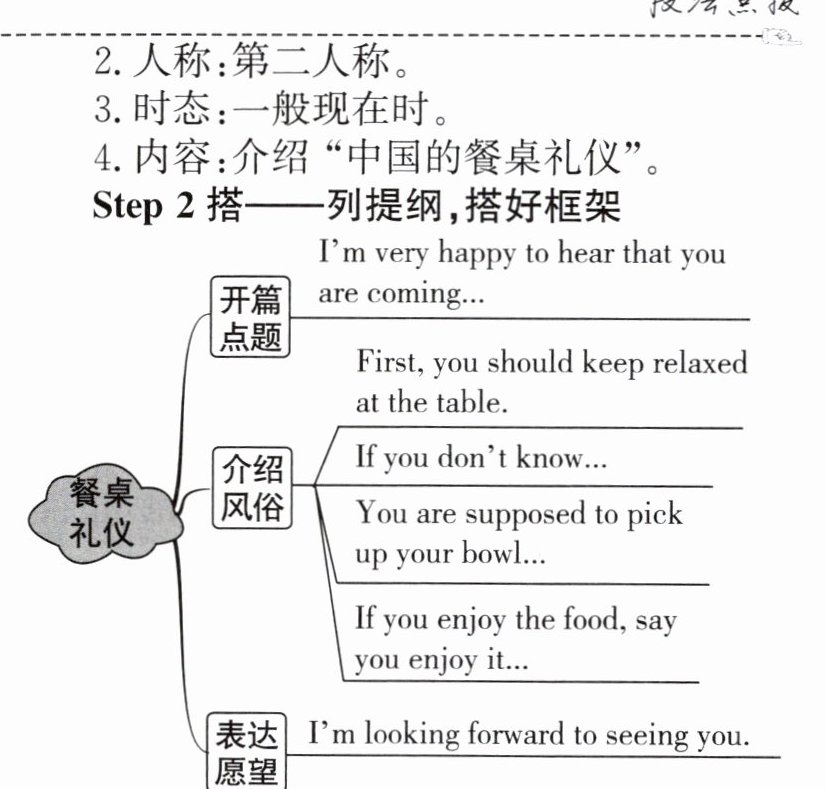
Step 2 搭——列提纲,搭好框架
Step 3 连——连词成句
1. 开篇点题:
I'm very happy to hear that you are ________(要来我们国家).
2. 主体内容:
First, you should keep relaxed at the table. If you don't know ________(如何使用)chopsticks, just watch other people and follow them. If you still don't know what to do, don't be shy about asking the person next to you politely. If you are uncomfortable or nervous, you'd better ask others for help. In China, you are supposed to ________(拿起)your bowl while eating. If you enjoy the food, say you enjoy it. You can also ________(因为……而感谢男主人和女主人)the meal and for their kindness.
3. 总结收尾:
I'm looking forward to seeing you.
Step 4 组——组句成篇
Dear Michael,
I'm very happy to hear that you are coming to our country. Different countries have different customs. Let me tell you something about Chinese table manners.
①First, you should keep relaxed at the table. If you don't know how to use chopsticks, just watch other people and follow them. ②If you still don't know what to do, don't be shy about asking the person next to you politely. ③If you are uncomfortable or nervous, you'd better ask others for help. In China, you are supposed to pick up your bowl while eating. ④If you enjoy the food, say you enjoy it. You can also thank the host and hostess for the meal and for their kindness.
I'm looking forward to seeing you.
Yours,
Zhang Lei
Step 5 修——修饰美化
1. 将①改为含有 suppose 的句子:
______________________________
2. 将②改为含有 have no idea about 结构的句子:
______________________________
3. 将③改为含有 it 作形式主语的句子:
______________________________
4. 将④改为省略句:
______________________________
要点:
1. 在餐桌上要尽量放松;
2. 当你不知道怎样使用餐具时,可以看看别人,跟着他们做,也可以礼貌地向旁边的人询问;
3. 在中国,你应该端起你的饭碗吃饭;
4. 如果你喜欢吃他们的饭菜,可以对此表示感谢。
要求:
1. 可以适当发挥,以保证内容的完整、丰富与流畅;
2. 80 词左右(开头和结尾已给出,不计入总词数)。
Dear Michael,
I'm very happy to hear that ________
Yours,
Zhang Lei
Step 1 审——审清题意
1. 文体:应用文。
2. 人称:第二人称。
3. 时态:一般现在时。
4. 内容:介绍“中国的餐桌礼仪”。
Step 2 搭——列提纲,搭好框架
Step 3 连——连词成句
1. 开篇点题:
I'm very happy to hear that you are ________(要来我们国家).
2. 主体内容:
First, you should keep relaxed at the table. If you don't know ________(如何使用)chopsticks, just watch other people and follow them. If you still don't know what to do, don't be shy about asking the person next to you politely. If you are uncomfortable or nervous, you'd better ask others for help. In China, you are supposed to ________(拿起)your bowl while eating. If you enjoy the food, say you enjoy it. You can also ________(因为……而感谢男主人和女主人)the meal and for their kindness.
3. 总结收尾:
I'm looking forward to seeing you.
Step 4 组——组句成篇
Dear Michael,
I'm very happy to hear that you are coming to our country. Different countries have different customs. Let me tell you something about Chinese table manners.
①First, you should keep relaxed at the table. If you don't know how to use chopsticks, just watch other people and follow them. ②If you still don't know what to do, don't be shy about asking the person next to you politely. ③If you are uncomfortable or nervous, you'd better ask others for help. In China, you are supposed to pick up your bowl while eating. ④If you enjoy the food, say you enjoy it. You can also thank the host and hostess for the meal and for their kindness.
I'm looking forward to seeing you.
Yours,
Zhang Lei
Step 5 修——修饰美化
1. 将①改为含有 suppose 的句子:
______________________________
2. 将②改为含有 have no idea about 结构的句子:
______________________________
3. 将③改为含有 it 作形式主语的句子:
______________________________
4. 将④改为省略句:
______________________________
答案:
1. First, you are supposed to keep relaxed at the table.
2. If you still have no idea about what to do, don’t be shy about asking the person next to you politely.
3. It’s better to ask others for help than to be uncomfortable or nervous.
4. If you enjoy the food, say so.
2. If you still have no idea about what to do, don’t be shy about asking the person next to you politely.
3. It’s better to ask others for help than to be uncomfortable or nervous.
4. If you enjoy the food, say so.
查看更多完整答案,请扫码查看

