

 搜索
搜索
第62页
- 第1页
- 第2页
- 第3页
- 第4页
- 第5页
- 第6页
- 第7页
- 第8页
- 第9页
- 第10页
- 第11页
- 第12页
- 第13页
- 第14页
- 第15页
- 第16页
- 第17页
- 第18页
- 第19页
- 第20页
- 第21页
- 第22页
- 第23页
- 第24页
- 第25页
- 第26页
- 第27页
- 第28页
- 第29页
- 第30页
- 第31页
- 第32页
- 第33页
- 第34页
- 第35页
- 第36页
- 第37页
- 第38页
- 第39页
- 第40页
- 第41页
- 第42页
- 第43页
- 第44页
- 第45页
- 第46页
- 第47页
- 第48页
- 第49页
- 第50页
- 第51页
- 第52页
- 第53页
- 第54页
- 第55页
- 第56页
- 第57页
- 第58页
- 第59页
- 第60页
- 第61页
- 第62页
- 第63页
- 第64页
- 第65页
- 第66页
- 第67页
- 第68页
- 第69页
- 第70页
- 第71页
- 第72页
- 第73页
- 第74页
- 第75页
- 第76页
- 第77页
- 第78页
- 第79页
- 第80页
- 第81页
- 第82页
- 第83页
- 第84页
- 第85页
- 第86页
- 第87页
- 第88页
- 第89页
- 第90页
- 第91页
- 第92页
- 第93页
- 第94页
- 第95页
- 第96页
- 第97页
- 第98页
- 第99页
- 第100页
- 第101页
- 第102页
- 第103页
- 第104页
- 第105页
- 第106页
四 连词成句,使对话完整。(注意标点符号和字母大小写形式)
Miss Li: 1.
Helen: Yes,I did.
Miss Li: Where did you go?
Helen: 2.
Miss Li: 3.
Helen: Mike and I went there by bike. Su Hai and Su Yang took a bus.
Miss Li: 4.
Helen: We saw pandas,monkeys,bears,lions,tigers and giraffes.
Miss Li: Did you feed(喂) them?
Helen: No. 5.
Miss Li: You're right.
Miss Li: 1.
Did you have a happy weekend
?Helen: Yes,I did.
Miss Li: Where did you go?
Helen: 2.
I went to the zoo with my friends
.Miss Li: 3.
How did you go there
?Helen: Mike and I went there by bike. Su Hai and Su Yang took a bus.
Miss Li: 4.
What animals did you see
?Helen: We saw pandas,monkeys,bears,lions,tigers and giraffes.
Miss Li: Did you feed(喂) them?
Helen: No. 5.
We should not feed animals in the zoo
.Miss Li: You're right.
答案:
1. Did you have a happy weekend
2. I went to the zoo with my friends
3. How did you go there
4. What animals did you see
5. We should not feed animals in the zoo
2. I went to the zoo with my friends
3. How did you go there
4. What animals did you see
5. We should not feed animals in the zoo
五 新情景 传统文化 根据短文内容,完成下面的表格,每空一词。
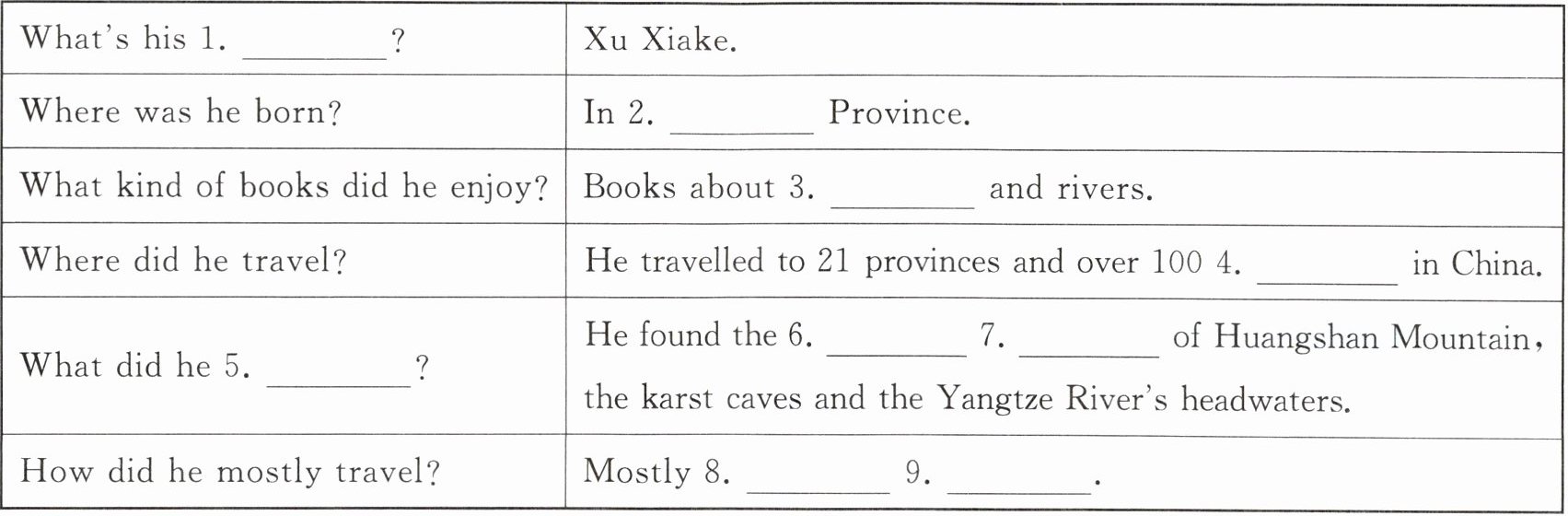
A long time ago,there was a super traveller who spent his life visiting mountains and rivers in nature. His name was Xu Xiake.
In 1587,Xu Xiake was born in Jiangsu Province. When he was a child,Xu enjoyed reading books about Chinese mountains and rivers. He decided to see them when he grew up. Xu travelled to 21 provinces and over 100 cities in China. He climbed thousands of mountains and explored(勘探) over 350 caves(山洞).
Xu was the first person to find the highest peak(山峰) of Huangshan Mountain. He was also the first to find the karst caves(溶洞). What's more,he discovered the Yangtze River's headwaters(河源). Xu travelled mostly on foot. He slept and ate in the wild. He was robbed(抢劫) many times. Sometimes he fell into rivers or ran into dangerous animals. But Xu was brave and enjoyed his journey. He kept diaries while travelling. His Travel Notes of Xu Xiake(《徐霞客游记》) is very important to Chinese geography(地理学) and literature(文学).
| What's his 1.
| Where was he born? | In 2.
| What kind of books did he enjoy? | Books about 3.
| Where did he travel? | He travelled to 21 provinces and over 100 4.
| What did he 5.
| How did he mostly travel? | Mostly 8.
A long time ago,there was a super traveller who spent his life visiting mountains and rivers in nature. His name was Xu Xiake.
In 1587,Xu Xiake was born in Jiangsu Province. When he was a child,Xu enjoyed reading books about Chinese mountains and rivers. He decided to see them when he grew up. Xu travelled to 21 provinces and over 100 cities in China. He climbed thousands of mountains and explored(勘探) over 350 caves(山洞).
Xu was the first person to find the highest peak(山峰) of Huangshan Mountain. He was also the first to find the karst caves(溶洞). What's more,he discovered the Yangtze River's headwaters(河源). Xu travelled mostly on foot. He slept and ate in the wild. He was robbed(抢劫) many times. Sometimes he fell into rivers or ran into dangerous animals. But Xu was brave and enjoyed his journey. He kept diaries while travelling. His Travel Notes of Xu Xiake(《徐霞客游记》) is very important to Chinese geography(地理学) and literature(文学).
| What's his 1.
name
? | Xu Xiake. || Where was he born? | In 2.
Jiangsu
Province. || What kind of books did he enjoy? | Books about 3.
mountains
and rivers. || Where did he travel? | He travelled to 21 provinces and over 100 4.
cities
in China. || What did he 5.
do/find
? | He found the 6. highest
7. peak
of Huangshan Mountain,the karst caves and the Yangtze River's headwaters. || How did he mostly travel? | Mostly 8.
on
9. foot
. |
答案:
1. name
表格翻译
| 他的1. ______是什么? | 徐霞客。 |
| ---- | ---- |
| 他出生在哪里? | 在2. ______省。 |
| 他喜欢什么类型的书? | 有关3. ______和河流的书。 |
| 他去哪里旅行了? | 他游历了中国21个省和100多个4. ______。 |
| 他5. ______了什么? | 他发现了黄山的6. ______7. ______、溶洞和长江的河源。 |
| 他主要怎么旅行? | 主要8. ______9. ______旅行。 |1. name
解析:根据“A long time ago, there was a super traveller... His name was Xu Xiake.”(很久以前,有一位超级旅行者……他的名字叫徐霞客。),可知此处询问他的名字,故填name。
2. Jiangsu
解析:根据“In 1587, Xu Xiake was born in Jiangsu Province.”(1587年,徐霞客出生于江苏省。),可知他出生于江苏省,故填Jiangsu。
3. mountains
解析:根据“When he was a child, Xu enjoyed reading books about Chinese mountains and rivers.”(当他还是个孩子的时候,徐喜欢读关于中国山川的书籍。),可知他喜欢关于山川的书籍,故填mountains。
4. cities
解析:根据“Xu travelled to 21 provinces and over 100 cities in China.”(徐霞客游历了中国21个省份和100多个城市。),可知他游历了100多个城市,故填cities。
5. find/do
解析:根据“Xu was the first person to find... He was also the first to find... he discovered...”(徐霞客是第一个发现……的人,他也是第一个发现……的人,他还发现了……),此处询问他的发现或的事,“find”(发现)和“do”(做)均符合语境,故填find/do。
6. highest
解析:根据“Xu was the first person to find the highest peak(山峰) of Huangshan Mountain.”(徐霞客是第一个发现黄山最高峰的人。),可知他发现了黄山的最高峰,故填highest。
7. peak
解析:根据“Xu was the first person to find the highest peak(山峰) of Huangshan Mountain.”(徐霞客是第一个发现黄山最高峰的人。),可知此处填peak。
8. on
解析:根据“Xu travelled mostly on foot.”(徐霞客主要徒步旅行。),可知他主要徒步旅行,“on foot”是固定搭配,故填on。
9. foot
解析:根据“Xu travelled mostly on foot.”(徐霞客主要徒步旅行。),可知此处填foot。
查看更多完整答案,请扫码查看

