

 搜索
搜索
第19页
- 第1页
- 第2页
- 第3页
- 第4页
- 第5页
- 第6页
- 第7页
- 第8页
- 第9页
- 第10页
- 第11页
- 第12页
- 第13页
- 第14页
- 第15页
- 第16页
- 第17页
- 第18页
- 第19页
- 第20页
- 第21页
- 第22页
- 第23页
- 第24页
- 第25页
- 第26页
- 第27页
- 第28页
- 第29页
- 第30页
- 第31页
- 第32页
- 第33页
- 第34页
- 第35页
- 第36页
- 第37页
- 第38页
- 第39页
- 第40页
- 第41页
- 第42页
- 第43页
- 第44页
- 第45页
- 第46页
- 第47页
- 第48页
- 第49页
- 第50页
- 第51页
- 第52页
- 第53页
- 第54页
- 第55页
- 第56页
- 第57页
- 第58页
- 第59页
- 第60页
- 第61页
- 第62页
- 第63页
- 第64页
- 第65页
- 第66页
- 第67页
- 第68页
- 第69页
- 第70页
- 第71页
- 第72页
- 第73页
- 第74页
- 第75页
- 第76页
- 第77页
- 第78页
- 第79页
- 第80页
- 第81页
- 第82页
- 第83页
- 第84页
- 第85页
- 第86页
- 第87页
- 第88页
- 第89页
- 第90页
一、完成句子
1. 作此决定并非偶然,对此我已思虑多时。
The decision
2. 能否完成这项任务并不取决于你愿意花多少时间。
Whether you can finish this task
3. 关注细节使你更易于获得成功。
Paying attention to details
4. 我不确定我们是否该对所有事情三思而行。
I'm not sure
5. Amy 情绪低落时,她更喜欢听音乐来
When Amy was in a bad mood, she preferred to listen to music
6. 我想知道蓝色是否真的能给我们的身心带来安宁。
I wonder
1. 作此决定并非偶然,对此我已思虑多时。
The decision
wasn't made by accident
and I'd thought about it for long.2. 能否完成这项任务并不取决于你愿意花多少时间。
Whether you can finish this task
doesn't depend on/upon how much time
you are willing to spend on it.3. 关注细节使你更易于获得成功。
Paying attention to details
makes it easier for you to
achieve success.4. 我不确定我们是否该对所有事情三思而行。
I'm not sure
if/whether we should think twice
about everything.5. Amy 情绪低落时,她更喜欢听音乐来
使
自
己振作起来。When Amy was in a bad mood, she preferred to listen to music
to cheer herself up
.6. 我想知道蓝色是否真的能给我们的身心带来安宁。
I wonder
if/whether blue can really bring peace to our mind and body
.
答案:
1. wasn't made by accident 2. doesn't depend on/upon how much time 3. makes it easier for you to 4. if/whether we should think twice 5. to cheer herself up 6. if/whether blue can really bring peace to our mind and body
二、阅读理解
A
Every country has its own way of saying things—its own special expressions. Many everyday American expressions are based on colours. Today our program is all about colours.
Red is a hot colour. Americans often use it to express heat. They may say they are “red hot” about something unfair. When they are “red hot”, they are very angry about something. Fast, loud music is popular with many people. They may say the music is “red hot”.
Pink is a lighter kind of red. People sometimes say they are “in the pink” when they are in good health. It probably comes from the fact that many babies are born with a nice pink colour that shows they are in good health.
Blue is a cool colour. The traditional blues music in the United States is the opposite of red hot music. Blues is slow and sad. Someone who is blue is very sad.
The colour green is natural for trees and grass. But it is an unnatural colour for humans. A person who has a sick - feeling stomach may say he feels “a little green”. A passenger on a boat who feels sick may look very green.
Sometimes a person may be unhappy because he doesn't have something as nice as a friend does, like a fast new car. That person may say he is “green with envy”. Some people are green with envy because a friend has more dollars or greenbacks. Dollars are called greenbacks because that's the colour of the back side of the paper money.
The colour black is often used in expressions. People describe a day in which everything goes wrong as “a black day”. And at one time, some companies refused to employ (雇佣) the people on the “blacklist”, because they belonged to unpopular organizations.
(
A. angry B. sad C. sick D. healthy
(
A. the grass B. the tree C. the colour green D. the colour blue
(
A. He was ‘green with envy’. B. He had ‘a black day’.
C. He felt ‘a little green’. D. He was on the ‘blacklist’.
(
A. science B. health C. culture D. music
A
Every country has its own way of saying things—its own special expressions. Many everyday American expressions are based on colours. Today our program is all about colours.
Red is a hot colour. Americans often use it to express heat. They may say they are “red hot” about something unfair. When they are “red hot”, they are very angry about something. Fast, loud music is popular with many people. They may say the music is “red hot”.
Pink is a lighter kind of red. People sometimes say they are “in the pink” when they are in good health. It probably comes from the fact that many babies are born with a nice pink colour that shows they are in good health.
Blue is a cool colour. The traditional blues music in the United States is the opposite of red hot music. Blues is slow and sad. Someone who is blue is very sad.
The colour green is natural for trees and grass. But it is an unnatural colour for humans. A person who has a sick - feeling stomach may say he feels “a little green”. A passenger on a boat who feels sick may look very green.
Sometimes a person may be unhappy because he doesn't have something as nice as a friend does, like a fast new car. That person may say he is “green with envy”. Some people are green with envy because a friend has more dollars or greenbacks. Dollars are called greenbacks because that's the colour of the back side of the paper money.
The colour black is often used in expressions. People describe a day in which everything goes wrong as “a black day”. And at one time, some companies refused to employ (雇佣) the people on the “blacklist”, because they belonged to unpopular organizations.
(
D
)1. If a person is “in the pink”, we know he/she is ______.A. angry B. sad C. sick D. healthy
(
C
)2. The underlined word “it” in Paragraph 5 refers to ______.A. the grass B. the tree C. the colour green D. the colour blue
(
B
)3. It was raining hard and John's car broke down on his way home. So we can say “______”.A. He was ‘green with envy’. B. He had ‘a black day’.
C. He felt ‘a little green’. D. He was on the ‘blacklist’.
(
C
)4. This passage is probably in the part of ______ in the radio program.A. science B. health C. culture D. music
答案:
1.D 2.C 3.B 4.C
B
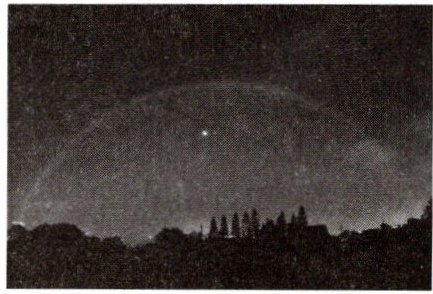
You might have seen beautiful rainbows in the sky before. They form when sunlight falls on water drops in the air. But in fact, moonlight can also create rainbows in the same way. They are called “moonbows”. They are similar to rainbows, but they are created by moonlight instead of direct sunlight.
Moonbows are rarer than rainbows. Different weather and astronomical (天文
The moon has to be very low in the sky—only 42 degrees from the horizon (地平线). The moon period has to be a full moon or nearly full. The sky must be very dark for a moonbow to be watched clearly—any bright light can obscure it. Water drops must appear in the air in the opposite direction of the moon.
Moonbows appear on the opposite side of the moon and usually look white to the human eye. This is because their colors are not bright enough to be noticed by the human eye. It is possible, however, to view the colors in a moonbow using long exposure (长时间曝光) photography.
Moonbows more often appear in some locations around the world. Most of these locations usually have waterfalls, which create thin fog in the air. Some of these locations are the Yosemite National Park in California and Cumberland Falls State Resort Park in Kentucky, US; Victoria Falls on the border of Zambia and Zimbabwe; and Waimea in Hawaii, US.
Moonbows do really happen. So at a certain time and a certain place, when a moonbow happens to appear, you can't miss it if you're right there.
(
A. created by sunlight B. much easier to find
C. seen during the day D. more difficult to form
(
A. A full moon hangs high in the bright sky.
B. A half moon is 42 degrees from the horizon.
C. A nearly full moon hangs low in the dark sky.
D. Water drops are in the opposite direction of the sun.
(
A. cover B. drop C. connect D. produce
(
A. Conditions of moonbows. B. Background of moonbows.
C. Locations of moonbows. D. Development of moonbows.
You might have seen beautiful rainbows in the sky before. They form when sunlight falls on water drops in the air. But in fact, moonlight can also create rainbows in the same way. They are called “moonbows”. They are similar to rainbows, but they are created by moonlight instead of direct sunlight.
Moonbows are rarer than rainbows. Different weather and astronomical (天文
学
的) conditions have to be just right for moonbows to be created.The moon has to be very low in the sky—only 42 degrees from the horizon (地平线). The moon period has to be a full moon or nearly full. The sky must be very dark for a moonbow to be watched clearly—any bright light can obscure it. Water drops must appear in the air in the opposite direction of the moon.
Moonbows appear on the opposite side of the moon and usually look white to the human eye. This is because their colors are not bright enough to be noticed by the human eye. It is possible, however, to view the colors in a moonbow using long exposure (长时间曝光) photography.
Moonbows more often appear in some locations around the world. Most of these locations usually have waterfalls, which create thin fog in the air. Some of these locations are the Yosemite National Park in California and Cumberland Falls State Resort Park in Kentucky, US; Victoria Falls on the border of Zambia and Zimbabwe; and Waimea in Hawaii, US.
Moonbows do really happen. So at a certain time and a certain place, when a moonbow happens to appear, you can't miss it if you're right there.
(
D
)5. According to the first two paragraphs, moonbows are ______.A. created by sunlight B. much easier to find
C. seen during the day D. more difficult to form
(
C
)6. Which of the following can be the conditions for a moonbow to form?A. A full moon hangs high in the bright sky.
B. A half moon is 42 degrees from the horizon.
C. A nearly full moon hangs low in the dark sky.
D. Water drops are in the opposite direction of the sun.
(
A
)7. What does the underlined word “obscure” in Paragraph 3 probably mean?A. cover B. drop C. connect D. produce
(
C
)8. What is Paragraph 5 mainly about?A. Conditions of moonbows. B. Background of moonbows.
C. Locations of moonbows. D. Development of moonbows.
答案:
5.D 6.C 7.A 8.C
查看更多完整答案,请扫码查看

