

 搜索
搜索
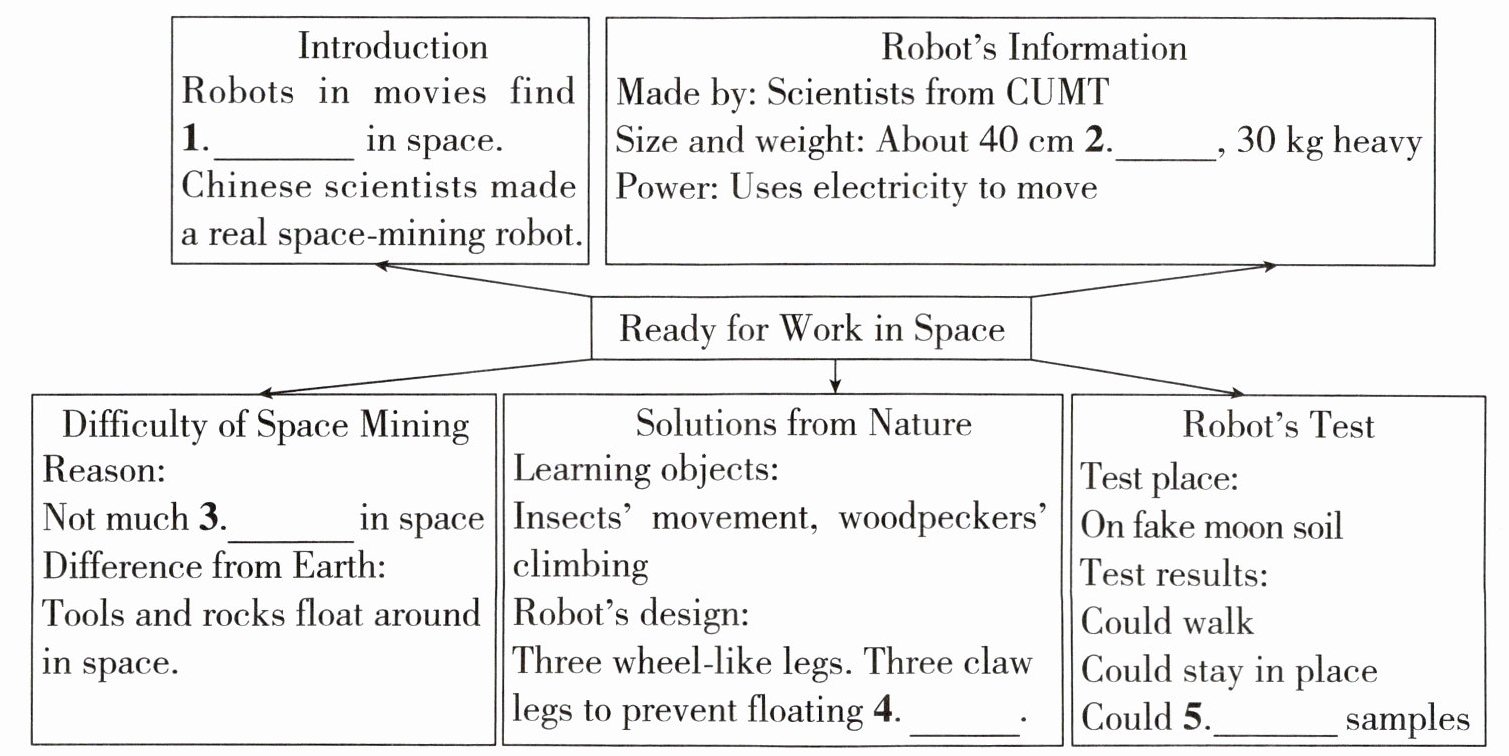
In movies,robots fly into space to find treasure( 宝藏). Now,Chinese scientists have made a real space-mining( 采矿) robot!
This robot is the first of its kind in China. Scientists from China University of Mining and Technology ( CUMT) created it. It is about 40 cm wide and weighs 30 kg. It uses electricity( 电) to move.
Mining in space is hard because there is not much gravity( 引力). On Earth,gravity keeps tools and rocks in place,but in space,they float( 漂浮) around.
To solve this,the CUMT team learned from nature. They studied how insects move and woodpeckers( 啄木鸟) climb trees. Then they gave the robot three wheel-like legs to move quickly on asteroids( 小行星). It also has three claw( 爪子) legs to hold on tightly,so it won’t float away.
The team tested the robot on fake moon soil. It worked well—it could walk,stay in place,and even collect samples( 样本).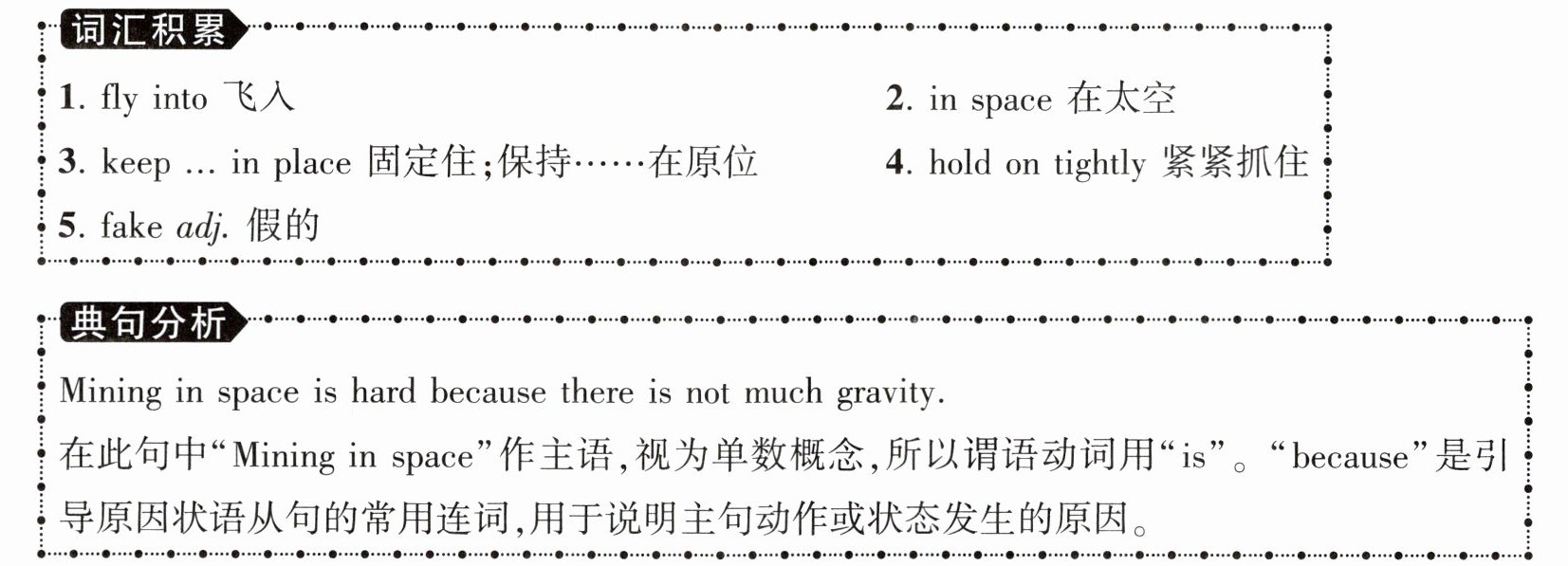
读后探究
Ⅰ.根据文章内容完成思维导图
Ⅱ.根据文章内容选择最佳选项
(
A. It is very light in weight.
B. It can fly very fast in space.
C. It can change its shape easily.
D. It is the first of its kind in China.
(
A. Because it is too cold in space.
B. Because there is no air in space.
C. Because there are too many asteroids.
D. Because there is not much gravity in space.
(
A. From the study of the stars.
B. From the way people work on Earth.
C. From watching how insects move and woodpeckers climb trees.
D. From observing( 观察) how fish swim in the sea and woodpeckers climb trees.
Ⅲ.反思与实践
9. What are some challenges( 挑战) scientists might face( 面临) in space-mining?
This robot is the first of its kind in China. Scientists from China University of Mining and Technology ( CUMT) created it. It is about 40 cm wide and weighs 30 kg. It uses electricity( 电) to move.
Mining in space is hard because there is not much gravity( 引力). On Earth,gravity keeps tools and rocks in place,but in space,they float( 漂浮) around.
To solve this,the CUMT team learned from nature. They studied how insects move and woodpeckers( 啄木鸟) climb trees. Then they gave the robot three wheel-like legs to move quickly on asteroids( 小行星). It also has three claw( 爪子) legs to hold on tightly,so it won’t float away.
The team tested the robot on fake moon soil. It worked well—it could walk,stay in place,and even collect samples( 样本).
读后探究
Ⅰ.根据文章内容完成思维导图
Ⅱ.根据文章内容选择最佳选项
(
D
) 6. What is special about the space-mining robot made by Chinese scientists?A. It is very light in weight.
B. It can fly very fast in space.
C. It can change its shape easily.
D. It is the first of its kind in China.
(
D
) 7. Why is mining in space hard?A. Because it is too cold in space.
B. Because there is no air in space.
C. Because there are too many asteroids.
D. Because there is not much gravity in space.
(
C
) 8. Where did the CUMT team get ideas to solve the problem of the robot’s movement?A. From the study of the stars.
B. From the way people work on Earth.
C. From watching how insects move and woodpeckers climb trees.
D. From observing( 观察) how fish swim in the sea and woodpeckers climb trees.
Ⅲ.反思与实践
9. What are some challenges( 挑战) scientists might face( 面临) in space-mining?
No gravity; dangerous space; getting power; finding and getting resources.(答案不唯一,言之有理即可)
答案:
I .1.treasure 2.wide 3.gravity 4.away 5.collect
Ⅱ.6-8 DDC
Ⅲ.9. No gravity; dangerous space; getting power; finding and getting resources.(答案不唯一,言之有理即可)
Ⅱ.6-8 DDC
Ⅲ.9. No gravity; dangerous space; getting power; finding and getting resources.(答案不唯一,言之有理即可)
查看更多完整答案,请扫码查看

