

 搜索
搜索
第16页
- 第1页
- 第2页
- 第3页
- 第4页
- 第5页
- 第6页
- 第7页
- 第8页
- 第9页
- 第10页
- 第11页
- 第12页
- 第13页
- 第14页
- 第15页
- 第16页
- 第17页
- 第18页
- 第19页
- 第20页
- 第21页
- 第22页
- 第23页
- 第24页
- 第25页
- 第26页
- 第27页
- 第28页
- 第29页
- 第30页
- 第31页
- 第32页
- 第33页
- 第34页
- 第35页
- 第36页
- 第37页
- 第38页
- 第39页
- 第40页
- 第41页
- 第42页
- 第43页
- 第44页
- 第45页
- 第46页
- 第47页
- 第48页
- 第49页
- 第50页
- 第51页
- 第52页
- 第53页
- 第54页
- 第55页
- 第56页
- 第57页
- 第58页
- 第59页
- 第60页
- 第61页
- 第62页
- 第63页
- 第64页
- 第65页
- 第66页
- 第67页
- 第68页
- 第69页
- 第70页
- 第71页
- 第72页
- 第73页
- 第74页
- 第75页
- 第76页
- 第77页
- 第78页
- 第79页
- 第80页
- 第81页
- 第82页
- 第83页
- 第84页
- 第85页
- 第86页
- 第87页
- 第88页
- 第89页
- 第90页
- 第91页
- 第92页
- 第93页
- 第94页
- 第95页
- 第96页
- 第97页
- 第98页
- 第99页
- 第100页
- 第101页
- 第102页
- 第103页
- 第104页
- 第105页
- 第106页
- 第107页
- 第108页
- 第109页
- 第110页
- 第111页
- 第112页
- 第113页
- 第114页
- 第115页
- 第116页
- 第117页
- 第118页
- 第119页
- 第120页
- 第121页
- 第122页
- 第123页
- 第124页
- 第125页
- 第126页
- 第127页
- 第128页
- 第129页
- 第130页
- 第131页
- 第132页
- 第133页
- 第134页
- 第135页
- 第136页
- 第137页
- 第138页
- 第139页
- 第140页
- 第141页
- 第142页
- 第143页
- 第144页
- 第145页
- 第146页
- 第147页
- 第148页
- 第149页
- 第150页
- 第151页
- 第152页
- 第153页
- 第154页
- 第155页
- 第156页
- 第157页
- 第158页
- 第159页
- 第160页
- 第161页
- 第162页
- 第163页
- 第164页
- 第165页
- 第166页
- 第167页
- 第168页
- 第169页
- 第170页
- 第171页
- 第172页
- 第173页
1.[中考·雅安]若关于x的一元二次方程$x^{2}+6x+c= 0配方后得到方程(x+3)^{2}= 2c$,则c的值为( )
A.-3
B.0
C.3
D.9
A.-3
B.0
C.3
D.9
答案:
C 点拨:$x^{2}+6x+c=0$,
$x^{2}+6x=-c$,
$x^{2}+6x+9=-c+9$.
$(x+3)^{2}=-c+9$.
$\because (x+3)^{2}=2c$,
$\therefore -c+9=2c$,
$\therefore c=3$.
$x^{2}+6x=-c$,
$x^{2}+6x+9=-c+9$.
$(x+3)^{2}=-c+9$.
$\because (x+3)^{2}=2c$,
$\therefore -c+9=2c$,
$\therefore c=3$.
2.[中考·丹东]若实数k、b是一元二次方程$(x+3)(x-1)= 0$的两个根,且$k\lt b$,则一次函数$y= kx+b$的图像不经过( )
A.第一象限
B.第二象限
C.第三象限
D.第四象限
A.第一象限
B.第二象限
C.第三象限
D.第四象限
答案:
C
3.[中考·雅安]若直角三角形的两边长分别是方程$x^{2}-7x+12= 0$的两个根,则该直角三角形的面积是( )
A.6
B.12
C.12或$\frac{3\sqrt{7}}{2}$
D.6或$\frac{3\sqrt{7}}{2}$
A.6
B.12
C.12或$\frac{3\sqrt{7}}{2}$
D.6或$\frac{3\sqrt{7}}{2}$
答案:
D 点拨:$x^{2}-7x+12=0$,$(x-3)(x-4)=0$.
解得$x_{1}=3$,$x_{2}=4$.
①当边长是4的边是直角边时,该直角三角形的面积是$\frac{1}{2}× 3× 4=6$;
②当边长是4的边是斜边时,第三边的边长是$\sqrt{4^{2}-3^{2}}=\sqrt{7}$,该直角三角形的面积是$\frac{1}{2}× 3× \sqrt{7}=\frac{3\sqrt{7}}{2}$.
综上所述,该直角三角形的面积是6或$\frac{3\sqrt{7}}{2}$.
解得$x_{1}=3$,$x_{2}=4$.
①当边长是4的边是直角边时,该直角三角形的面积是$\frac{1}{2}× 3× 4=6$;
②当边长是4的边是斜边时,第三边的边长是$\sqrt{4^{2}-3^{2}}=\sqrt{7}$,该直角三角形的面积是$\frac{1}{2}× 3× \sqrt{7}=\frac{3\sqrt{7}}{2}$.
综上所述,该直角三角形的面积是6或$\frac{3\sqrt{7}}{2}$.
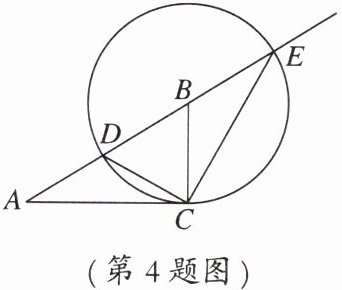
4.[二模·泰州]欧几里得的《几何原本》中记载了形如$x^{2}-2bx+4c^{2}= 0(b\gt2c\gt0)$的方程根的图形解法:如图,画$Rt\triangle ABC$,使$\angle C= 90^{\circ}$,$AC= 2c$,$AB= b$,以B为圆心,BC长为半径画圆,交射线AB于点D、E,则该方程较大的根是( )
A.CE的长度
B.CD的长度
C.DE的长度
D.AE的长度
A.CE的长度
B.CD的长度
C.DE的长度
D.AE的长度
答案:
D 点拨:$\because x^{2}-2bx+4c^{2}=0$,
$\therefore x^{2}-2bx=-4c^{2}$,
则$x^{2}-2bx+b^{2}=b^{2}-4c^{2}$.
$\therefore (x-b)^{2}=b^{2}-4c^{2}$,
$\therefore x-b=\pm \sqrt{b^{2}-4c^{2}}$.
$\therefore x_{1}=b+\sqrt{b^{2}-4c^{2}}$,$x_{2}=b-\sqrt{b^{2}-4c^{2}}$.
在$Rt\triangle ABC$中,$\angle C=90^{\circ}$,$AC=2c$,$AB=b$,
$\therefore BC=\sqrt{AB^{2}-AC^{2}}=\sqrt{b^{2}-4c^{2}}$.
$\therefore$方程较大的根为$AB+BC=AB+BE=AE$的长度.
$\therefore x^{2}-2bx=-4c^{2}$,
则$x^{2}-2bx+b^{2}=b^{2}-4c^{2}$.
$\therefore (x-b)^{2}=b^{2}-4c^{2}$,
$\therefore x-b=\pm \sqrt{b^{2}-4c^{2}}$.
$\therefore x_{1}=b+\sqrt{b^{2}-4c^{2}}$,$x_{2}=b-\sqrt{b^{2}-4c^{2}}$.
在$Rt\triangle ABC$中,$\angle C=90^{\circ}$,$AC=2c$,$AB=b$,
$\therefore BC=\sqrt{AB^{2}-AC^{2}}=\sqrt{b^{2}-4c^{2}}$.
$\therefore$方程较大的根为$AB+BC=AB+BE=AE$的长度.
5.[中考·扬州]请填写一个常数,使得关于x的方程$x^{2}-2x+\underline{\quad\quad}=0$有两个不相等的实数根.
答案:
-1(答案不唯一)
6.[中考·枣庄]若等腰三角形的一边长是4,另两边的长是关于x的方程$x^{2}-6x+n= 0$的两个根,则n的值为$\underline{\quad\quad}$.
答案:
8或9 点拨:当4为腰长时,则4是关于x的方程$x^{2}-6x+n=0$的一个根.
把$x=4$代入$x^{2}-6x+n=0$,
得$4^{2}-6× 4+n=0$.解得$n=8$.
把$n=8$代入原方程,原方程为$x^{2}-6x+8=0$.
解得$x_{1}=2$,$x_{2}=4$.
$\because 2+4>4$,$\therefore n=8$符合题意.
当4为底边长时,关于x的方程$x^{2}-6x+n=0$有两个相等的实数根,
$\therefore b^{2}-4ac=(-6)^{2}-4× 1× n=0$.解得$n=9$.
把$n=9$代入原方程,原方程为$x^{2}-6x+9=0$,
解得$x_{1}=x_{2}=3$.
$\because 3+3>4$,$\therefore n=9$符合题意.
综上所述,n的值为8或9.
把$x=4$代入$x^{2}-6x+n=0$,
得$4^{2}-6× 4+n=0$.解得$n=8$.
把$n=8$代入原方程,原方程为$x^{2}-6x+8=0$.
解得$x_{1}=2$,$x_{2}=4$.
$\because 2+4>4$,$\therefore n=8$符合题意.
当4为底边长时,关于x的方程$x^{2}-6x+n=0$有两个相等的实数根,
$\therefore b^{2}-4ac=(-6)^{2}-4× 1× n=0$.解得$n=9$.
把$n=9$代入原方程,原方程为$x^{2}-6x+9=0$,
解得$x_{1}=x_{2}=3$.
$\because 3+3>4$,$\therefore n=9$符合题意.
综上所述,n的值为8或9.
7.[期末·宁波]关于x的方程$a(x+m)^{2}+b= 0的解是x_{1}= 2$,$x_{2}= -1$(a,b,m均为常数,且$a\neq0$),则$a(2x+m-1)^{2}+b= 0的解是\underline{\quad\quad}$.
答案:
$x_{1}=\frac{3}{2}$,$x_{2}=0$ 点拨:把方程$a(2x+m-1)^{2}+b=0$变形为$a[(2x-1)+m]^{2}+b=0$.
$\because$关于x的方程$a(x+m)^{2}+b=0$的解是$x_{1}=2$,$x_{2}=-1$,
$\therefore 2x-1=2$或$2x-1=-1$,
$\therefore x_{1}=\frac{3}{2}$,$x_{2}=0$.
$\because$关于x的方程$a(x+m)^{2}+b=0$的解是$x_{1}=2$,$x_{2}=-1$,
$\therefore 2x-1=2$或$2x-1=-1$,
$\therefore x_{1}=\frac{3}{2}$,$x_{2}=0$.
8.[期末·北京]解下列一元二次方程:
(1)$(x-5)^{2}-36= 0$;
(2)$2x^{2}+4x-7= 0$(用配方法);
(3)$9(x-1)^{2}= 4(x-2)^{2}$;
(4)$2x^{2}-3x-1= 0$.
(1)$(x-5)^{2}-36= 0$;
(2)$2x^{2}+4x-7= 0$(用配方法);
(3)$9(x-1)^{2}= 4(x-2)^{2}$;
(4)$2x^{2}-3x-1= 0$.
答案:
解:
(1)移项,得$(x-5)^{2}=36$.
因为$(x-5)$是36的平方根,
所以$x-5=\pm 6$.则$x_{1}=-1$,$x_{2}=11$.
(2)两边都除以2,得$x^{2}+2x-\frac{7}{2}=0$.
移项,得$x^{2}+2x=\frac{7}{2}$.
配方,得$x^{2}+2x+1^{2}=\frac{7}{2}+1^{2}$.
即$(x+1)^{2}=\frac{9}{2}$.
解这个方程,得$x+1=\pm \frac{3\sqrt{2}}{2}$.
$\therefore x_{1}=-1+\frac{3\sqrt{2}}{2}$,$x_{2}=-1-\frac{3\sqrt{2}}{2}$.
(3)方法一:两边开平方,得$3(x-1)=\pm 2(x-2)$.
$3(x-1)=2(x-2)$或$3(x-1)=-2(x-2)$.
解得$x_{1}=-1$,$x_{2}=\frac{7}{5}$.
方法二:移项,得$9(x-1)^{2}-4(x-2)^{2}=0$.
原方程可变形为$[3(x-1)+2(x-2)][3(x-1)-2(x-2)]=0$.
即$(5x-7)(x+1)=0$.
$5x-7=0$或$x+1=0$.
所以$x_{1}=\frac{7}{5}$,$x_{2}=-1$.
(4)$\because a=2$,$b=-3$,$c=-1$,
$b^{2}-4ac=(-3)^{2}-4× 2× (-1)=17>0$,
$\therefore x=\frac{3\pm \sqrt{17}}{2× 2}=\frac{3\pm \sqrt{17}}{4}$.
$\therefore x_{1}=\frac{3+\sqrt{17}}{4}$,$x_{2}=\frac{3-\sqrt{17}}{4}$.
(1)移项,得$(x-5)^{2}=36$.
因为$(x-5)$是36的平方根,
所以$x-5=\pm 6$.则$x_{1}=-1$,$x_{2}=11$.
(2)两边都除以2,得$x^{2}+2x-\frac{7}{2}=0$.
移项,得$x^{2}+2x=\frac{7}{2}$.
配方,得$x^{2}+2x+1^{2}=\frac{7}{2}+1^{2}$.
即$(x+1)^{2}=\frac{9}{2}$.
解这个方程,得$x+1=\pm \frac{3\sqrt{2}}{2}$.
$\therefore x_{1}=-1+\frac{3\sqrt{2}}{2}$,$x_{2}=-1-\frac{3\sqrt{2}}{2}$.
(3)方法一:两边开平方,得$3(x-1)=\pm 2(x-2)$.
$3(x-1)=2(x-2)$或$3(x-1)=-2(x-2)$.
解得$x_{1}=-1$,$x_{2}=\frac{7}{5}$.
方法二:移项,得$9(x-1)^{2}-4(x-2)^{2}=0$.
原方程可变形为$[3(x-1)+2(x-2)][3(x-1)-2(x-2)]=0$.
即$(5x-7)(x+1)=0$.
$5x-7=0$或$x+1=0$.
所以$x_{1}=\frac{7}{5}$,$x_{2}=-1$.
(4)$\because a=2$,$b=-3$,$c=-1$,
$b^{2}-4ac=(-3)^{2}-4× 2× (-1)=17>0$,
$\therefore x=\frac{3\pm \sqrt{17}}{2× 2}=\frac{3\pm \sqrt{17}}{4}$.
$\therefore x_{1}=\frac{3+\sqrt{17}}{4}$,$x_{2}=\frac{3-\sqrt{17}}{4}$.
9.[二模·南京]已知关于x的一元二次方程$(x-1)(x-2)= m+1$(m为常数).
(1)若它的一个实数根是方程$2(x-1)-4= 0$的解,则$m= \underline{\quad\quad}$,方程的另一个根为$\underline{\quad\quad}$;
(2)若它的一个实数根是关于x的方程$2(x-m)-4= 0$的根,求m的值;
(3)若它的一个实数根是关于x的方程$2(x-n)-4= 0$的根,求$m+n$的最小值.
(1)若它的一个实数根是方程$2(x-1)-4= 0$的解,则$m= \underline{\quad\quad}$,方程的另一个根为$\underline{\quad\quad}$;
(2)若它的一个实数根是关于x的方程$2(x-m)-4= 0$的根,求m的值;
(3)若它的一个实数根是关于x的方程$2(x-n)-4= 0$的根,求$m+n$的最小值.
答案:
(1)1;$x=0$ 点拨:解$2(x-1)-4=0$,得$x=3$.将$x=3$代入$(x-1)(x-2)=m+1$,得$m=1$.
将$m=1$代入$(x-1)(x-2)=m+1$,
得$(x-1)(x-2)=2$,
解这个方程,得$x_{1}=3$,$x_{2}=0$.
$\therefore$方程的另一个根为$x=0$.
(2)由$2(x-m)-4=0$,得$x=2+m$.
将$x=2+m$代入$(x-1)(x-2)=m+1$,
得$(2+m-1)(2+m-2)=m+1$.
解得$m_{1}=1$,$m_{2}=-1$.
即m的值为1或-1.
(3)由$2(x-n)-4=0$,得$x=2+n$.
将$x=2+n$代入$(x-1)(x-2)=m+1$,
得$(2+n-1)(2+n-2)=m+1$.
整理,得$m=n^{2}+n-1$.
$\therefore m+n=n^{2}+n-1+n=n^{2}+2n-1=(n+1)^{2}-2$.
$\because (n+1)^{2}\geq 0$,$\therefore (n+1)^{2}-2\geq -2$.
$\therefore m+n$的最小值为-2.
(1)1;$x=0$ 点拨:解$2(x-1)-4=0$,得$x=3$.将$x=3$代入$(x-1)(x-2)=m+1$,得$m=1$.
将$m=1$代入$(x-1)(x-2)=m+1$,
得$(x-1)(x-2)=2$,
解这个方程,得$x_{1}=3$,$x_{2}=0$.
$\therefore$方程的另一个根为$x=0$.
(2)由$2(x-m)-4=0$,得$x=2+m$.
将$x=2+m$代入$(x-1)(x-2)=m+1$,
得$(2+m-1)(2+m-2)=m+1$.
解得$m_{1}=1$,$m_{2}=-1$.
即m的值为1或-1.
(3)由$2(x-n)-4=0$,得$x=2+n$.
将$x=2+n$代入$(x-1)(x-2)=m+1$,
得$(2+n-1)(2+n-2)=m+1$.
整理,得$m=n^{2}+n-1$.
$\therefore m+n=n^{2}+n-1+n=n^{2}+2n-1=(n+1)^{2}-2$.
$\because (n+1)^{2}\geq 0$,$\therefore (n+1)^{2}-2\geq -2$.
$\therefore m+n$的最小值为-2.
查看更多完整答案,请扫码查看

