

 搜索
搜索
Ⅰ.选出与画线部分发音不同的单词
(
A. yes
B. yellow
C. gym
(
A. lucky
B. baby
C. by
(
A. who
B. why
C. what
(
A. window
B. wife
C. swim
(
C
)1. yearA. yes
B. yellow
C. gym
(
C
)2. happyA. lucky
B. baby
C. by
(
A
)3. whenA. who
B. why
C. what
(
A
)4. waterA. window
B. wife
C. swim
答案:
Ⅰ.1—4 CCAA
Ⅱ.根据音标写单词或根据画线字母写音标
1. /'ætrtju:d/
2. /ɪ'fekt/
3. /əd'vɑ:ntɪdʒ/
4. /dɪ'vaɪs/
5. anywhere
6. development
7. progress
8. mobile
1. /'ætrtju:d/
attitude
2. /ɪ'fekt/
effect
3. /əd'vɑ:ntɪdʒ/
advantage
4. /dɪ'vaɪs/
device
5. anywhere
/w/
6. development
/ɪ/
7. progress
/aʊ/
8. mobile
/aɪ/
答案:
II.1.attitude 2.effect 3.advantage 4.device 5./w/ 6./ɪ/ 7./aʊ/ 8./aɪ/
Ⅲ.根据句意及音标或汉语注释完成单词
1.
2. Sitting in the same position for hours can cause back
3. He gets
4. Learning a new skill is always
5. Mobile
1.
Nowadays
(如今),more and more people choose to work at home.2. Sitting in the same position for hours can cause back
pain
/peɪn/.3. He gets
bored
/bɔ:d/ easily if he has nothing interesting to do.4. Learning a new skill is always
useful
(有用的)in today's competitive world.5. Mobile
devices
(设备)like smartphones have changed the way we communicate.
答案:
III.1.Nowadays 2.pain 3.bored 4.useful 5.devices
Ⅳ.阅读理解
A
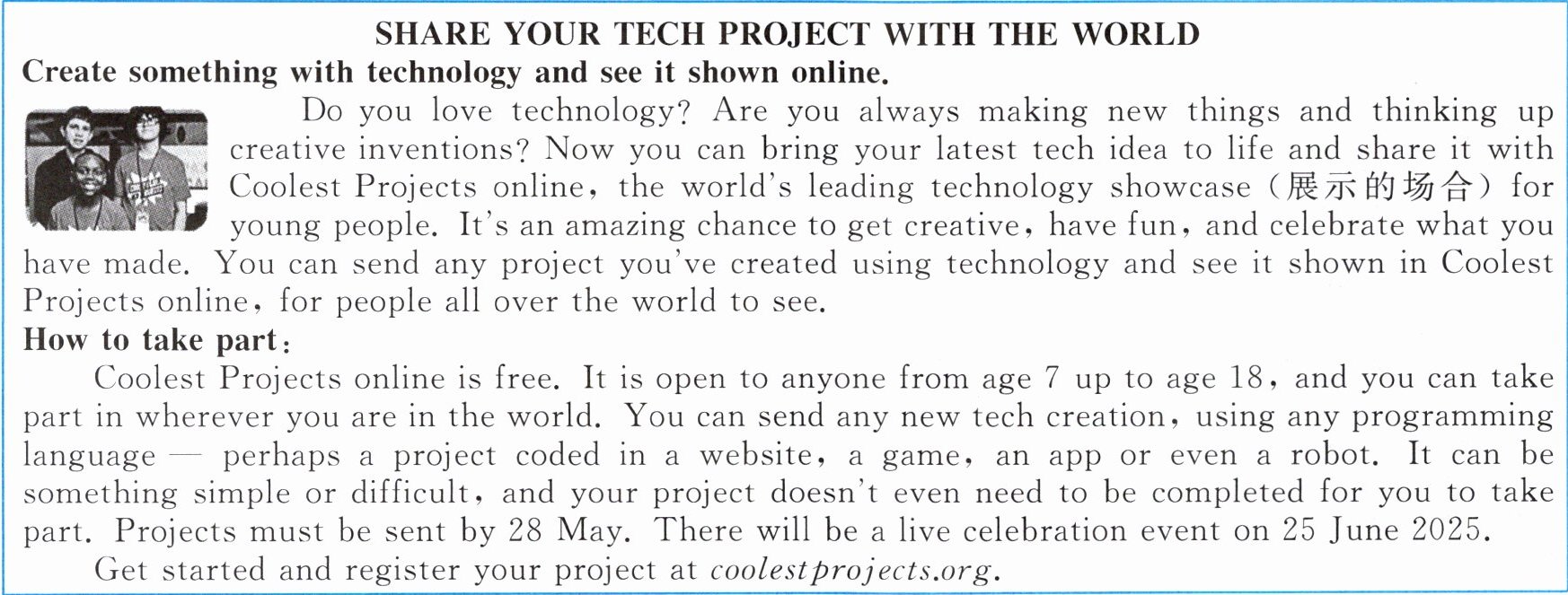
(
A. It is managed by young people.
B. It develops tech projects by itself.
C. It helps people live in a fun way.
D. It allows anyone to see the projects on it.
(
A. have to be over eighteen years old
B. should pay a lot of money online
C. needn't make sure your project is finished
D. can hand in your project on 25 June
(
A. Linda — she is learning foreign languages.
B. Tom — he plays computer games well.
C. Peter — he is ready to share his inventions.
D. Betty — she plans to make friends online.
A
(
D
)1. What can we know about the Coolest Projects online from the text?A. It is managed by young people.
B. It develops tech projects by itself.
C. It helps people live in a fun way.
D. It allows anyone to see the projects on it.
(
C
)2. To take part in Coolest Projects online,you _______.A. have to be over eighteen years old
B. should pay a lot of money online
C. needn't make sure your project is finished
D. can hand in your project on 25 June
(
C
)3. Who would most probably like to read this text?A. Linda — she is learning foreign languages.
B. Tom — he plays computer games well.
C. Peter — he is ready to share his inventions.
D. Betty — she plans to make friends online.
答案:
Ⅳ.1—3 DCC
B
Smartphones are getting boring. The new ones are either a bit faster or have a better camera,but they are basically no different from the old ones in our pockets. This is why scientists are hoping,and working for something new. Smart glasses might be the one.
Just imagine. Instead of having to pick up your phone and look at the screen,all of the information you need simply appears just in front of you,in your glasses.
Satellite navigation(卫星导
Smart glasses could also be used in industry. They could show engineers the instructions they need to fix things more quickly. A doctor could carry out a difficult operation,guided in real time by someone on the other side of the world.
This may sound impossible. But most of the technologies needed to invent them are already there. For example,one key technology is called AR. It can make digital 3-D objects appear as if they were part of the real world. We've used it a lot on our video calls. Similarly,huge progress has been made in spatial audio(空间音频). This is when a sound is made to give it a sense of place,like what you hear in an empty room. Some high-end headphones can already do that. Future glasses will of course need to recognise your voice to do tasks. This technology has already widely used in our daily life.
So,why haven't we all worn smart glasses yet? So far,no one has invented a good way to send images(映像)of our world onto glasses. However,with the rapid development of technology,smart glasses could arrive much sooner than we think.
(
A. To start a story.
B. To explain an idea.
C. To introduce a topic.
D. To discuss a problem.
(
A. When smart glasses might be made.
B. Why smart glasses should be changed.
C. Where smart glasses could be used.
D. How smart glasses would give directions.
(
A. Making spatial audio.
B. Recognising voices.
C. Creating digital 3-D objects.
D. Sending images onto glasses.
(
A. Bored.
B. Confident.
C. Satisfied.
D. Uncertain.
Smartphones are getting boring. The new ones are either a bit faster or have a better camera,but they are basically no different from the old ones in our pockets. This is why scientists are hoping,and working for something new. Smart glasses might be the one.
Just imagine. Instead of having to pick up your phone and look at the screen,all of the information you need simply appears just in front of you,in your glasses.
Satellite navigation(卫星导
航
)directions would appear right there on the road. And your smart glasses could guide you to the right shelf in the supermarket!Smart glasses could also be used in industry. They could show engineers the instructions they need to fix things more quickly. A doctor could carry out a difficult operation,guided in real time by someone on the other side of the world.
This may sound impossible. But most of the technologies needed to invent them are already there. For example,one key technology is called AR. It can make digital 3-D objects appear as if they were part of the real world. We've used it a lot on our video calls. Similarly,huge progress has been made in spatial audio(空间音频). This is when a sound is made to give it a sense of place,like what you hear in an empty room. Some high-end headphones can already do that. Future glasses will of course need to recognise your voice to do tasks. This technology has already widely used in our daily life.
So,why haven't we all worn smart glasses yet? So far,no one has invented a good way to send images(映像)of our world onto glasses. However,with the rapid development of technology,smart glasses could arrive much sooner than we think.
(
C
)4. Why does the writer mention smartphones in Paragraph 1?A. To start a story.
B. To explain an idea.
C. To introduce a topic.
D. To discuss a problem.
(
C
)5. What are Paragraphs 2 and 3 mainly about?A. When smart glasses might be made.
B. Why smart glasses should be changed.
C. Where smart glasses could be used.
D. How smart glasses would give directions.
(
D
)6. Which of the following technologies needs to be improved to invent smart glasses?A. Making spatial audio.
B. Recognising voices.
C. Creating digital 3-D objects.
D. Sending images onto glasses.
(
B
)7. How might the writer feel about the future of smart glasses?A. Bored.
B. Confident.
C. Satisfied.
D. Uncertain.
答案:
4—7 CCDB
查看更多完整答案,请扫码查看

