

 搜索
搜索
第37页
- 第1页
- 第2页
- 第3页
- 第4页
- 第5页
- 第6页
- 第7页
- 第8页
- 第9页
- 第10页
- 第11页
- 第12页
- 第13页
- 第14页
- 第15页
- 第16页
- 第17页
- 第18页
- 第19页
- 第20页
- 第21页
- 第22页
- 第23页
- 第24页
- 第25页
- 第26页
- 第27页
- 第28页
- 第29页
- 第30页
- 第31页
- 第32页
- 第33页
- 第34页
- 第35页
- 第36页
- 第37页
- 第38页
- 第39页
- 第40页
- 第41页
- 第42页
- 第43页
- 第44页
- 第45页
- 第46页
- 第47页
- 第48页
- 第49页
- 第50页
- 第51页
- 第52页
- 第53页
- 第54页
- 第55页
- 第56页
- 第57页
- 第58页
- 第59页
- 第60页
- 第61页
- 第62页
- 第63页
- 第64页
- 第65页
- 第66页
- 第67页
- 第68页
- 第69页
- 第70页
- 第71页
- 第72页
- 第73页
- 第74页
- 第75页
- 第76页
- 第77页
第一部分 听对话回答问题(计10分)
本部分共有10道小题,每小题你将听到一段对话,每段对话听两遍。在听每段对话前,你将有5秒钟的时间阅读题目;听完后,你仍有5秒钟的时间选择你认为最合适的备选答案。在听到“嘀”的信号后,进入下一小题。
( ) 1. What are the two speakers talking about?

( ) 2. What does the woman want to borrow?

( ) 3. What does an astronaut need most?

( ) 4. What does the man need to have?

( ) 5. What activity may people like on Mars in the future?
A. Basketball. B. Online games. C. Football.
( ) 6. Where are people going to live?
A. On the Moon. B. On the Earth. C. On Mars.
( ) 7. When did the USA send a space robot to Mars?
A. Five years ago. B. Last year. C. This year.
( ) 8. Who will do housework for Simon on Mars?
A. His parents. B. His robots. C. His washing machine.
( ) 9. What do most scientists believe?
A. There may be some kind of life on Mars.
B. There may be some water on Mars.
C. There isn’t any kind of life on Mars.
( ) 10. Where is the girl?
A. On a train. B. On a bus. C. On an underground.
本部分共有10道小题,每小题你将听到一段对话,每段对话听两遍。在听每段对话前,你将有5秒钟的时间阅读题目;听完后,你仍有5秒钟的时间选择你认为最合适的备选答案。在听到“嘀”的信号后,进入下一小题。
( ) 1. What are the two speakers talking about?
( ) 2. What does the woman want to borrow?
( ) 3. What does an astronaut need most?
( ) 4. What does the man need to have?
( ) 5. What activity may people like on Mars in the future?
A. Basketball. B. Online games. C. Football.
( ) 6. Where are people going to live?
A. On the Moon. B. On the Earth. C. On Mars.
( ) 7. When did the USA send a space robot to Mars?
A. Five years ago. B. Last year. C. This year.
( ) 8. Who will do housework for Simon on Mars?
A. His parents. B. His robots. C. His washing machine.
( ) 9. What do most scientists believe?
A. There may be some kind of life on Mars.
B. There may be some water on Mars.
C. There isn’t any kind of life on Mars.
( ) 10. Where is the girl?
A. On a train. B. On a bus. C. On an underground.
答案:
听一段对话,回答第11—12小题。答题完毕,请等待“嘀”的信号,进入第一篇短文。
( ) 11. What does Daniel think of the life on the Moon in the future?
A. Impossible. B. Boring. C. Interesting.
( ) 12. How will the sun help humans on the Moon?
A. Provide food. B. Provide energy. C. Provide temperature.
( ) 11. What does Daniel think of the life on the Moon in the future?
A. Impossible. B. Boring. C. Interesting.
( ) 12. How will the sun help humans on the Moon?
A. Provide food. B. Provide energy. C. Provide temperature.
答案:
听第一篇短文,回答第13—15小题。请根据短文内容,选择正确答案,完成信息记录表。答题完毕,请等待“嘀”的信号,进入下一篇短文。
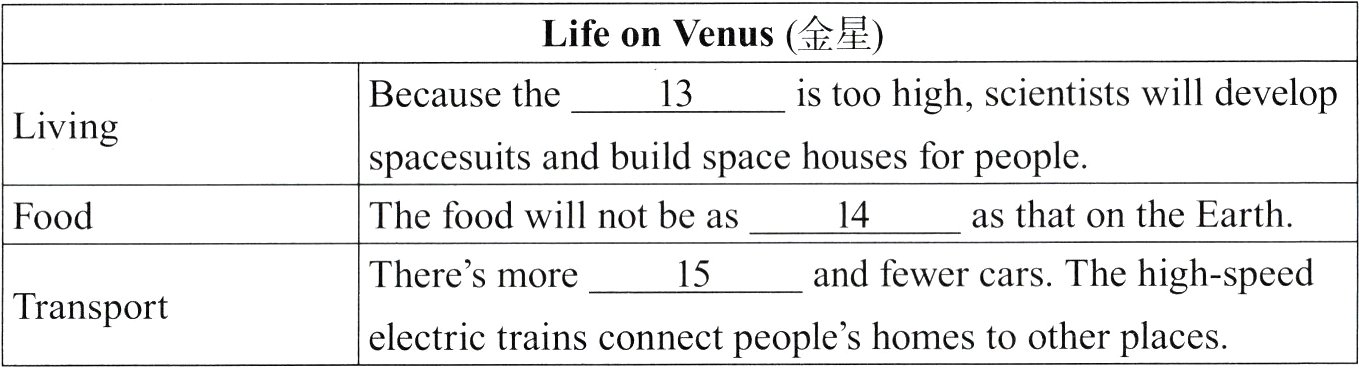
|Life on Venus (金星)| |
|--|--|
|Living|Because the ____13____ is too high, scientists will develop spacesuits and build space houses for people.|
|Food|The food will not be as ____14____ as that on the Earth.|
|Transport|There’s more ____15____ and fewer cars. The high - speed electric trains connect people’s homes to other places.|
( ) 13. A. temperature B. water C. sky
( ) 14. A. fresh B. tasty C. cheap
( ) 15. A. roads B. bikes C. space
|Life on Venus (金星)| |
|--|--|
|Living|Because the ____13____ is too high, scientists will develop spacesuits and build space houses for people.|
|Food|The food will not be as ____14____ as that on the Earth.|
|Transport|There’s more ____15____ and fewer cars. The high - speed electric trains connect people’s homes to other places.|
( ) 13. A. temperature B. water C. sky
( ) 14. A. fresh B. tasty C. cheap
( ) 15. A. roads B. bikes C. space
答案:
听第二篇短文,回答第16—20小题。
( ) 16. How many reasons are mentioned in the passage?
A. Two. B. Three. C. Four.
( ) 17. Why is the air polluted?
A. Because there are too many factories and cars.
B. Because more and more people live in big cities.
C. Because people in big cities can seldom breathe fresh air.
( ) 18. What are the rivers like now?
A. They are as clean as those in the old days.
B. All of them are dirty now.
C. We couldn’t easily find a clean river.
( ) 19. Who cannot have enough food to eat?
A. People in big cities.
B. People in small villages.
C. People in poor areas.
( ) 20. What can we do to change the situation?
A. We can protect our Earth.
B. We can move to Mars or the Moon.
C. We can move into big cities.
( ) 16. How many reasons are mentioned in the passage?
A. Two. B. Three. C. Four.
( ) 17. Why is the air polluted?
A. Because there are too many factories and cars.
B. Because more and more people live in big cities.
C. Because people in big cities can seldom breathe fresh air.
( ) 18. What are the rivers like now?
A. They are as clean as those in the old days.
B. All of them are dirty now.
C. We couldn’t easily find a clean river.
( ) 19. Who cannot have enough food to eat?
A. People in big cities.
B. People in small villages.
C. People in poor areas.
( ) 20. What can we do to change the situation?
A. We can protect our Earth.
B. We can move to Mars or the Moon.
C. We can move into big cities.
答案:
查看更多完整答案,请扫码查看

