

 搜索
搜索
第74页
- 第1页
- 第2页
- 第3页
- 第4页
- 第5页
- 第6页
- 第7页
- 第8页
- 第9页
- 第10页
- 第11页
- 第12页
- 第13页
- 第14页
- 第15页
- 第16页
- 第17页
- 第18页
- 第19页
- 第20页
- 第21页
- 第22页
- 第23页
- 第24页
- 第25页
- 第26页
- 第27页
- 第28页
- 第29页
- 第30页
- 第31页
- 第32页
- 第33页
- 第34页
- 第35页
- 第36页
- 第37页
- 第38页
- 第39页
- 第40页
- 第41页
- 第42页
- 第43页
- 第44页
- 第45页
- 第46页
- 第47页
- 第48页
- 第49页
- 第50页
- 第51页
- 第52页
- 第53页
- 第54页
- 第55页
- 第56页
- 第57页
- 第58页
- 第59页
- 第60页
- 第61页
- 第62页
- 第63页
- 第64页
- 第65页
- 第66页
- 第67页
- 第68页
- 第69页
- 第70页
- 第71页
- 第72页
- 第73页
- 第74页
- 第75页
- 第76页
- 第77页
- 第78页
- 第79页
- 第80页
- 第81页
- 第82页
- 第83页
- 第84页
- 第85页
- 第86页
- 第87页
语法学习策略指导(你对 be going to 了解多少? 请完成下列内容)
|一般将来时(1)be going to do|
|定义|用于表达计划或打算做某事,或表示预测即将发生某事|
|结构|肯定句:主语 + be(am/is/are) going to +
|用法|表示计划、打算:常用于表达事先经过考虑、安排好要做的事情,如:“I'm going to visit my grandparents this weekend. (我打算这个周末去看望我的祖父母。)” 表示预测:根据某种迹象判断某事即将发生,如:“Look at the dark clouds. It's going to rain. (看那些乌云,要下雨了。)” |
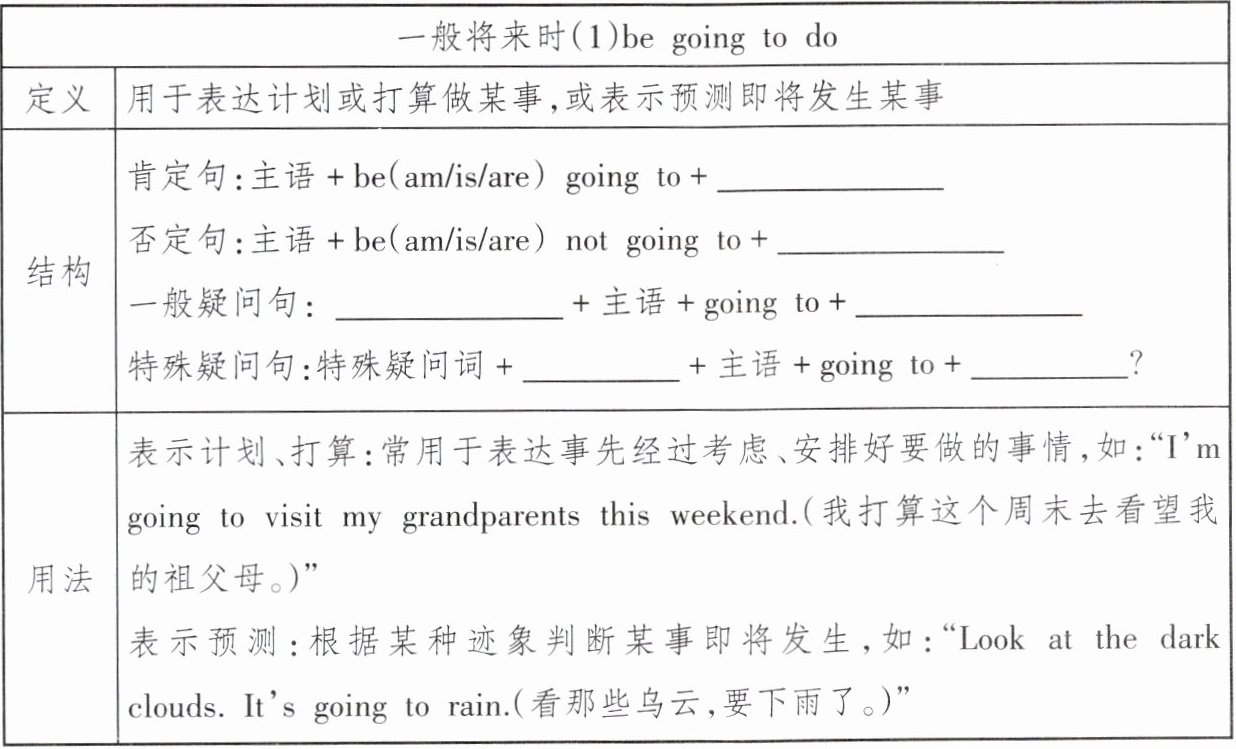
|一般将来时(1)be going to do|
|定义|用于表达计划或打算做某事,或表示预测即将发生某事|
|结构|肯定句:主语 + be(am/is/are) going to +
动词原形
否定句:主语 + be(am/is/are) not going to + 动词原形
一般疑问句:Be
+ 主语 + going to + 动词原形
特殊疑问句:特殊疑问词 + be
+ 主语 + going to + 动词原形
? ||用法|表示计划、打算:常用于表达事先经过考虑、安排好要做的事情,如:“I'm going to visit my grandparents this weekend. (我打算这个周末去看望我的祖父母。)” 表示预测:根据某种迹象判断某事即将发生,如:“Look at the dark clouds. It's going to rain. (看那些乌云,要下雨了。)” |
答案:
结构中肯定句和否定句空处依次为:动词原形;动词原形;
一般疑问句空处为:Be;动词原形;
特殊疑问句空处依次为:be;动词原形。
一般疑问句空处为:Be;动词原形;
特殊疑问句空处依次为:be;动词原形。
Ⅵ. 从方框中选择恰当的句子补全对话。其中有一项是多余的。
A:Hi, Dale! 1. ______ B:I'm reading a newspaper.A:2. ______ B:Yes, there is. Huang Xuhua won China's top science award(奖). A:What exciting news! 3. ______ B:He is the father of China's nuclear submarines(核潜艇). A:How great he is! 4. ______ B:You're right. He is a good example to us middle school students. We must study hard so that we can do something for our country one day. A:5. ______ B:Yes. It's my favorite subject. I'm going to be a scientist like Huang Xuhua when I grow up. A:Well, I think your dream will come true as long as you work hard. B:Yeah, I hope so.
|A. But who is he?|B. What's happening?|
|C. What are you doing?|D. Do you like science?|
|E. We should learn from him.|F. Is there any good news?|
1.
2.
3.
4.
5.
A:Hi, Dale! 1. ______ B:I'm reading a newspaper.A:2. ______ B:Yes, there is. Huang Xuhua won China's top science award(奖). A:What exciting news! 3. ______ B:He is the father of China's nuclear submarines(核潜艇). A:How great he is! 4. ______ B:You're right. He is a good example to us middle school students. We must study hard so that we can do something for our country one day. A:5. ______ B:Yes. It's my favorite subject. I'm going to be a scientist like Huang Xuhua when I grow up. A:Well, I think your dream will come true as long as you work hard. B:Yeah, I hope so.
|A. But who is he?|B. What's happening?|
|C. What are you doing?|D. Do you like science?|
|E. We should learn from him.|F. Is there any good news?|
1.
C
2.
F
3.
A
4.
E
5.
D
答案:
1.C
2.F
3.A
4.E
5.D
2.F
3.A
4.E
5.D
查看更多完整答案,请扫码查看

