

 搜索
搜索
第70页
- 第1页
- 第2页
- 第3页
- 第4页
- 第5页
- 第6页
- 第7页
- 第8页
- 第9页
- 第10页
- 第11页
- 第12页
- 第13页
- 第14页
- 第15页
- 第16页
- 第17页
- 第18页
- 第19页
- 第20页
- 第21页
- 第22页
- 第23页
- 第24页
- 第25页
- 第26页
- 第27页
- 第28页
- 第29页
- 第30页
- 第31页
- 第32页
- 第33页
- 第34页
- 第35页
- 第36页
- 第37页
- 第38页
- 第39页
- 第40页
- 第41页
- 第42页
- 第43页
- 第44页
- 第45页
- 第46页
- 第47页
- 第48页
- 第49页
- 第50页
- 第51页
- 第52页
- 第53页
- 第54页
- 第55页
- 第56页
- 第57页
- 第58页
- 第59页
- 第60页
- 第61页
- 第62页
- 第63页
- 第64页
- 第65页
- 第66页
- 第67页
- 第68页
- 第69页
- 第70页
- 第71页
- 第72页
- 第73页
- 第74页
课文再现 未来种植食物的土地将会更少。There
迁移运用 “20年后会有更多的学校吗?”“不,不会。我认为未来学生会用家里的电脑学习。”—Will there
will be
less land to grow food.迁移运用 “20年后会有更多的学校吗?”“不,不会。我认为未来学生会用家里的电脑学习。”—Will there
be
more schools in 20 years? — No, ______ ______there won't
. I think students will study at home on their computers.
答案:
will be; be; there won't
1. 城市人口将会更多,但交通系统会更加高效。There will be
迁移运用 未来人们的工作机会将会更少,因为更多的机器人将和人类做相同的工作。There will be
more
people in cities,but transport system will be more
efficient. 2. 交通事故将会更少。There will be fewer
traffic accidents.迁移运用 未来人们的工作机会将会更少,因为更多的机器人将和人类做相同的工作。There will be
fewer
jobs for people because more
robots will do the same jobs as people.
答案:
1. more;more
2. fewer
迁移运用:fewer;more
2. fewer
迁移运用:fewer;more
Ⅰ 听句子,选择正确答语。
1. A. Yes, we will. B. I have a dog.
C. Robots are big.
2. A. For 2 weeks. B. Two weeks ago.
C. In 2 weeks.
3. A. A scientist. B. Good idea.
C. Study hard.
1. A. Yes, we will. B. I have a dog.
C. Robots are big.
2. A. For 2 weeks. B. Two weeks ago.
C. In 2 weeks.
3. A. A scientist. B. Good idea.
C. Study hard.
答案:
ACA
Ⅱ 听短文,根据你所听到的短文内容填空。每空不超过3个单词。
|Peter is 1.
|Robots|AI and robots will 2.
|School|Students 3.
|4.
|Climate change|There will be more ways to 5.
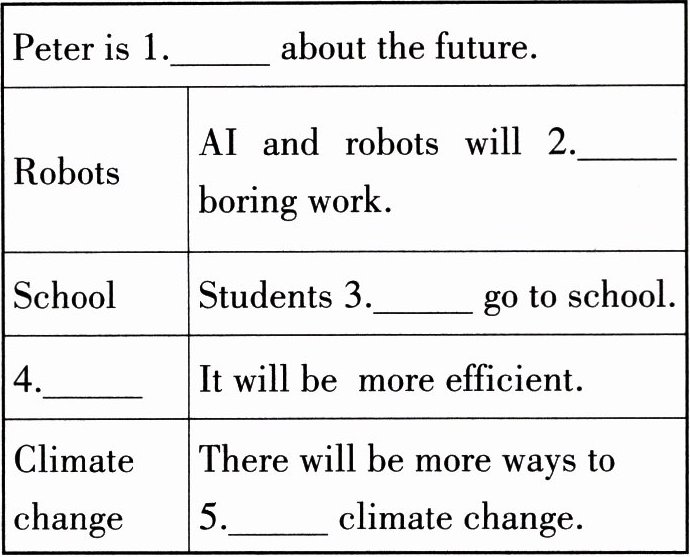
|Peter is 1.
talking
about the future.|||||Robots|AI and robots will 2.
take over
boring work.||||School|Students 3.
won't
go to school.||||4.
Transport
|It will be more efficient.||||Climate change|There will be more ways to 5.
improve
climate change.|||
答案:
1. talking 2. take over 3. won't 4. Transport 5. improve
Ⅲ 口语运用。
A. Then you must do something to save the earth with others.
B. Climate change will be worse in the future.
C. Try to use less water and take more public transport instead of private cars.
D. How are you going to do that?
E. I am going to be a doctor.
F. I'm watching a sci-fi film about the future prediction.
G. We'll have to move to the outer space.
A:Hey, Tom! What's up?
B:Hi, Helen. 1.
A:So, What will the future be like?
B:2.
A: That sounds terrible. We'll not have proper environment to live in, right?
B:Yes, you're right. 3.
A:Oh, no! I love this planet and don't want to move away.
B:4.
A:What can I do?
B:Very easy. 5.
A:OK, I'll tell all my friends to do that.
A. Then you must do something to save the earth with others.
B. Climate change will be worse in the future.
C. Try to use less water and take more public transport instead of private cars.
D. How are you going to do that?
E. I am going to be a doctor.
F. I'm watching a sci-fi film about the future prediction.
G. We'll have to move to the outer space.
A:Hey, Tom! What's up?
B:Hi, Helen. 1.
F
A:So, What will the future be like?
B:2.
B
A: That sounds terrible. We'll not have proper environment to live in, right?
B:Yes, you're right. 3.
G
A:Oh, no! I love this planet and don't want to move away.
B:4.
A
A:What can I do?
B:Very easy. 5.
C
A:OK, I'll tell all my friends to do that.
答案:
1. F
2. B
3. G
4. A
5. C
2. B
3. G
4. A
5. C
查看更多完整答案,请扫码查看

