

 搜索
搜索
第83页
- 第1页
- 第2页
- 第3页
- 第4页
- 第5页
- 第6页
- 第7页
- 第8页
- 第9页
- 第10页
- 第11页
- 第12页
- 第13页
- 第14页
- 第15页
- 第16页
- 第17页
- 第18页
- 第19页
- 第20页
- 第21页
- 第22页
- 第23页
- 第24页
- 第25页
- 第26页
- 第27页
- 第28页
- 第29页
- 第30页
- 第31页
- 第32页
- 第33页
- 第34页
- 第35页
- 第36页
- 第37页
- 第38页
- 第39页
- 第40页
- 第41页
- 第42页
- 第43页
- 第44页
- 第45页
- 第46页
- 第47页
- 第48页
- 第49页
- 第50页
- 第51页
- 第52页
- 第53页
- 第54页
- 第55页
- 第56页
- 第57页
- 第58页
- 第59页
- 第60页
- 第61页
- 第62页
- 第63页
- 第64页
- 第65页
- 第66页
- 第67页
- 第68页
- 第69页
- 第70页
- 第71页
- 第72页
- 第73页
- 第74页
- 第75页
- 第76页
- 第77页
- 第78页
- 第79页
- 第80页
- 第81页
- 第82页
- 第83页
- 第84页
- 第85页
- 第86页
- 第87页
- 第88页
- 第89页
- 第90页
- 第91页
- 第92页
- 第93页
- 第94页
- 第95页
- 第96页
- 第97页
- 第98页
- 第99页
- 第100页
- 第101页
- 第102页
- 第103页
- 第104页
- 第105页
- 第106页
- 第107页
- 第108页
- 第109页
- 第110页
- 第111页
- 第112页
- 第113页
- 第114页
- 第115页
- 第116页
- 第117页
- 第118页
- 第119页
- 第120页
- 第121页
- 第122页
- 第123页
- 第124页
- 第125页
- 第126页
- 第127页
- 第128页
- 第129页
- 第130页
- 第131页
- 第132页
- 第133页
- 第134页
- 第135页
七、根据上下文及首字母提示,完成短文。(12 分)
Mr Green has an e-friend. He is Mr Wang. He is a 1. f
Mr Green has an e-friend. He is Mr Wang. He is a 1. f
factory
worker. He 2. mmakes
cars there. He likes his job very much. He works 3. ffrom
Monday to Saturday. He usually 4. ggoes
to work by car. He has many 5. hhobbies
. He likes 6. rreading
books,7. wwatching
films and playing basketball. He is a tall man and he 8. pplays
basketball very well. In the evening,he often reads books and 9. llistens
to music. Sometimes,he goes 10. cclimbing
in the hills. At weekends,he sometimes 11. fflies
kites 12. wwith
his family in the park.
答案:
【解析】:
这是一道英语填空题,考查的是学生根据上下文及首字母提示完成短文的能力。学生需要结合所给的首字母,以及短文的整体语境,来填写合适的单词。这要求学生对英语词汇有一定的掌握,同时能够理解短文的大致意思。
【答案】:
1. factory
根据上下文,“He is a 1. f______ worker.”中,根据首字母f和worker(工人)的提示,可以推断出这里应该填写“factory”(工厂),表示他是一个工厂的工人。
2. makes
在“He 2. m______ cars there.”中,根据首字母m和cars(汽车)的提示,可以推断出这里应该填写“makes”(制造),表示他在那里制造汽车。
3. from
“He works 3. f______ Monday to Saturday.”中,根据首字母f和Monday to Saturday(从周一到周六)的提示,应该填写“from”,表示他从周一到周六工作。
4. goes
“He usually 4. g______ to work by car.”中,根据首字母g和to work(去工作)以及by car(开车)的提示,可以填写“goes”,表示他通常开车去工作。
5. hobbies
“He has many 5. h______.”中,根据首字母h和many(很多)的提示,可以推断出应该填写“hobbies”(爱好),表示他有很多爱好。
6. reading
“He likes 6. r______ books”中,根据首字母r和books(书)的提示,可以填写“reading”,表示他喜欢读书。
7. watching
“7. w______ films”中,根据首字母w和films(电影)的提示,可以填写“watching”,表示他喜欢看电影。
8. plays
“He is a tall man and he 8. p______ basketball very well.”中,根据首字母p和basketball(篮球)的提示,可以填写“plays”,表示他篮球打得很好。
9. listens
“In the evening, he often reads books and 9. l______ to music.”中,根据首字母l和to music(听音乐)的提示,可以填写“listens”,表示他晚上经常读书和听音乐。
10. climbing
“Sometimes, he goes 10. c______ in the hills.”中,根据首字母c和in the hills(在山上)的提示,可以填写“climbing”,表示有时他去山上爬山。
11. flies
“At weekends, he sometimes 11. f______ kites”中,根据首字母f和kites(风筝)的提示,可以填写“flies”,表示周末他有时放风筝。
12. with
“12. w______ his family in the park.”中,根据首字母w和his family(他的家人)以及在公园的语境,可以填写“with”,表示他和家人在公园里。
这是一道英语填空题,考查的是学生根据上下文及首字母提示完成短文的能力。学生需要结合所给的首字母,以及短文的整体语境,来填写合适的单词。这要求学生对英语词汇有一定的掌握,同时能够理解短文的大致意思。
【答案】:
1. factory
根据上下文,“He is a 1. f______ worker.”中,根据首字母f和worker(工人)的提示,可以推断出这里应该填写“factory”(工厂),表示他是一个工厂的工人。
2. makes
在“He 2. m______ cars there.”中,根据首字母m和cars(汽车)的提示,可以推断出这里应该填写“makes”(制造),表示他在那里制造汽车。
3. from
“He works 3. f______ Monday to Saturday.”中,根据首字母f和Monday to Saturday(从周一到周六)的提示,应该填写“from”,表示他从周一到周六工作。
4. goes
“He usually 4. g______ to work by car.”中,根据首字母g和to work(去工作)以及by car(开车)的提示,可以填写“goes”,表示他通常开车去工作。
5. hobbies
“He has many 5. h______.”中,根据首字母h和many(很多)的提示,可以推断出应该填写“hobbies”(爱好),表示他有很多爱好。
6. reading
“He likes 6. r______ books”中,根据首字母r和books(书)的提示,可以填写“reading”,表示他喜欢读书。
7. watching
“7. w______ films”中,根据首字母w和films(电影)的提示,可以填写“watching”,表示他喜欢看电影。
8. plays
“He is a tall man and he 8. p______ basketball very well.”中,根据首字母p和basketball(篮球)的提示,可以填写“plays”,表示他篮球打得很好。
9. listens
“In the evening, he often reads books and 9. l______ to music.”中,根据首字母l和to music(听音乐)的提示,可以填写“listens”,表示他晚上经常读书和听音乐。
10. climbing
“Sometimes, he goes 10. c______ in the hills.”中,根据首字母c和in the hills(在山上)的提示,可以填写“climbing”,表示有时他去山上爬山。
11. flies
“At weekends, he sometimes 11. f______ kites”中,根据首字母f和kites(风筝)的提示,可以填写“flies”,表示周末他有时放风筝。
12. with
“12. w______ his family in the park.”中,根据首字母w和his family(他的家人)以及在公园的语境,可以填写“with”,表示他和家人在公园里。
八、阅读理解。(10 分)
A. 根据对话内容,判断正(T)误(F)。(5 分)
(
(
(
(
(
A. 根据对话内容,判断正(T)误(F)。(5 分)
(
T
)1. Most of Paul's friends like eating fish and chips.(
F
)2. Naoko's family live in the countryside.(
F
)3. Naoko's parents often make sushi with rice and chicken.(
T
)4. Tom is from America.(
F
)5. Paul likes eating pork best.
答案:
【解析】:本题主要考查阅读理解中的细节理解能力。需要根据对话内容,判断每个句子的正误。
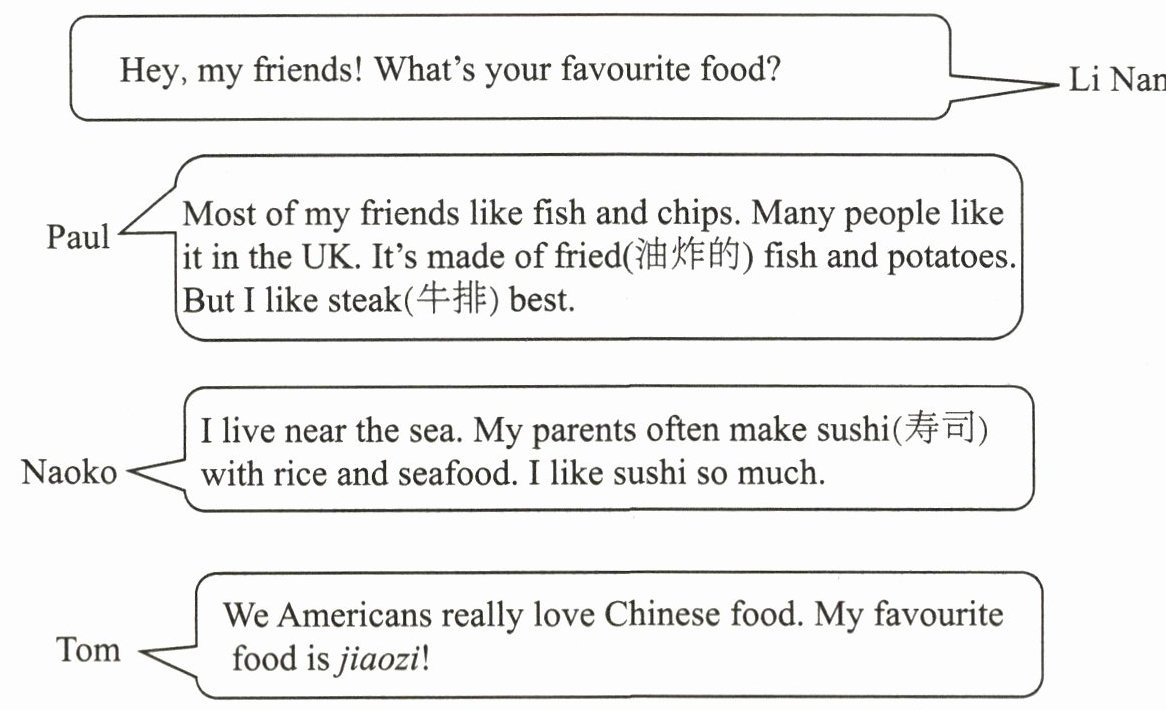
1. 根据Paul的话“Most of my friends like fish and chips.”可知,此句正确。
2. 根据Naoko的话“I live near the sea.”可知,Naoko家住在海边,而不是乡下,此句错误。
3. 根据Naoko的话“My parents often make sushi(寿司) with rice and seafood.”可知,Naoko的父母经常用米饭和海鲜做寿司,而不是米饭和鸡肉,此句错误。
4. 根据Tom的话“We Americans really love Chinese food.”可知,Tom来自美国,此句正确。
5. 根据Paul的话“But I like steak(牛排) best.”可知,Paul最喜欢吃牛排,而不是猪肉,此句错误。
【答案】:1. T;2. F;3. F;4. T;5. F。
1. 根据Paul的话“Most of my friends like fish and chips.”可知,此句正确。
2. 根据Naoko的话“I live near the sea.”可知,Naoko家住在海边,而不是乡下,此句错误。
3. 根据Naoko的话“My parents often make sushi(寿司) with rice and seafood.”可知,Naoko的父母经常用米饭和海鲜做寿司,而不是米饭和鸡肉,此句错误。
4. 根据Tom的话“We Americans really love Chinese food.”可知,Tom来自美国,此句正确。
5. 根据Paul的话“But I like steak(牛排) best.”可知,Paul最喜欢吃牛排,而不是猪肉,此句错误。
【答案】:1. T;2. F;3. F;4. T;5. F。
B. 根据短文内容,选择正确答案。(5 分)
Mr Robert lives and works in New York. He works in a hospital. His house is far from his hospital. He usually goes to work by bus. Today the bus is late. So he rides his bike to work.
On Sundays,he doesn't go to work. Sometimes he goes to see a film. Sometimes he plays football. Sometimes he stays at home and reads books about animals.
(
A. In London. B. In New York. C. In Beijing.
(
A. In a factory. B. In a hospital. C. In a school.
(
A. No,he doesn't. B. Yes,he does. C. Yes,he is.
(
A. Yes,he does. B. No,he doesn't. C. Yes,he is.
(
A. He watches a show. B. He plays basketball. C. He reads books.
Mr Robert lives and works in New York. He works in a hospital. His house is far from his hospital. He usually goes to work by bus. Today the bus is late. So he rides his bike to work.
On Sundays,he doesn't go to work. Sometimes he goes to see a film. Sometimes he plays football. Sometimes he stays at home and reads books about animals.
(
B
)1. Where does Mr Robert live?A. In London. B. In New York. C. In Beijing.
(
B
)2. Where does Mr Robert work?A. In a factory. B. In a hospital. C. In a school.
(
A
)3. Does Mr Robert usually go to work on Sundays?A. No,he doesn't. B. Yes,he does. C. Yes,he is.
(
B
)4. Does Mr Robert usually go to work by bike?A. Yes,he does. B. No,he doesn't. C. Yes,he is.
(
C
)5. What does Mr Robert sometimes do at home?A. He watches a show. B. He plays basketball. C. He reads books.
答案:
【解析】:本题主要考查对英语短文内容的理解,通过阅读短文,提取关键信息来回答相关问题。
1. 第一题问Mr Robert住在哪里,需要在短文中找到关于他居住地点的描述。
2. 第二题问Mr Robert在哪里工作,需从短文中找到他工作地点的信息。
3. 第三题是一个一般疑问句,询问Mr Robert周日是否通常去上班,要根据短文中关于他周日活动的描述来回答。
4. 第四题也是一般疑问句,问Mr Robert是否通常骑自行车上班,需依据短文中他上班的交通方式来判断。
5. 第五题问Mr Robert有时在家做什么,要从短文中找到他在家进行的活动。
【答案】:
1. B
根据短文中“Mr Robert lives and works in New York.”可知,Mr Robert住在纽约,所以选B。
2. B
由短文中“He works in a hospital.”可知,Mr Robert在医院工作,所以选B。
3. A
从短文中“On Sundays,he doesn't go to work.”可知,Mr Robert周日不上班,所以选A。
4. B
根据短文中“He usually goes to work by bus.”可知,Mr Robert通常乘公交车上班,不是骑自行车,所以选B。
5. C
由短文中“Sometimes he stays at home and reads books about animals.”可知,Mr Robert有时在家读关于动物的书,所以选C。
1. 第一题问Mr Robert住在哪里,需要在短文中找到关于他居住地点的描述。
2. 第二题问Mr Robert在哪里工作,需从短文中找到他工作地点的信息。
3. 第三题是一个一般疑问句,询问Mr Robert周日是否通常去上班,要根据短文中关于他周日活动的描述来回答。
4. 第四题也是一般疑问句,问Mr Robert是否通常骑自行车上班,需依据短文中他上班的交通方式来判断。
5. 第五题问Mr Robert有时在家做什么,要从短文中找到他在家进行的活动。
【答案】:
1. B
根据短文中“Mr Robert lives and works in New York.”可知,Mr Robert住在纽约,所以选B。
2. B
由短文中“He works in a hospital.”可知,Mr Robert在医院工作,所以选B。
3. A
从短文中“On Sundays,he doesn't go to work.”可知,Mr Robert周日不上班,所以选A。
4. B
根据短文中“He usually goes to work by bus.”可知,Mr Robert通常乘公交车上班,不是骑自行车,所以选B。
5. C
由短文中“Sometimes he stays at home and reads books about animals.”可知,Mr Robert有时在家读关于动物的书,所以选C。
查看更多完整答案,请扫码查看

