

 搜索
搜索
第20页
- 第1页
- 第2页
- 第3页
- 第4页
- 第5页
- 第6页
- 第7页
- 第8页
- 第9页
- 第10页
- 第11页
- 第12页
- 第13页
- 第14页
- 第15页
- 第16页
- 第17页
- 第18页
- 第19页
- 第20页
- 第21页
- 第22页
- 第23页
- 第24页
- 第25页
- 第26页
- 第27页
- 第28页
- 第29页
- 第30页
- 第31页
- 第32页
- 第33页
- 第34页
- 第35页
- 第36页
- 第37页
- 第38页
- 第39页
- 第40页
- 第41页
- 第42页
- 第43页
- 第44页
- 第45页
- 第46页
- 第47页
- 第48页
- 第49页
- 第50页
- 第51页
- 第52页
- 第53页
- 第54页
- 第55页
- 第56页
- 第57页
- 第58页
- 第59页
- 第60页
- 第61页
- 第62页
- 第63页
- 第64页
- 第65页
- 第66页
- 第67页
- 第68页
一、朗读句子或对话,将所有可以连读的地方用连读符号标记出来。
1. We must stop at a red light.
2. Look at me! I am on a bike.
3. —Today I take a subway to school. How do you come to school?
—I come on foot.
1. We must stop at a red light.
2. Look at me! I am on a bike.
3. —Today I take a subway to school. How do you come to school?
—I come on foot.
答案:
1. We must stop at a red light. 2. Look at me! I am on a bike. 3. —Today I take a subway to school. How do you come to school? —I come on foot. 解析 1. stop 以辅音结尾,at 以元音开头,二者可以连读。at 以辅音结尾,a 以元音开头,二者可以连读。 2. Look 以辅音结尾,at 以元音开头,二者可以连读。am 以辅音结尾,on 以元音开头,二者可以连读。on 以辅音结尾,a 以元音开头,二者可以连读。 3. take 以辅音结尾,a 以元音开头,二者可以连读。come 以辅音结尾,on 以元音开头,二者可以连读。
二、根据课文内容,判断句子正(T)误(F)。
(
(
(
(
(
(
F
)1. All children in Munich, Germany, walk to school.(
T
)2. In Alaska, some children go to school by sled. It moves on the snow.(
F
)3. Children in Beijing cannot go to school by subway.(
F
)4. Some kids in Papa Westray go to school by plane now because the ferry doesn't work.(
T
)5. Robin is a robot. He doesn't go to school. He can learn at home.
答案:
1.F 2.T 3.F 4.F 5.T 解析 1. 句意:德国慕尼黑的所有孩子都步行去学校。 依据:Some children go to school on foot in Munich,Germany. 分析:德国慕尼黑的一些孩子步行上学,而不是“所有孩子”,故答案为 F。 2. 句意:在阿拉斯加州,一些孩子坐雪橇上学。它在雪上移动。 依据:In Alaska,USA,it snows a lot. Some kids go to school by sled. 分析:阿拉斯加州的一些孩子下雪时坐雪橇上学,说明雪橇可以在雪上移动,故答案为 T。 3. 句意:北京的孩子不能乘地铁上学。 依据:Some children in Beijing,China,go to school by subway every day. 分析:北京一些孩子每天乘地铁上学,故答案为 F。 4. 句意:帕帕韦斯特雷岛的一些孩子现在乘飞机上学,因为轮渡不工作。 依据:But in 2009,they went to school by plane because the ferry didn't work. 分析:只在 2009 年,因轮渡故障,帕帕韦斯特雷岛的孩子们乘飞机上学,现在还是乘轮渡,故答案为 F。 5. 句意:Robin 是一个机器人,他不上学,他可以在家学习。 依据:I don't go to school. I learn at home. 分析:Robin 是个机器人,在家学习,故答案为 T。
(
A.must
B.can't
C.don't
A
)1.We stop at a red light.A.must
B.can't
C.don't
答案:
A 解析 1. 句意:我们在红灯时 停下。 分析:红灯时必须停下,故选 A.
(
A.puts
B.put
C.putting
B
)2.He must things in order.A.puts
B.put
C.putting
答案:
B 解析 2. 句意:他必须 物品整齐。 分析:must 后接动词原形,故选 B.
(
A.Not
B.No
C.Don't
C
)3.eat chocolate or sweets.A.Not
B.No
C.Don't
答案:
C 解析 3. 句意: 吃巧克力和糖果。 分析:否定祈使句的句型包括“Don't+动词原形.” 和“No+动词-ing.”,故选 C.
(
A.shout, sleep
B.shouts, sleeps
C.shout, is sleeping
C
)4.Don't . The baby .A.shout, sleep
B.shouts, sleeps
C.shout, is sleeping
答案:
C 解析 4. 句意:别 ,宝宝 。 分析:Don't 后接动词原形,排除 B。The baby 是单数,动词用 sleeps 或 is,排除 A。故选 C.
(
A.can, must
B.can't, must
C.mustn't, can't
B
)5.Jane, you watch TV. You go to bed. It's too late.A.can, must
B.can't, must
C.mustn't, can't
答案:
B 解析 5. 句意:Jane,你 看电视,你 上床睡觉。太晚了。 分析:太晚了,所以“不能”看电视,“必须”上床睡觉,故选 B.
四、读句子,推断说话人的位置,选择正确的选项。
(
A. At the bookstore.
B. Not at the bookstore.
(
A. At the zoo.
B. Not at the zoo.
(
A. In the library.
B. Not in the library.
(
B
)1. Go to the bookstore.A. At the bookstore.
B. Not at the bookstore.
(
A
)2. Come to the zoo and play with me.A. At the zoo.
B. Not at the zoo.
(
B
)3. How can I go to the library?A. In the library.
B. Not in the library.
答案:
1.B 2.A 3.B 解析 1. 句意:去书店。 分析:不在书店才能说去书店,故选 B。 2. 句意:来动物园和我一起玩。 分析:说话人在动物园,才会让对方来,故选 A。 3. 句意:我怎么去图书馆? 分析:在图书馆内不会问如何去,说明说话人不在图书馆,故选 B。
五、根据句意,选择相应的图片。
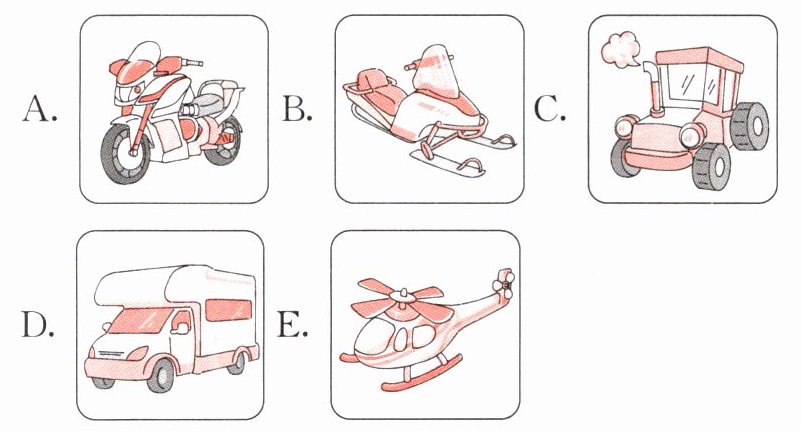
(
(
(
(
(
(
E
)1. The helicopter can fly in the sky. It has a big propeller(螺旋桨)that looks like a fan.(
B
)2. The snowmobile looks like a sled. It can move fast on the snow.(
C
)3. Farmers like driving the tractor on the farm. It has four tyres(轮胎). They can help it move on the rough roads.(
D
)4. The camper looks like a minibus. There is living space in it. You can cook and sleep in it.(
A
)5. The scooter is a motor vehicle(机动车)with two small wheels(车轮). It looks like a bike, but it's usually faster than the bike.
答案:
1.E 2.B 3.C 4.D 5.A 解析 1. 句意:直升机可以在空中飞行,它有一个看起来像风扇的大螺旋桨。 分析:图 E 是直升机,故选 E。 2. 句意:雪地机动车看起来像一个雪橇,它能在雪上快速移动。 分析:图 B 是雪地机动车,故选 B。 3. 句意:农民喜欢在农场里开拖拉机,它有四个轮胎,它们能帮它在崎岖的道路上移动。 分析:图 C 是拖拉机,故选 C。 4. 句意:野营车看起来像一辆小型公共汽车,它里面有居住空间,你可以在它里面做饭睡觉。 分析:图 D 是野营车,故选 D。 5. 句意:小型摩托车是一辆有两个小车轮的机动车,它看起来像自行车,但它通常比自行车快。 分析:图 A 是小型摩托车,故选 A。
查看更多完整答案,请扫码查看

