

 搜索
搜索
第7页
- 第1页
- 第2页
- 第3页
- 第4页
- 第5页
- 第6页
- 第7页
- 第8页
- 第9页
- 第10页
- 第11页
- 第12页
- 第13页
- 第14页
- 第15页
- 第16页
- 第17页
- 第18页
- 第19页
- 第20页
- 第21页
- 第22页
- 第23页
- 第24页
- 第25页
- 第26页
- 第27页
- 第28页
- 第29页
- 第30页
- 第31页
- 第32页
- 第33页
- 第34页
- 第35页
- 第36页
- 第37页
- 第38页
- 第39页
- 第40页
- 第41页
- 第42页
- 第43页
- 第44页
- 第45页
- 第46页
- 第47页
- 第48页
- 第49页
- 第50页
- 第51页
- 第52页
- 第53页
- 第54页
- 第55页
- 第56页
- 第57页
- 第58页
- 第59页
- 第60页
- 第61页
- 第62页
- 第63页
- 第64页
- 第65页
- 第66页
- 第67页
- 第68页
I have some new friends. They are all very nice. What are they like? Let me introduce them.
1. Rose often says "Hello!" and "Thank you!" to others. She is
2. Yangyang often reads books after school. He is
3. Kate often cleans the room. She is
4. Nancy is very
5. Xiaolu is
1. Rose often says "Hello!" and "Thank you!" to others. She is
polite
.2. Yangyang often reads books after school. He is
hard-working
.3. Kate often cleans the room. She is
helpful
at home.4. Nancy is very
shy
. Her face turns (变 成) red when she talks with strangers(陌生人).5. Xiaolu is
clever
. He knows a lot and always has many great ideas(主意).
答案:
1. polite 2. hard-working 3. helpful 4. shy 5. clever
解析
1. 句意:Rose 经常对别人说"你好!"和"谢谢!"。她是 。
分析:说"你好"和"谢谢"体现出是有礼貌的,故填 polite。
2. 句意:Yangyang 放学后经常读书。他是 。
分析:经常读书体现勤奋,故填 hard-working。
3. 句意:Kate 经常打扫房间。她在家是 。
分析:经常打扫房间,说明 Kate 在家是愿意帮忙的,故填 helpful。
4. 句意:Nancy 非常 。她和陌生人说话时脸变红。
分析:和陌生人说话脸红,体现"害羞的",故填 shy。
5. 句意:Xiaolu 是 。他知道很多,总有很多好主意。
分析:知道的多且有许多好主意,体现"聪明的",故填 clever。
解析
1. 句意:Rose 经常对别人说"你好!"和"谢谢!"。她是 。
分析:说"你好"和"谢谢"体现出是有礼貌的,故填 polite。
2. 句意:Yangyang 放学后经常读书。他是 。
分析:经常读书体现勤奋,故填 hard-working。
3. 句意:Kate 经常打扫房间。她在家是 。
分析:经常打扫房间,说明 Kate 在家是愿意帮忙的,故填 helpful。
4. 句意:Nancy 非常 。她和陌生人说话时脸变红。
分析:和陌生人说话脸红,体现"害羞的",故填 shy。
5. 句意:Xiaolu 是 。他知道很多,总有很多好主意。
分析:知道的多且有许多好主意,体现"聪明的",故填 clever。
二、按要求完成下列各题。
1. your, like, what, mother, is (?)(连词成句)
2. is, Lingling, clever, really (.)(连词成句)
3. —What's Rose like?
(看图作答)
—
4. 看图写一个句子。
5. Who's your good friend? What's he/she like?(根据实际情况回答)
1. your, like, what, mother, is (?)(连词成句)
What is your mother like?
2. is, Lingling, clever, really (.)(连词成句)
Lingling is really clever.
3. —What's Rose like?
(看图作答)
—
She is polite.
4. 看图写一个句子。
They are hard-working.
5. Who's your good friend? What's he/she like?(根据实际情况回答)
示例:My good friend is Tom. He is clever.
答案:
1. What is your mother like?
2. Lingling is really clever.
3. She is polite.
4. They are hard-working.
5. 示例:My good friend is Tom. He is clever.
解析
1. 由 what、is、like 和"?"可推测该句为"What is ... like?"的句型,用于询问某人的性格或外貌特征,将词按此结构组合,故答案为"What is your mother like?"。
2. 由"."可知此句为陈述句,基本结构为"主语+谓语(be 动词)+其他。"。really 可作为副词,修饰形容词 clever,表示"真的聪明",故正确答案为"Lingling is really clever."。
3. 句意:Rose 是什么样的人?
分析:图中 Rose 在向老师问好,体现出她是有礼貌的,故答案为"She is polite."。
4. 图中两个人在晚上看书,学习很努力,可以用 hard-working 描述,人称代词应用 They(他们),be 动词应用 are,故答案为"They are hard-working."。
5. 句意:谁是你的好朋友?他或她是什么样的人?
分析:根据实际情况,先回答好朋友是谁,用句型"My good friend is ...",再描述其外貌或性格特征,用句型"He/She is ..."。
2. Lingling is really clever.
3. She is polite.
4. They are hard-working.
5. 示例:My good friend is Tom. He is clever.
解析
1. 由 what、is、like 和"?"可推测该句为"What is ... like?"的句型,用于询问某人的性格或外貌特征,将词按此结构组合,故答案为"What is your mother like?"。
2. 由"."可知此句为陈述句,基本结构为"主语+谓语(be 动词)+其他。"。really 可作为副词,修饰形容词 clever,表示"真的聪明",故正确答案为"Lingling is really clever."。
3. 句意:Rose 是什么样的人?
分析:图中 Rose 在向老师问好,体现出她是有礼貌的,故答案为"She is polite."。
4. 图中两个人在晚上看书,学习很努力,可以用 hard-working 描述,人称代词应用 They(他们),be 动词应用 are,故答案为"They are hard-working."。
5. 句意:谁是你的好朋友?他或她是什么样的人?
分析:根据实际情况,先回答好朋友是谁,用句型"My good friend is ...",再描述其外貌或性格特征,用句型"He/She is ..."。
三、Li Hua 喜爱读书,今天他读了一篇传统民间故事。读一读,完成题目。
When Sima Guang is a little boy, he plays a ball with his friends in the courtyard(院子).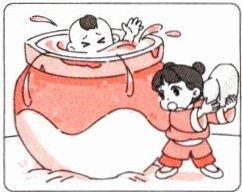 A boy kicks(踢) the ball into a large vat. The vat is full of water. All the children run to the vat. They talk about how to take the ball out. One boy steps on another boy's shoulders to get (拿到)the ball. Suddenly he slips(滑倒), and falls into the vat. The children are scared(害怕的)and don't know what to do. Then Sima Guang has an idea. He picks up a big stone and breaks(打破)the vat with it. The water flows out. The boy is saved(获救).
(一)用数字将司马光救人的步骤排序。
(
(
(
(
(二)根据短文内容,选择正确的答案。
(
A. 脚步
B. 踩
C. 进入
(
A. Sima Guang likes to break the vat
B. we can't play football in the courtyard
C. Sima Guang is clever and brave
When Sima Guang is a little boy, he plays a ball with his friends in the courtyard(院子).
A boy kicks(踢) the ball into a large vat. The vat is full of water. All the children run to the vat. They talk about how to take the ball out. One boy steps on another boy's shoulders to get (拿到)the ball. Suddenly he slips(滑倒), and falls into the vat. The children are scared(害怕的)and don't know what to do. Then Sima Guang has an idea. He picks up a big stone and breaks(打破)the vat with it. The water flows out. The boy is saved(获救).(一)用数字将司马光救人的步骤排序。
(
3
)The water flows out.(
2
)He breaks the vat with the stone.(
4
)The boy is saved.(
1
)He picks up a big stone.(二)根据短文内容,选择正确的答案。
(
B
)1. The underlined words(画线词)"steps on" means "______" in Chinese.A. 脚步
B. 踩
C. 进入
(
C
)2. From the passage, we can know ______.A. Sima Guang likes to break the vat
B. we can't play football in the courtyard
C. Sima Guang is clever and brave
答案:
(一)3 2 4 1 (二)1. B 2. C
解析
(一)
依据:He picks up a big stone and breaks the vat with it. The water flows out. The boy is saved.
分析:"He picks up a big stone."是第一步。
"He breaks the vat with the stone."是第二步。
"The water flows out."是第三步。
"The boy is saved."是第四步。
(二)
1. 句意:画线词"steps on"在中文中的意思是" "。
分析:由上下文语境可知,是一个男孩"踩"在另一个男孩的肩膀上,steps on 意为"踩",故选 B。
2. 句意:从短文中我们能知道 。
分析:A 项意为"司马光喜欢打破缸",由短文内容可知,司马光打破缸是为救人,不是喜欢打破缸,故 A 项错误;B 项意为"我们不能在院子里踢足球",短文未提及此内容,故 B 项错误;C 项意为"司马光聪明且勇敢",司马光想出打破缸救人的办法,体现聪明和勇敢,故 C 项正确。
解析
(一)
依据:He picks up a big stone and breaks the vat with it. The water flows out. The boy is saved.
分析:"He picks up a big stone."是第一步。
"He breaks the vat with the stone."是第二步。
"The water flows out."是第三步。
"The boy is saved."是第四步。
(二)
1. 句意:画线词"steps on"在中文中的意思是" "。
分析:由上下文语境可知,是一个男孩"踩"在另一个男孩的肩膀上,steps on 意为"踩",故选 B。
2. 句意:从短文中我们能知道 。
分析:A 项意为"司马光喜欢打破缸",由短文内容可知,司马光打破缸是为救人,不是喜欢打破缸,故 A 项错误;B 项意为"我们不能在院子里踢足球",短文未提及此内容,故 B 项错误;C 项意为"司马光聪明且勇敢",司马光想出打破缸救人的办法,体现聪明和勇敢,故 C 项正确。
查看更多完整答案,请扫码查看

