

 搜索
搜索
第11页
- 第1页
- 第2页
- 第3页
- 第4页
- 第5页
- 第6页
- 第7页
- 第8页
- 第9页
- 第10页
- 第11页
- 第12页
- 第13页
- 第14页
- 第15页
- 第16页
- 第17页
- 第18页
- 第19页
- 第20页
- 第21页
- 第22页
- 第23页
- 第24页
- 第25页
- 第26页
- 第27页
- 第28页
- 第29页
- 第30页
- 第31页
- 第32页
- 第33页
- 第34页
- 第35页
- 第36页
- 第37页
- 第38页
- 第39页
- 第40页
- 第41页
- 第42页
- 第43页
- 第44页
- 第45页
- 第46页
- 第47页
- 第48页
- 第49页
- 第50页
- 第51页
- 第52页
- 第53页
- 第54页
- 第55页
- 第56页
- 第57页
- 第58页
- 第59页
- 第60页
- 第61页
- 第62页
- 第63页
- 第64页
- 第65页
- 第66页
- 第67页
- 第68页
- 第69页
- 第70页
- 第71页
- 第72页
- 第73页
- 第74页
- 第75页
- 第76页
- 第77页
- 第78页
- 第79页
- 第80页
- 第81页
- 第82页
- 第83页
- 第84页
- 第85页
- 第86页
- 第87页
- 第88页
- 第89页
- 第90页
- 第91页
- 第92页
例2 [2021河南A篇节选]
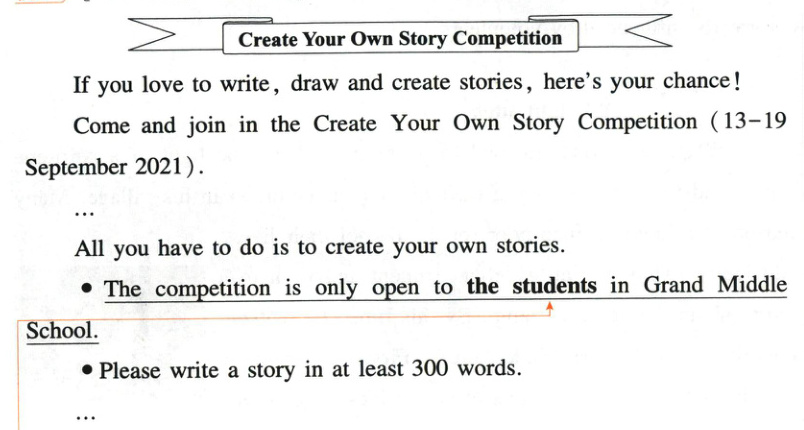
Who is the text written for?
A. Students.
B. Teachers.
C. Parents.
D. Artists.
②寻找关键信息
Step 1 快速浏览全文,理解文章的整体内容:本文是一则故事大赛启事。
Step 2 仔细阅读题目,寻找与题目相关的关键信息。
Step 3 根据文中的“The competition is only open to the students in Grand Middle School.”可推断,此次活动是面向学生的,文本内容是为学生而写。故选A。
Who is the text written for?
A. Students.
B. Teachers.
C. Parents.
D. Artists.
②寻找关键信息
Step 1 快速浏览全文,理解文章的整体内容:本文是一则故事大赛启事。
Step 2 仔细阅读题目,寻找与题目相关的关键信息。
Step 3 根据文中的“The competition is only open to the students in Grand Middle School.”可推断,此次活动是面向学生的,文本内容是为学生而写。故选A。
答案:
练1
It is more than sixty years since the death of Lei Feng, and yet his spirit of selflessness is still alive, inspiring Chinese young people. In fact, the wish to help others can always be found among common people.
On September 5, 2022, when an earthquake hit Luding, Sichuan, 28 - year - old hydropower station (水电站) worker Gan Yu chose not to leave but stay at his workplace, saving villages downstream from being flooded. People think he is a hero like Lei Feng, but he doesn't feel that he should be compared to the young hero. “Lei Feng is a role model to all Chinese young people. The things he did may seem small but behind them was the nobility(高贵的品质) that we can all achieve,” he said.
Zeng Qiangfei, 24, is also from Sichuan. In 2013, when an earthquake happened in his hometown, he was studying in a middle school. Zeng remembered seeing rescuers(救援者) and volunteers gather there to help. When he grew up, he became a volunteer himself. After a terrible quake hit Türkiye and Syria in 2023, he flew there to help. During the rescue, he always saw local people bowing quietly to rescuers like them. “I grew up listening to Lei Feng's stories. He is an excellent young man who spared no effort to help others,” said Zeng.
This view is shared by a 56 - year - old British man named James Elroy Edginton, who lives in Hunan, the hometown of Lei Feng. Working at a local college, Edginton volunteers to help students from poor families, and is warmly regarded as a “foreign Lei Feng”. “I am honored to be connected with the spirit of Lei Feng. His qualities are timeless and borderless,” he said.
( ) 1. Which of the following words can best describe Gan Yu?
A. Responsible.
B. Smart.
C. Patient.
D. Careful.
( ) 2. Why did Zeng Qiangfei become a volunteer when he grew up?
A. Because he wanted local people to thank him.
B. Because he was quite moved by Gan Yu's story.
C. Because he learned about volunteering at school.
D. Because he was greatly influenced by volunteers.
It is more than sixty years since the death of Lei Feng, and yet his spirit of selflessness is still alive, inspiring Chinese young people. In fact, the wish to help others can always be found among common people.
On September 5, 2022, when an earthquake hit Luding, Sichuan, 28 - year - old hydropower station (水电站) worker Gan Yu chose not to leave but stay at his workplace, saving villages downstream from being flooded. People think he is a hero like Lei Feng, but he doesn't feel that he should be compared to the young hero. “Lei Feng is a role model to all Chinese young people. The things he did may seem small but behind them was the nobility(高贵的品质) that we can all achieve,” he said.
Zeng Qiangfei, 24, is also from Sichuan. In 2013, when an earthquake happened in his hometown, he was studying in a middle school. Zeng remembered seeing rescuers(救援者) and volunteers gather there to help. When he grew up, he became a volunteer himself. After a terrible quake hit Türkiye and Syria in 2023, he flew there to help. During the rescue, he always saw local people bowing quietly to rescuers like them. “I grew up listening to Lei Feng's stories. He is an excellent young man who spared no effort to help others,” said Zeng.
This view is shared by a 56 - year - old British man named James Elroy Edginton, who lives in Hunan, the hometown of Lei Feng. Working at a local college, Edginton volunteers to help students from poor families, and is warmly regarded as a “foreign Lei Feng”. “I am honored to be connected with the spirit of Lei Feng. His qualities are timeless and borderless,” he said.
( ) 1. Which of the following words can best describe Gan Yu?
A. Responsible.
B. Smart.
C. Patient.
D. Careful.
( ) 2. Why did Zeng Qiangfei become a volunteer when he grew up?
A. Because he wanted local people to thank him.
B. Because he was quite moved by Gan Yu's story.
C. Because he learned about volunteering at school.
D. Because he was greatly influenced by volunteers.
答案:
1.A 2.D
练2
A Bright Idea
Evans Wadongo was from a village of Africa. He had to do homework by the light of a kerosene lamp(煤油灯). Evans' eyes hurt and this made studying difficult. It was common in his village. Many children left school for this reason...so they remained poor for the rest of their lives.
Although studying was difficult, Evans was an excellent student and went to a university. He continued to worry about the kerosene lamp. By this time, he realized it was not just bad for schoolchildren but for the whole family. First, it can cause illnesses such as coughs. Also, the light can hurt people's eyes. Besides, it can lead to fires. Lastly kerosene is expensive, so families have less money for food. It was difficult to come up with a different kind of lamp that was cheap and good for the environment. Yet Evans did not give up.
One day, he had an idea. He could use a small solar(太阳能的) light. Sunlight is free and solar power is good for the environment. Evans built his first solar lamp, and it worked. He began to build more lamps and sent them to local families. An organization heard about this and provided money for him to build more solar lamps.
Each lamp only cost $20. However, this was a lot of money to many villagers, who only earned around $34 a week, so Evans made sure he kept the cost down. First, Evans used recycled materials. Next volunteers built the lamps. Finally, people from many countries gave away money to his team, so the lamps were usually free.
Thousands of people had safe lights. Julia, a mother of three, said, “Thanks to Evans, my children have lights to read, and I have my own light to cook.” The solar lamps made a big difference.
( ) 1. Why does the writer give Julia's example in Paragraph 5?
A. To share Julia's experience.
B. To show Evans' influence.
C. To describe Evans' feelings.
D. To introduce Evans' invention.
( ) 2. What is Evans like according to the passage?
A. Polite, talented and humorous.
B. Quiet, smart and honest.
C. Humorous, clever and friendly.
D. Hard - working, loving and creative.
A Bright Idea
Evans Wadongo was from a village of Africa. He had to do homework by the light of a kerosene lamp(煤油灯). Evans' eyes hurt and this made studying difficult. It was common in his village. Many children left school for this reason...so they remained poor for the rest of their lives.
Although studying was difficult, Evans was an excellent student and went to a university. He continued to worry about the kerosene lamp. By this time, he realized it was not just bad for schoolchildren but for the whole family. First, it can cause illnesses such as coughs. Also, the light can hurt people's eyes. Besides, it can lead to fires. Lastly kerosene is expensive, so families have less money for food. It was difficult to come up with a different kind of lamp that was cheap and good for the environment. Yet Evans did not give up.
One day, he had an idea. He could use a small solar(太阳能的) light. Sunlight is free and solar power is good for the environment. Evans built his first solar lamp, and it worked. He began to build more lamps and sent them to local families. An organization heard about this and provided money for him to build more solar lamps.
Each lamp only cost $20. However, this was a lot of money to many villagers, who only earned around $34 a week, so Evans made sure he kept the cost down. First, Evans used recycled materials. Next volunteers built the lamps. Finally, people from many countries gave away money to his team, so the lamps were usually free.
Thousands of people had safe lights. Julia, a mother of three, said, “Thanks to Evans, my children have lights to read, and I have my own light to cook.” The solar lamps made a big difference.
( ) 1. Why does the writer give Julia's example in Paragraph 5?
A. To share Julia's experience.
B. To show Evans' influence.
C. To describe Evans' feelings.
D. To introduce Evans' invention.
( ) 2. What is Evans like according to the passage?
A. Polite, talented and humorous.
B. Quiet, smart and honest.
C. Humorous, clever and friendly.
D. Hard - working, loving and creative.
答案:
1.B 2.D
查看更多完整答案,请扫码查看

