

 搜索
搜索
第104页
- 第1页
- 第2页
- 第3页
- 第4页
- 第5页
- 第6页
- 第7页
- 第8页
- 第9页
- 第10页
- 第11页
- 第12页
- 第13页
- 第14页
- 第15页
- 第16页
- 第17页
- 第18页
- 第19页
- 第20页
- 第21页
- 第22页
- 第23页
- 第24页
- 第25页
- 第26页
- 第27页
- 第28页
- 第29页
- 第30页
- 第31页
- 第32页
- 第33页
- 第34页
- 第35页
- 第36页
- 第37页
- 第38页
- 第39页
- 第40页
- 第41页
- 第42页
- 第43页
- 第44页
- 第45页
- 第46页
- 第47页
- 第48页
- 第49页
- 第50页
- 第51页
- 第52页
- 第53页
- 第54页
- 第55页
- 第56页
- 第57页
- 第58页
- 第59页
- 第60页
- 第61页
- 第62页
- 第63页
- 第64页
- 第65页
- 第66页
- 第67页
- 第68页
- 第69页
- 第70页
- 第71页
- 第72页
- 第73页
- 第74页
- 第75页
- 第76页
- 第77页
- 第78页
- 第79页
- 第80页
- 第81页
- 第82页
- 第83页
- 第84页
- 第85页
- 第86页
- 第87页
- 第88页
- 第89页
- 第90页
- 第91页
- 第92页
- 第93页
- 第94页
- 第95页
- 第96页
- 第97页
- 第98页
- 第99页
- 第100页
- 第101页
- 第102页
- 第103页
- 第104页
- 第105页
- 第106页
- 第107页
- 第108页
- 第109页
- 第110页
- 第111页
- 第112页
- 第113页
- 第114页
- 第115页
- 第116页
- 第117页
- 第118页
- 第119页
三、阅读理解(共15小题;每小题2分,满分30分)
A
Museum of Fine Arts (MFA), Boston
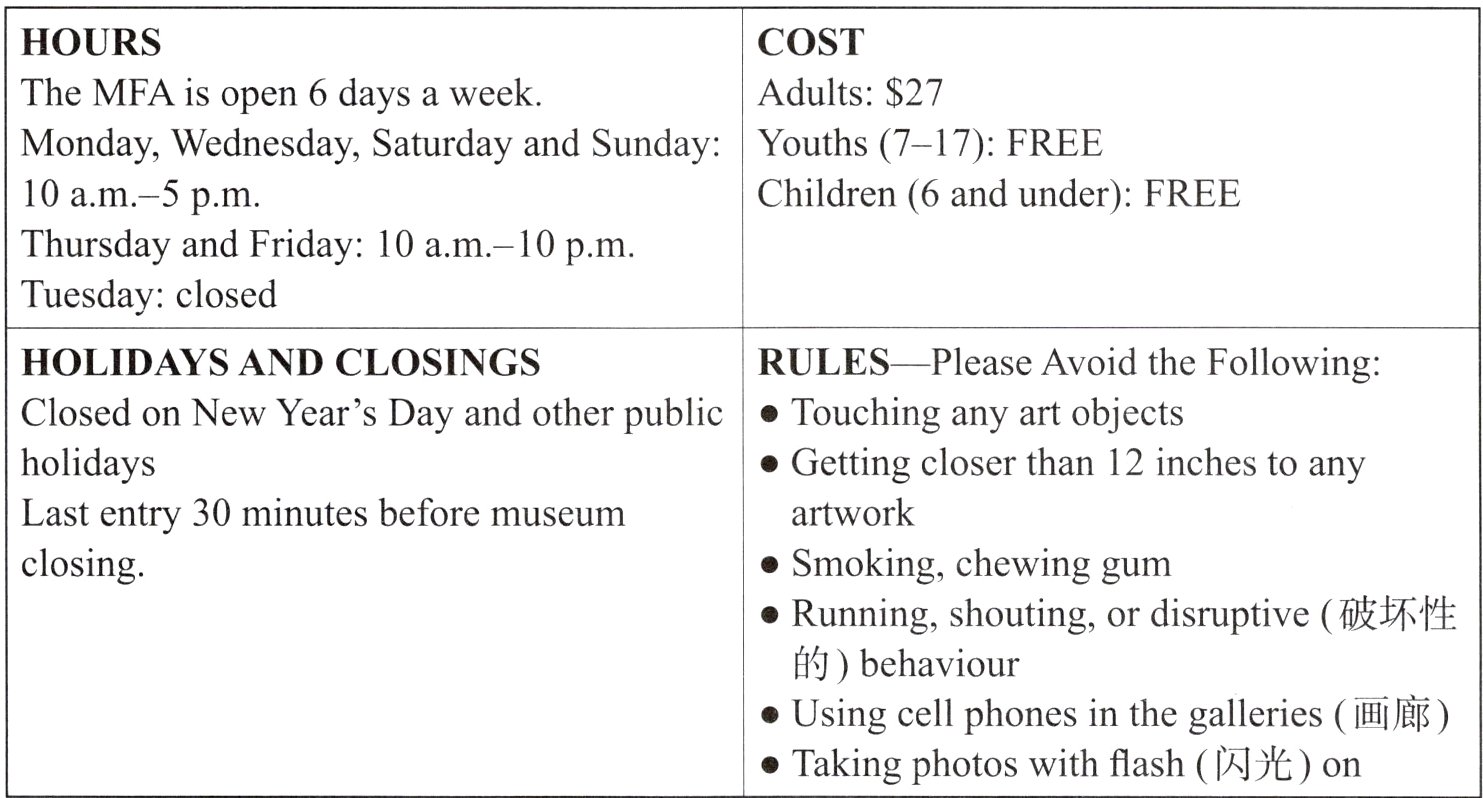
( ) 31. On which day can you stay the longest at the museum?
A. New Year’s Day. B. Friday. C. Tuesday. D. Sunday.
( ) 32. How much will middle - aged parents with a 10 - year - old boy and 5 - year - old girl have to pay for a visit?
A. $50. B. $46. C. $73. D. $54.
( ) 33. Which of the following is true according to the rules?
A. You can move the art object if it is necessary.
B. You should keep your distance from the artworks.
C. You can take photos of the artworks with flash on.
D. You can use your cell phone anywhere in the museum.
B
The famous Spanish painter Pablo Picasso once said, “Every child is an artist. The problem he has is how to remain an artist once he grows up.”
This is both encouraging and discouraging: the fact that we were all born to be artists is certainly exciting, and yet the reality has proved that remaining one is a task that many of us have failed.
Fortunately, some people have seen the problem and want to solve it.
Some educators have suggested that we introduce the concept (理念) of “STEAM” instead of “STEM”—traditional “core majors (核心专业)” including science, technology, engineering, and maths—since the “A”, which stands for “arts”, is just as important.
And years ago, China’s Ministry of Education issued a guideline. Colleges and universities were required to provide more art - related courses and students needed to earn a certain number of art credits (学分) in order to graduate.
These efforts came after many scientific studies have found that art education helps students develop self - confidence and teamwork skills, as well as habits of mind such as problem solving and critical thinking (批判性思维), according to a survey.
It’s true that none of these skills target (针对) specific jobs. But as the former American ballet dancer Damian Woetzel said, the purpose of art is “to give kids the tools to become adults who are creative, adaptable (适应性强的), and expressive—capable (有能力的) of having their eyes and ears and senses alive”.
And we can now see how we lost track of our born “artist self” on our way to growing up. We failed to keep our capabilities to see, hear and feel, and became blind, deaf and insensitive (迟钝的) adults.
Hopefully, art education can help turn things around.
( ) 34. What does the writer mean by showing Picasso’s words?
A. Everybody can be an artist.
B. Adults have no artistic gift.
C. People change as they grow up.
D. Children are more gifted than adults.
( ) 35. The guideline of China’s Ministry of Education is mainly about __________.
A. university students should earn enough art credits to graduate
B. the college entrance exam should include at least one art test
C. art credits should be the most important in university degrees
D. art - related courses should replace certain subjects in colleges
( ) 36. The writer mentions the American ballet dancer Damian Woetzel to __________.
A. give a good example of scientific studies
B. encourage children to learn how to dance
C. show dancers would have a brighter future
D. point out the value of children’s art education
( ) 37. How does the writer feel about art education?
A. Hopeful. B. Doubtful. C. Worried. D. Excited.
C
For years, it has been said that newspapers are about to disappear. Every year brings more news of closing. But why is the situation so terrible for newspapers?
Newspapers have a long history. The first newspaper was printed in the 1600s. The industry witnessed its most successful periods in the early 20th century.
With the appearance of radio and TV, however, the number of copies of newspaper that were sold began to fall. By the mid - 20th century, radio and TV had become so popular that people no longer had to depend on newspapers for news. That was especially true of breaking news.
Afternoon newspapers were the first to become worse. People coming home from work increasingly turned on the TV, instead of opening a newspaper. But generally, newspapers still managed to survive. Although TV had the advantage of speed, newspapers could provide in - depth reports that TV news could not.
But newspapers became worse after another heavier blow in the 1990s. With the appearance of the Internet, large amounts of information became free. Many newspaper readers realized that they could easily read news online for free. There seemed to be little reason to pay for a newspaper.
So what does the future hold? Will newspapers die? Maybe not. Many newspapers are now changing. Some are going digital. Some are going farther and taking the industry to places it has never been to. After all, people still want the news. And many agree that newspapers are still an important source of in - depth news, analysis (分析) and ideas. If newspapers disappear completely, there will be nothing to take their place.
( ) 38. The underlined part “breaking news” probably means news of events that __________.
A. make people sad B. have just happened C. are about famous people D. happen in other countries
( ) 39. How did newspapers manage to survive against competition from TV?
A. By going digital. B. By working with TV. C. By including more pictures. D. By centring on in - depth reports.
( ) 40. Newspapers became worse again in the 1990s because __________.
A. people lost interest in reading news B. newspapers became more expensive C. TV started to centre on in - depth news D. people could read news online for free
( ) 41. Which of the following would the author agree with?
A. The future of newspapers is very bright. B. The future of newspapers is still uncertain. C. Many newspapers will die in the near future. D. Afternoon newspapers will become popular again.
D
“Pull up the window shade. I want to see,” Johnsy ordered, quietly.
Sue obeyed.
After the beating rain and strong wind that blew through the night, there yet stood against the wall one ivy (常春藤) leaf. It was the last one. It was still dark green at the center. But its edges (边缘) were colored with yellow.
“It is the last one,” said Johnsy. “I thought it would surely fall during the night. I heard the wind. It will fall today and I shall die at the same time.”
“Dear, dear!” said Sue. “Think of me, if you won’t think of yourself. What would I do?”
But Johnsy did not answer.
The next morning, the ivy leaf was still there. Johnsy lay for a long time, looking at it. And then she called to Sue, who was preparing chicken soup.
“I’ve been a bad girl,” said Johnsy. “Something has made that last leaf stay there to show me how bad I was. It is wrong to want to die. You may bring me a little soup now.”
An hour later she said, “Someday I hope to paint the Eiffel Tower.”
Later in the day, the doctor came, and Sue talked to him in the hallway.
“Equal chances. With good care, you’ll win,” said the doctor. “And now I must see another case I have in your building. Behrman, his name is some kind of an artist, I believe. Pneumonia (肺炎), too. He is old and weak. There is no hope for him.”
The next day, the doctor said to Sue, “She’s out of danger. You won. Nutrition (营养) and care now—that’s all.”
Later that day, Sue came to the bed where Johnsy lay, and put one arm around her.
“I have something to tell you,” she said. “Mr Behrman died of pneumonia today in the hospital. He was sick only two days. They found him the morning of the first day in his room downstairs helpless with pain. His shoes and clothing were completely wet and icy cold. They didn’t know where he had been on such a terrible night. And then they found a lantern, still lighted. And oil paints and a painting board with green and yellow colors mixed on it. And look out of the window, dear, at the last ivy leaf on the wall. Didn’t you wonder why it never moved when the wind blew? Ah, dear, it is Behrman’s excellent work—he painted it there the night that the last leaf fell.”
( ) 42. What can we infer from the passage?
A. The doctor thought they should let Johnsy go.
B. Sue had no idea how to cheer Johnsy up.
C. Johnsy was sorry to have kept Sue busy.
D. Behrman was a world - famous painter.
( ) 43. Which of the following shows the right order of the story?
a. Johnsy was sent to the hospital.
b. Behrman painted the last ivy leaf.
c. Johnsy found herself totally wrong.
d. Behrman died of pneumonia.
e. Johnsy had strange ideas in her mind.
A. a - b - e - d - c B. e - d - a - c - b C. a - e - b - c - d D. e - b - a - c - d
( ) 44. What do you think of Sue?
A. She’s creative. B. She’s selfish. C. She’s humorous. D. She’s patient.
( ) 45. What would be the best title for this story?
A. The last leaf B. Kind - hearted Behrman C. True friendship D. A rainy and windy day
A
Museum of Fine Arts (MFA), Boston
( ) 31. On which day can you stay the longest at the museum?
A. New Year’s Day. B. Friday. C. Tuesday. D. Sunday.
( ) 32. How much will middle - aged parents with a 10 - year - old boy and 5 - year - old girl have to pay for a visit?
A. $50. B. $46. C. $73. D. $54.
( ) 33. Which of the following is true according to the rules?
A. You can move the art object if it is necessary.
B. You should keep your distance from the artworks.
C. You can take photos of the artworks with flash on.
D. You can use your cell phone anywhere in the museum.
B
The famous Spanish painter Pablo Picasso once said, “Every child is an artist. The problem he has is how to remain an artist once he grows up.”
This is both encouraging and discouraging: the fact that we were all born to be artists is certainly exciting, and yet the reality has proved that remaining one is a task that many of us have failed.
Fortunately, some people have seen the problem and want to solve it.
Some educators have suggested that we introduce the concept (理念) of “STEAM” instead of “STEM”—traditional “core majors (核心专业)” including science, technology, engineering, and maths—since the “A”, which stands for “arts”, is just as important.
And years ago, China’s Ministry of Education issued a guideline. Colleges and universities were required to provide more art - related courses and students needed to earn a certain number of art credits (学分) in order to graduate.
These efforts came after many scientific studies have found that art education helps students develop self - confidence and teamwork skills, as well as habits of mind such as problem solving and critical thinking (批判性思维), according to a survey.
It’s true that none of these skills target (针对) specific jobs. But as the former American ballet dancer Damian Woetzel said, the purpose of art is “to give kids the tools to become adults who are creative, adaptable (适应性强的), and expressive—capable (有能力的) of having their eyes and ears and senses alive”.
And we can now see how we lost track of our born “artist self” on our way to growing up. We failed to keep our capabilities to see, hear and feel, and became blind, deaf and insensitive (迟钝的) adults.
Hopefully, art education can help turn things around.
( ) 34. What does the writer mean by showing Picasso’s words?
A. Everybody can be an artist.
B. Adults have no artistic gift.
C. People change as they grow up.
D. Children are more gifted than adults.
( ) 35. The guideline of China’s Ministry of Education is mainly about __________.
A. university students should earn enough art credits to graduate
B. the college entrance exam should include at least one art test
C. art credits should be the most important in university degrees
D. art - related courses should replace certain subjects in colleges
( ) 36. The writer mentions the American ballet dancer Damian Woetzel to __________.
A. give a good example of scientific studies
B. encourage children to learn how to dance
C. show dancers would have a brighter future
D. point out the value of children’s art education
( ) 37. How does the writer feel about art education?
A. Hopeful. B. Doubtful. C. Worried. D. Excited.
C
For years, it has been said that newspapers are about to disappear. Every year brings more news of closing. But why is the situation so terrible for newspapers?
Newspapers have a long history. The first newspaper was printed in the 1600s. The industry witnessed its most successful periods in the early 20th century.
With the appearance of radio and TV, however, the number of copies of newspaper that were sold began to fall. By the mid - 20th century, radio and TV had become so popular that people no longer had to depend on newspapers for news. That was especially true of breaking news.
Afternoon newspapers were the first to become worse. People coming home from work increasingly turned on the TV, instead of opening a newspaper. But generally, newspapers still managed to survive. Although TV had the advantage of speed, newspapers could provide in - depth reports that TV news could not.
But newspapers became worse after another heavier blow in the 1990s. With the appearance of the Internet, large amounts of information became free. Many newspaper readers realized that they could easily read news online for free. There seemed to be little reason to pay for a newspaper.
So what does the future hold? Will newspapers die? Maybe not. Many newspapers are now changing. Some are going digital. Some are going farther and taking the industry to places it has never been to. After all, people still want the news. And many agree that newspapers are still an important source of in - depth news, analysis (分析) and ideas. If newspapers disappear completely, there will be nothing to take their place.
( ) 38. The underlined part “breaking news” probably means news of events that __________.
A. make people sad B. have just happened C. are about famous people D. happen in other countries
( ) 39. How did newspapers manage to survive against competition from TV?
A. By going digital. B. By working with TV. C. By including more pictures. D. By centring on in - depth reports.
( ) 40. Newspapers became worse again in the 1990s because __________.
A. people lost interest in reading news B. newspapers became more expensive C. TV started to centre on in - depth news D. people could read news online for free
( ) 41. Which of the following would the author agree with?
A. The future of newspapers is very bright. B. The future of newspapers is still uncertain. C. Many newspapers will die in the near future. D. Afternoon newspapers will become popular again.
D
“Pull up the window shade. I want to see,” Johnsy ordered, quietly.
Sue obeyed.
After the beating rain and strong wind that blew through the night, there yet stood against the wall one ivy (常春藤) leaf. It was the last one. It was still dark green at the center. But its edges (边缘) were colored with yellow.
“It is the last one,” said Johnsy. “I thought it would surely fall during the night. I heard the wind. It will fall today and I shall die at the same time.”
“Dear, dear!” said Sue. “Think of me, if you won’t think of yourself. What would I do?”
But Johnsy did not answer.
The next morning, the ivy leaf was still there. Johnsy lay for a long time, looking at it. And then she called to Sue, who was preparing chicken soup.
“I’ve been a bad girl,” said Johnsy. “Something has made that last leaf stay there to show me how bad I was. It is wrong to want to die. You may bring me a little soup now.”
An hour later she said, “Someday I hope to paint the Eiffel Tower.”
Later in the day, the doctor came, and Sue talked to him in the hallway.
“Equal chances. With good care, you’ll win,” said the doctor. “And now I must see another case I have in your building. Behrman, his name is some kind of an artist, I believe. Pneumonia (肺炎), too. He is old and weak. There is no hope for him.”
The next day, the doctor said to Sue, “She’s out of danger. You won. Nutrition (营养) and care now—that’s all.”
Later that day, Sue came to the bed where Johnsy lay, and put one arm around her.
“I have something to tell you,” she said. “Mr Behrman died of pneumonia today in the hospital. He was sick only two days. They found him the morning of the first day in his room downstairs helpless with pain. His shoes and clothing were completely wet and icy cold. They didn’t know where he had been on such a terrible night. And then they found a lantern, still lighted. And oil paints and a painting board with green and yellow colors mixed on it. And look out of the window, dear, at the last ivy leaf on the wall. Didn’t you wonder why it never moved when the wind blew? Ah, dear, it is Behrman’s excellent work—he painted it there the night that the last leaf fell.”
( ) 42. What can we infer from the passage?
A. The doctor thought they should let Johnsy go.
B. Sue had no idea how to cheer Johnsy up.
C. Johnsy was sorry to have kept Sue busy.
D. Behrman was a world - famous painter.
( ) 43. Which of the following shows the right order of the story?
a. Johnsy was sent to the hospital.
b. Behrman painted the last ivy leaf.
c. Johnsy found herself totally wrong.
d. Behrman died of pneumonia.
e. Johnsy had strange ideas in her mind.
A. a - b - e - d - c B. e - d - a - c - b C. a - e - b - c - d D. e - b - a - c - d
( ) 44. What do you think of Sue?
A. She’s creative. B. She’s selfish. C. She’s humorous. D. She’s patient.
( ) 45. What would be the best title for this story?
A. The last leaf B. Kind - hearted Behrman C. True friendship D. A rainy and windy day
答案:
31—33 BDB 34—37 AADA 38—41 BDDB 42—45 BCDA
查看更多完整答案,请扫码查看

