

 搜索
搜索
第11页
- 第1页
- 第2页
- 第3页
- 第4页
- 第5页
- 第6页
- 第7页
- 第8页
- 第9页
- 第10页
- 第11页
- 第12页
- 第13页
- 第14页
- 第15页
- 第16页
- 第17页
- 第18页
- 第19页
- 第20页
- 第21页
- 第22页
- 第23页
- 第24页
- 第25页
- 第26页
- 第27页
- 第28页
- 第29页
- 第30页
- 第31页
- 第32页
- 第33页
- 第34页
- 第35页
- 第36页
- 第37页
- 第38页
- 第39页
- 第40页
- 第41页
- 第42页
- 第43页
- 第44页
- 第45页
- 第46页
- 第47页
- 第48页
- 第49页
- 第50页
- 第51页
- 第52页
- 第53页
- 第54页
- 第55页
- 第56页
- 第57页
- 第58页
- 第59页
- 第60页
- 第61页
- 第62页
- 第63页
- 第64页
- 第65页
- 第66页
- 第67页
- 第68页
- 第69页
- 第70页
- 第71页
- 第72页
- 第73页
- 第74页
- 第75页
- 第76页
- 第77页
- 第78页
- 第79页
- 第80页
- 第81页
- 第82页
- 第83页
- 第84页
- 第85页
- 第86页
- 第87页
- 第88页
- 第89页
- 第90页
- 第91页
- 第92页
- 第93页
- 第94页
- 第95页
- 第96页
- 第97页
- 第98页
- 第99页
- 第100页
- 第101页
- 第102页
- 第103页
- 第104页
- 第105页
- 第106页
- 第107页
- 第108页
- 第109页
- 第110页
- 第111页
- 第112页
- 第113页
- 第114页
- 第115页
- 第116页
- 第117页
- 第118页
- 第119页
四、阅读短文,从短文后所给的七个选项中选出五个能填入空白处的最佳选项
They say that “travel is the best teacher” and there is no better example of this idea than the Ming Dynasty travel writer and geographer Xu Xiake (1587–1641). His book, The Travel Notes of Xu Xiake, not only encourages a love of travelling among Chinese people, but provides important scientific information about the country's land and geography.
Born into a wealthy Jiangyin family, Xu became interested in books about different places at an early age and wanted to travel. 1 He then was responsible for the family farm and taking care of his 60-year-old mother as the tradition required.
2 Understanding her son's love of travelling and valuing the knowledge he could get from such experiences, this modern-thinking woman refused to keep her son at home. She agreed that Xu could travel for three months every year, when there was less farm work.
So at the age of 20 and with his mother's support, Xu set off for the first time, leaving behind not only his mother but his new wife as well. 3 During this time, he travelled throughout the Ming kingdom, carefully studying the lands he passed through and recording his experiences and many discoveries in a diary. This diary, which once had over 600,000 words, would eventually become The Travel Notes of Xu Xiake.
4 This way he could research the environment in detail and get a true picture of the natural world. Many of his trips were to hard-to-reach mountain areas, and through wild forests where few people lived. His willingness to face hardships came at a cost, however. Progress was slow and tiring and he was frequently sick, robbed and beaten during his journeys.
Sadly, Xu became seriously ill during his last and longest journey, a four-year trip through the south-west of China. 5 When his diary was finally printed years after his death, much of it had been destroyed or lost. Although incomplete, it still made Xu a travelling legend (传奇) around the world.
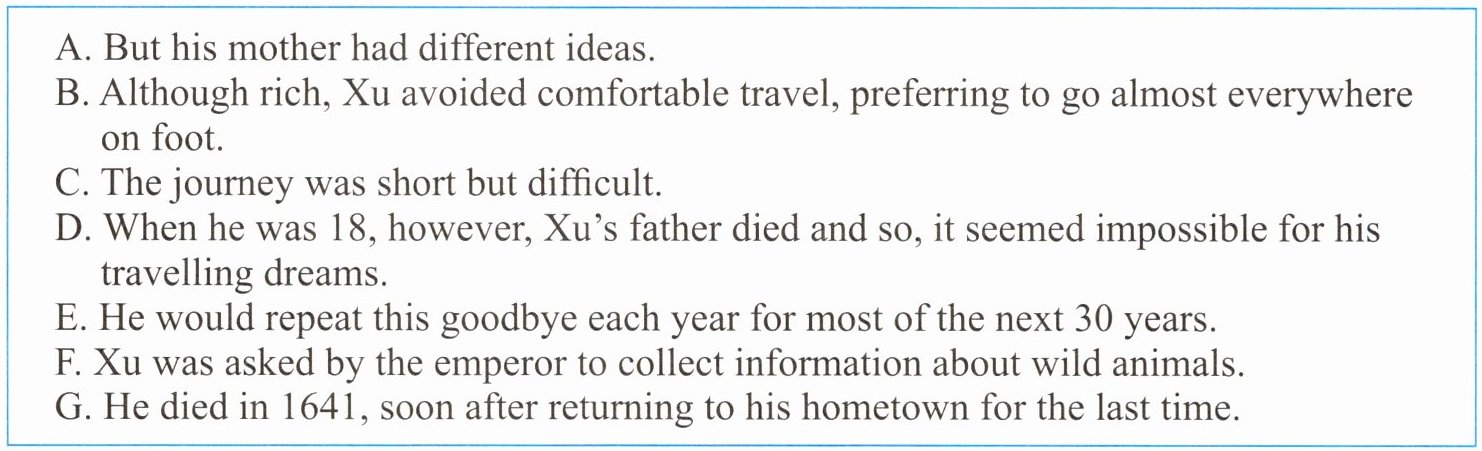
A. But his mother had different ideas.
B. Although rich, Xu avoided comfortable travel, preferring to go almost everywhere on foot.
C. The journey was short but difficult.
D. When he was 18, however, Xu's father died and so, it seemed impossible for his travelling dreams.
E. He would repeat this goodbye each year for most of the next 30 years.
F. Xu was asked by the emperor to collect information about wild animals.
G. He died in 1641, soon after returning to his hometown for the last time.
1.
2.
3.
4.
5.
They say that “travel is the best teacher” and there is no better example of this idea than the Ming Dynasty travel writer and geographer Xu Xiake (1587–1641). His book, The Travel Notes of Xu Xiake, not only encourages a love of travelling among Chinese people, but provides important scientific information about the country's land and geography.
Born into a wealthy Jiangyin family, Xu became interested in books about different places at an early age and wanted to travel. 1 He then was responsible for the family farm and taking care of his 60-year-old mother as the tradition required.
2 Understanding her son's love of travelling and valuing the knowledge he could get from such experiences, this modern-thinking woman refused to keep her son at home. She agreed that Xu could travel for three months every year, when there was less farm work.
So at the age of 20 and with his mother's support, Xu set off for the first time, leaving behind not only his mother but his new wife as well. 3 During this time, he travelled throughout the Ming kingdom, carefully studying the lands he passed through and recording his experiences and many discoveries in a diary. This diary, which once had over 600,000 words, would eventually become The Travel Notes of Xu Xiake.
4 This way he could research the environment in detail and get a true picture of the natural world. Many of his trips were to hard-to-reach mountain areas, and through wild forests where few people lived. His willingness to face hardships came at a cost, however. Progress was slow and tiring and he was frequently sick, robbed and beaten during his journeys.
Sadly, Xu became seriously ill during his last and longest journey, a four-year trip through the south-west of China. 5 When his diary was finally printed years after his death, much of it had been destroyed or lost. Although incomplete, it still made Xu a travelling legend (传奇) around the world.
A. But his mother had different ideas.
B. Although rich, Xu avoided comfortable travel, preferring to go almost everywhere on foot.
C. The journey was short but difficult.
D. When he was 18, however, Xu's father died and so, it seemed impossible for his travelling dreams.
E. He would repeat this goodbye each year for most of the next 30 years.
F. Xu was asked by the emperor to collect information about wild animals.
G. He died in 1641, soon after returning to his hometown for the last time.
1.
D
2.
A
3.
E
4.
B
5.
G
答案:
1.D 2.A 3.E 4.B 5.G
查看更多完整答案,请扫码查看

