

 搜索
搜索
第21页
- 第1页
- 第2页
- 第3页
- 第4页
- 第5页
- 第6页
- 第7页
- 第8页
- 第9页
- 第10页
- 第11页
- 第12页
- 第13页
- 第14页
- 第15页
- 第16页
- 第17页
- 第18页
- 第19页
- 第20页
- 第21页
- 第22页
- 第23页
- 第24页
- 第25页
- 第26页
- 第27页
- 第28页
- 第29页
- 第30页
- 第31页
- 第32页
- 第33页
- 第34页
- 第35页
- 第36页
- 第37页
- 第38页
- 第39页
- 第40页
- 第41页
- 第42页
- 第43页
- 第44页
- 第45页
- 第46页
- 第47页
- 第48页
- 第49页
- 第50页
- 第51页
- 第52页
- 第53页
- 第54页
- 第55页
- 第56页
- 第57页
- 第58页
- 第59页
- 第60页
- 第61页
- 第62页
- 第63页
- 第64页
- 第65页
- 第66页
- 第67页
- 第68页
- 第69页
- 第70页
- 第71页
- 第72页
- 第73页
- 第74页
- 第75页
- 第76页
- 第77页
- 第78页
- 第79页
- 第80页
- 第81页
- 第82页
- 第83页
- 第84页
- 第85页
- 第86页
- 第87页
- 第88页
- 第89页
- 第90页
- 第91页
- 第92页
- 第93页
- 第94页
- 第95页
- 第96页
- 第97页
- 第98页
- 第99页
- 第100页
1. until
【感知】
- Can I stay out until eleven?(教材第 15 页)我可以在外面待到 11 点吗?
- The child cried until his mother came back. 这个孩子一直哭,直到他妈妈回来。
- We didn’t know the truth until he told us. 直到他告诉我们,我们才知道真相。
【探究】
(1) until 作介词,意为“____”,其后跟名词、名词短语或时间点。
(2) until 作连词,意为“到……时;直到……为止”,后跟句子。用于肯定句时,主句谓语动词需为可持续动作或状态。与 not 连用构成“not... until...”结构,意为“____”,此时主句谓语动词常为瞬时动作。
【应用】
【感知】
- Can I stay out until eleven?(教材第 15 页)我可以在外面待到 11 点吗?
- The child cried until his mother came back. 这个孩子一直哭,直到他妈妈回来。
- We didn’t know the truth until he told us. 直到他告诉我们,我们才知道真相。
【探究】
(1) until 作介词,意为“____”,其后跟名词、名词短语或时间点。
(2) until 作连词,意为“到……时;直到……为止”,后跟句子。用于肯定句时,主句谓语动词需为可持续动作或状态。与 not 连用构成“not... until...”结构,意为“____”,此时主句谓语动词常为瞬时动作。
【应用】
答案:
(1)直到……为止
(2)直到……才……
(1)直到……为止
(2)直到……才……
完成句子
① 吉姆在完成他的工作之前不会回家。
Jim will ____ go home ____ he finishes his work.
② 放轻松。我们将一直支持你,直到你完成比赛。
Take it easy. We will support you all the time ____ you ____ the race.
① 吉姆在完成他的工作之前不会回家。
Jim will ____ go home ____ he finishes his work.
② 放轻松。我们将一直支持你,直到你完成比赛。
Take it easy. We will support you all the time ____ you ____ the race.
答案:
①not; until ②until; finish
2. dead
【感知】
- You want to call your parents, but your phone is dead.(教材第 15 页)你想给父母打电话,但你的手机没电了。
- I’m sorry to hear about the death of my favourite writer this morning. 今天早上听到我最喜欢的作家去世的消息,我感到很遗憾。
- My dog died five days ago. 我的狗在五天前死了。
- I will remember it to my dying day. 我至死都不会忘记此事。
【探究】
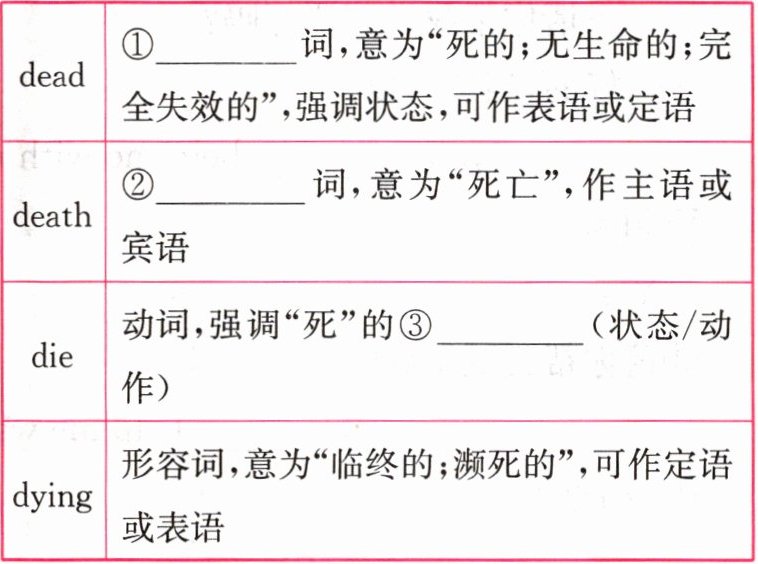
dead,death,die 与 dying 的用法辨析
| | |
| dead | ①____词,意为“死的;无生命的;完全失效的”,强调状态,可作表语或定语 |
| death | ②____词,意为“死亡”,作主语或宾语 |
| die | 动词,强调“死”的③____(状态/动作) |
| dying | 形容词,意为“临终的;濒死的”,可作定语或表语 |
【应用】
【感知】
- You want to call your parents, but your phone is dead.(教材第 15 页)你想给父母打电话,但你的手机没电了。
- I’m sorry to hear about the death of my favourite writer this morning. 今天早上听到我最喜欢的作家去世的消息,我感到很遗憾。
- My dog died five days ago. 我的狗在五天前死了。
- I will remember it to my dying day. 我至死都不会忘记此事。
【探究】
dead,death,die 与 dying 的用法辨析
| | |
| dead | ①____词,意为“死的;无生命的;完全失效的”,强调状态,可作表语或定语 |
| death | ②____词,意为“死亡”,作主语或宾语 |
| die | 动词,强调“死”的③____(状态/动作) |
| dying | 形容词,意为“临终的;濒死的”,可作定语或表语 |
【应用】
答案:
①形容 ②名 ③动作
用所给单词的适当形式填空
① The people built that tower to honour the ____(die)soldiers.
② The sudden ____(die)of the pet dog made the little boy very sad.
③ His pet dog ____(die)and he was sad for a long time.
① The people built that tower to honour the ____(die)soldiers.
② The sudden ____(die)of the pet dog made the little boy very sad.
③ His pet dog ____(die)and he was sad for a long time.
答案:
①dead ②death ③died
查看更多完整答案,请扫码查看

