

 搜索
搜索
第52页
- 第2页
- 第3页
- 第4页
- 第5页
- 第6页
- 第7页
- 第8页
- 第9页
- 第10页
- 第11页
- 第12页
- 第13页
- 第14页
- 第15页
- 第16页
- 第17页
- 第18页
- 第19页
- 第20页
- 第21页
- 第22页
- 第23页
- 第24页
- 第25页
- 第26页
- 第27页
- 第28页
- 第29页
- 第30页
- 第31页
- 第32页
- 第33页
- 第34页
- 第35页
- 第36页
- 第37页
- 第38页
- 第39页
- 第40页
- 第41页
- 第42页
- 第43页
- 第44页
- 第45页
- 第46页
- 第47页
- 第48页
- 第49页
- 第50页
- 第51页
- 第52页
- 第53页
- 第54页
- 第55页
- 第56页
- 第57页
- 第58页
- 第59页
- 第60页
- 第61页
- 第62页
- 第63页
- 第64页
- 第65页
- 第66页
- 第67页
- 第68页
- 第69页
- 第70页
- 第71页
- 第72页
一 用所给内容的适当形式填空。
1. —Is someone ______ (smoke)?
—Yes. I can smell it.
2. The signs ______ (mean) you can't shout in the reading room.
3. ______ (not park) your car over there, sir.
4. Mike and Liu Tao can buy new clothes at the ______ (shop) centre.
5. Harry ______ (not eat) any snacks before bedtime every day.
1. —Is someone ______ (smoke)?
—Yes. I can smell it.
2. The signs ______ (mean) you can't shout in the reading room.
3. ______ (not park) your car over there, sir.
4. Mike and Liu Tao can buy new clothes at the ______ (shop) centre.
5. Harry ______ (not eat) any snacks before bedtime every day.
答案:
【解析】:
这道题目是英语填空题,主要考查的是动词时态和语态的正确使用,以及根据语境理解选择合适的动词形式。题目给出了五个句子,每个句子中都有一个空白处需要填写适当的动词形式。
1. 第一句是一个现在进行时的一般疑问句,需要用现在分词形式。
2. 第二句描述的是标志牌的意义,使用一般现在时。
3. 第三句是一个否定祈使句,需要用动词原形的前面加上don't。
4. 第四句描述的是一个购物中心,需要用形容词形式。
5. 第五句是一个一般现在时的否定句,需要用第三人称单数的否定形式。
【答案】:
1. —Is someone $smoking$? —Yes. I can smell it.
2. The signs $mean$ you can't shout in the reading room.
3. $Don't park$ your car over there, sir.
4. Mike and Liu Tao can buy new clothes at the $shopping$ centre.
5. Harry $doesn't eat$ any snacks before bedtime every day.
这道题目是英语填空题,主要考查的是动词时态和语态的正确使用,以及根据语境理解选择合适的动词形式。题目给出了五个句子,每个句子中都有一个空白处需要填写适当的动词形式。
1. 第一句是一个现在进行时的一般疑问句,需要用现在分词形式。
2. 第二句描述的是标志牌的意义,使用一般现在时。
3. 第三句是一个否定祈使句,需要用动词原形的前面加上don't。
4. 第四句描述的是一个购物中心,需要用形容词形式。
5. 第五句是一个一般现在时的否定句,需要用第三人称单数的否定形式。
【答案】:
1. —Is someone $smoking$? —Yes. I can smell it.
2. The signs $mean$ you can't shout in the reading room.
3. $Don't park$ your car over there, sir.
4. Mike and Liu Tao can buy new clothes at the $shopping$ centre.
5. Harry $doesn't eat$ any snacks before bedtime every day.
二 英汉互译。
1. —Is there a ______ (购物中心) near your house?
—Yes, there is.
2. Don't ______ (走进) the teachers' office. They are having a meeting.
3. You should ______ (把你的书带入) the music room.
4. What should we do when we see the sign "______ (地面湿滑)." ?
5. The park is not far from here. Let's ______ (继续走路).
6. ______ (墙上的那个标志的意思是) you can't eat here.
7. Jack ______ (带了一些面条到学校作为午饭) yesterday.
8. It is ______ (一个危险的地方). You should ______ (小心).
9. We should learn more about school rules. ______
10. We saw some public signs in the library yesterday. ______
1. —Is there a ______ (购物中心) near your house?
—Yes, there is.
2. Don't ______ (走进) the teachers' office. They are having a meeting.
3. You should ______ (把你的书带入) the music room.
4. What should we do when we see the sign "______ (地面湿滑)." ?
5. The park is not far from here. Let's ______ (继续走路).
6. ______ (墙上的那个标志的意思是) you can't eat here.
7. Jack ______ (带了一些面条到学校作为午饭) yesterday.
8. It is ______ (一个危险的地方). You should ______ (小心).
9. We should learn more about school rules. ______
10. We saw some public signs in the library yesterday. ______
答案:
1. shopping mall
2. go into
3. take your books into
4. Wet floor
5. walk on
6. The sign on the wall means
7. brought some noodles to school for lunch
8. a dangerous place; be careful
9. 我们应该学习更多关于校规的知识。
10. 昨天我们在图书馆看到了一些公共标识。
2. go into
3. take your books into
4. Wet floor
5. walk on
6. The sign on the wall means
7. brought some noodles to school for lunch
8. a dangerous place; be careful
9. 我们应该学习更多关于校规的知识。
10. 昨天我们在图书馆看到了一些公共标识。
三 从方框中选择合适的选项完成句子。(只写字母标号,有多余项)
A. with B. of C. for D. on E. at
1. We can make friends ______ the Internet now.
2. We are waiting ______ our friends in the park.
3. We can make a sentence ______ "smoke".
4. Li Ming is looking out ______ the window. He sees a little bird in the tree.
A. with B. of C. for D. on E. at
1. We can make friends ______ the Internet now.
2. We are waiting ______ our friends in the park.
3. We can make a sentence ______ "smoke".
4. Li Ming is looking out ______ the window. He sees a little bird in the tree.
答案:
【解析】:
这道题目考查的是英语介词的使用。对于不同的场景和语境,需要选择合适的介词来填空。
1. 第一个句子中有"the Internet",表示“在互联网上”,通常用介词"on",所以选择D。
2. 第二个句子中有"waiting"和"our friends",表示“等待朋友”,常用搭配是"wait for sb",所以选择C。
3. 第三个句子中有"make a sentence"和"smoke",表示“用...造句”,常用搭配是"make a sentence with...",所以选择A。
4. 第四个句子中有"looking out"和"the window",表示“向窗外看”,常用搭配是"look out of the window",所以选择B。
【答案】:
1. D
2. C
3. A
4. B
这道题目考查的是英语介词的使用。对于不同的场景和语境,需要选择合适的介词来填空。
1. 第一个句子中有"the Internet",表示“在互联网上”,通常用介词"on",所以选择D。
2. 第二个句子中有"waiting"和"our friends",表示“等待朋友”,常用搭配是"wait for sb",所以选择C。
3. 第三个句子中有"make a sentence"和"smoke",表示“用...造句”,常用搭配是"make a sentence with...",所以选择A。
4. 第四个句子中有"looking out"和"the window",表示“向窗外看”,常用搭配是"look out of the window",所以选择B。
【答案】:
1. D
2. C
3. A
4. B
( )1.Li Dong knows ______ public signs.
A.a lot
B.a lot of about
C.a lot about
A.a lot
B.a lot of about
C.a lot about
答案:
【解析】:
本题主要考查对英语短语和语法的掌握。题目中的关键信息是“Li Dong knows ______ public signs”,需要找到一个合适的短语填入空白处。
A选项“a lot”通常用于表示数量很多,但后面不直接跟名词,如果后面要接名词,通常需要加“of”,所以A选项在这里不合适。
B选项“a lot of about”在语法上是不正确的,“a lot of”后面应该直接跟名词,而不需要再加“about”,所以B选项也不合适。
C选项“a lot about”表示“很多关于……”,在这里就表示“李东知道很多关于公共标志的信息”,这既符合语法规则,也符合题目要求。
【答案】:
C
本题主要考查对英语短语和语法的掌握。题目中的关键信息是“Li Dong knows ______ public signs”,需要找到一个合适的短语填入空白处。
A选项“a lot”通常用于表示数量很多,但后面不直接跟名词,如果后面要接名词,通常需要加“of”,所以A选项在这里不合适。
B选项“a lot of about”在语法上是不正确的,“a lot of”后面应该直接跟名词,而不需要再加“about”,所以B选项也不合适。
C选项“a lot about”表示“很多关于……”,在这里就表示“李东知道很多关于公共标志的信息”,这既符合语法规则,也符合题目要求。
【答案】:
C
( )2.You can't ______ here. Here's a sign saying "No ______."
A.smoke; smoking
B.smoke; smoke
C.smoking; smoking
A.smoke; smoking
B.smoke; smoke
C.smoking; smoking
答案:
【解析】:本题主要考查情态动词后接动词原形以及名词的用法。
1. 分析句子结构,`You can't ______ here.` 中,`can't` 是情态动词 `can` 的否定形式,情态动词后应接动词原形,所以第一个空应填 `smoke`。
2. 分析 `Here's a sign saying "No ______."`,`No` 在这里作为限定词,后面常接名词或动名词,表示禁止做某事。`No smoking` 是一个常见的表达,意为“禁止吸烟”。所以第二个空应填 `smoking`。
3. 对比选项,A 选项 `smoke; smoking` 符合上述分析,B 选项 `smoke; smoke` 中第二个空不符合 `No` 后接名词或动名词的规则,C 选项 `smoking; smoking` 中第一个空不符合情态动词后接动词原形的规则。
【答案】:A
1. 分析句子结构,`You can't ______ here.` 中,`can't` 是情态动词 `can` 的否定形式,情态动词后应接动词原形,所以第一个空应填 `smoke`。
2. 分析 `Here's a sign saying "No ______."`,`No` 在这里作为限定词,后面常接名词或动名词,表示禁止做某事。`No smoking` 是一个常见的表达,意为“禁止吸烟”。所以第二个空应填 `smoking`。
3. 对比选项,A 选项 `smoke; smoking` 符合上述分析,B 选项 `smoke; smoke` 中第二个空不符合 `No` 后接名词或动名词的规则,C 选项 `smoking; smoking` 中第一个空不符合情态动词后接动词原形的规则。
【答案】:A
( )3.—Where can you find the sign ?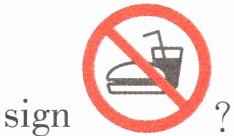
—We can find it in a ______.
A.library
B.restaurant
C.juice shop
—We can find it in a ______.
A.library
B.restaurant
C.juice shop
答案:
【解析】:这是一道英语题目,考查的是对特定标志含义的理解以及场所的匹配。题目中给出了一个禁止饮食的标志,我们需要根据这个标志的含义,选择出它可能出现的场所。
A选项library是图书馆,图书馆通常需要保持安静和整洁,因此禁止饮食是合理的;
B选项restaurant是餐馆,餐馆是允许饮食的,所以不符合标志的含义;
C选项juice shop是果汁店,同样也是允许饮食的,也不符合标志的含义。
因此,我们可以确定这个标志最有可能出现在图书馆。
【答案】:A
A选项library是图书馆,图书馆通常需要保持安静和整洁,因此禁止饮食是合理的;
B选项restaurant是餐馆,餐馆是允许饮食的,所以不符合标志的含义;
C选项juice shop是果汁店,同样也是允许饮食的,也不符合标志的含义。
因此,我们可以确定这个标志最有可能出现在图书馆。
【答案】:A
( )4.Someone ______ smoking in the room. It smells ______.
A.is; badly
B.is; bad
C.are; bad
A.is; badly
B.is; bad
C.are; bad
答案:
【解析】:本题考查的是主谓一致和形容词副词的用法。首先,我们需要确定句子的主语是单数还是复数,以决定使用is还是are。其次,我们需要判断smells是感官动词,其后应该接形容词还是副词来描述气味。Someone是不定代词,用作单数,所以应该用is。而smells是感官动词,后面应该接形容词来描述气味,所以应该用bad而不是badly。
【答案】:B
【答案】:B
五 选择合适的选项补全对话。
A. We can have lunch there.
B. Look at the sign on the wall.
C. It means we can't eat or drink here.
D. They have different meanings.
E. Can I have my lunch here?
A: Look, there are many public signs here. 1. ______
B: Yes. Oh, I'm hungry. 2. ______
A: No, you can't. 3. ______
B: What does it mean?
A: 4. ______
B: I see. Look, there is a restaurant over there.
A: Great! 5. ______
B: Let's go.
A. We can have lunch there.
B. Look at the sign on the wall.
C. It means we can't eat or drink here.
D. They have different meanings.
E. Can I have my lunch here?
A: Look, there are many public signs here. 1. ______
B: Yes. Oh, I'm hungry. 2. ______
A: No, you can't. 3. ______
B: What does it mean?
A: 4. ______
B: I see. Look, there is a restaurant over there.
A: Great! 5. ______
B: Let's go.
答案:
1. D
2. E
3. B
4. C
5. A
2. E
3. B
4. C
5. A
查看更多完整答案,请扫码查看

