

 搜索
搜索
第63页
- 第1页
- 第2页
- 第3页
- 第4页
- 第5页
- 第6页
- 第7页
- 第8页
- 第9页
- 第10页
- 第11页
- 第12页
- 第13页
- 第14页
- 第15页
- 第16页
- 第17页
- 第18页
- 第19页
- 第20页
- 第21页
- 第22页
- 第23页
- 第24页
- 第25页
- 第26页
- 第27页
- 第28页
- 第29页
- 第30页
- 第31页
- 第32页
- 第33页
- 第34页
- 第35页
- 第36页
- 第37页
- 第38页
- 第39页
- 第40页
- 第41页
- 第42页
- 第43页
- 第44页
- 第45页
- 第46页
- 第47页
- 第48页
- 第49页
- 第50页
- 第51页
- 第52页
- 第53页
- 第54页
- 第55页
- 第56页
- 第57页
- 第58页
- 第59页
- 第60页
- 第61页
- 第62页
- 第63页
- 第64页
- 第65页
- 第66页
- 第67页
- 第68页
- 第69页
- 第70页
- 第71页
- 第72页
- 第73页
- 第74页
- 第75页
- 第76页
- 第77页
- 第78页
- 第79页
- 第80页
- 第81页
- 第82页
- 第83页
- 第84页
- 第85页
- 第86页
- 第87页
- 第88页
- 第89页
- 第90页
- 第91页
- 第92页
- 第93页
- 第94页
- 第95页
- 第96页
- 第97页
- 第98页
- 第99页
- 第100页
- 第101页
- 第102页
- 第103页
- 第104页
- 第105页
- 第106页
- 第107页
- 第108页
- 第109页
- 第110页
- 第111页
- 第112页
- 第113页
- 第114页
- 第115页
- 第116页
- 第117页
- 第118页
- 第119页
- 第120页
- 第121页
- 第122页
- 第123页
- 第124页
- 第125页
- 第126页
( )1.
( )2.
( )3.
( )4.
( )5.
( )6.
( )7.
( )8.
( )9.
( )10.
A
( )2.
C
( )3.
D
( )4.
A
( )5.
B
( )6.
C
( )7.
C
( )8.
A
( )9.
D
( )10.
B
答案:
1.A 2.C 3.D 4.A 5.B 6.C 7.C 8.A 9.D 10.B
二、阅读理解
答案:
【解析】:
由于题目指出是英语九年级译林版全一册的微组合13,这通常意味着题目类型可能是阅读理解题,需要阅读一篇短文或对话,然后回答相关问题。阅读理解题主要考查学生的阅读理解能力、信息提取能力和逻辑推理能力。在解答时,学生需要先通读全文,了解大意,然后仔细阅读题目,根据题目要求回到文中寻找相关信息,最后进行分析和推理,得出答案。
【答案】:
由于题目没有给出具体的阅读材料和问题,所以无法给出具体的答案。在真实的考试环境中,学生需要根据给出的阅读材料和问题,按照上述解析中的方法,仔细阅读,提取信息,进行逻辑推理,然后书写答案。答案的具体内容将取决于阅读材料的内容和问题的具体要求。
图略(因为本题是阅读理解题,不涉及图形绘制)。
由于题目指出是英语九年级译林版全一册的微组合13,这通常意味着题目类型可能是阅读理解题,需要阅读一篇短文或对话,然后回答相关问题。阅读理解题主要考查学生的阅读理解能力、信息提取能力和逻辑推理能力。在解答时,学生需要先通读全文,了解大意,然后仔细阅读题目,根据题目要求回到文中寻找相关信息,最后进行分析和推理,得出答案。
【答案】:
由于题目没有给出具体的阅读材料和问题,所以无法给出具体的答案。在真实的考试环境中,学生需要根据给出的阅读材料和问题,按照上述解析中的方法,仔细阅读,提取信息,进行逻辑推理,然后书写答案。答案的具体内容将取决于阅读材料的内容和问题的具体要求。
图略(因为本题是阅读理解题,不涉及图形绘制)。
范畴:人与社会 主题:国际新闻 体裁:新闻报道 难度:★★★ 建议用时:5 分钟 评价:___/3
Here comes something about nature and technology. Let's have a look!
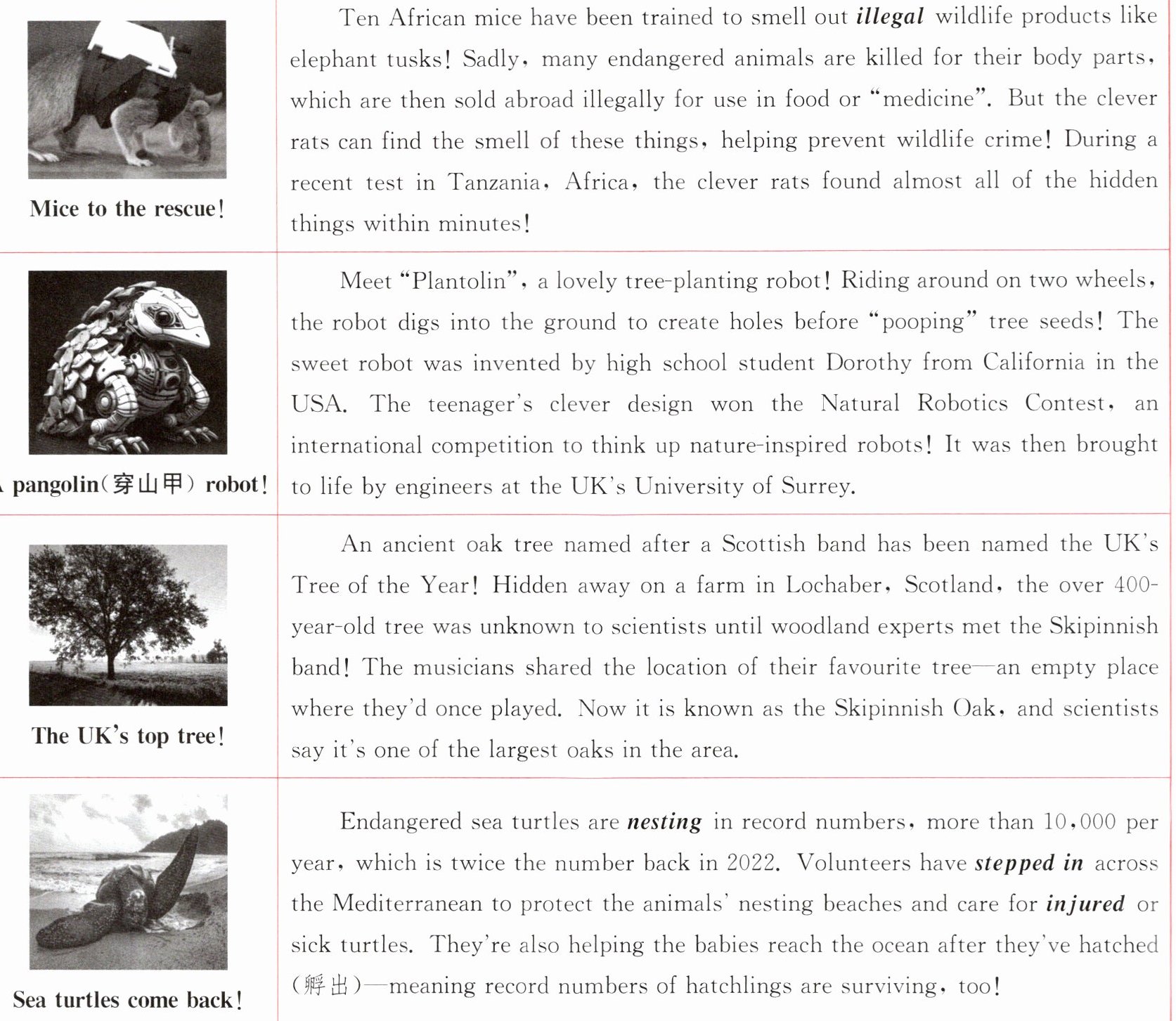
(
A. To serve as food or medicine. B. To save endangered sea turtles.
C. To find illegal wildlife products. D. To help dig holes for planting trees.
(
A. They planted it long ago. B. They found it on the farm.
C. They created a song about the tree. D. They once played music near the tree.
(
A. About 5,000. B. About 10,000. C. About 15,000. D. About 20,000.
Here comes something about nature and technology. Let's have a look!
(
C
)1. What is the purpose of training the mice?A. To serve as food or medicine. B. To save endangered sea turtles.
C. To find illegal wildlife products. D. To help dig holes for planting trees.
(
B
)2. Why was the ancient oak tree named after a Scottish band?A. They planted it long ago. B. They found it on the farm.
C. They created a song about the tree. D. They once played music near the tree.
(
A
)3. How many sea turtles nested in 2022?A. About 5,000. B. About 10,000. C. About 15,000. D. About 20,000.
答案:
1.C 2.B 3.A
范畴:人与自我 主题:敢于创新 体裁:新闻报道 难度:★★★★ 建议用时:8 分钟 评价:___/4
On March 11, ten U. S. high school seniors won top prizes in the Regeneron Science Talent Search (STS), a famous science competition. This year, 2,471 students were involved in it—the most since 1967.
What is STS? STS is America's oldest youth Science, Technology, Engineering and Math (STEM) competition. It started in 1942 by a charity group and Westinghouse Electric. Later, Intel managed it from 1998 to 2016, and Regeneron (a biotechnology company) took over it in May 2016. Winners often become leaders in science, start companies, or win big awards like Nobel Prizes. Each year, Regeneron gives $3.1 million to students and schools.How does it work? U. S. high school seniors or Americans studying abroad can join by sharing their science projects. Judges look for strong research, creative ideas, and leadership skills. First, they pick 300 students, and then choose 40 finalists to attend STS Finals Week in Washington, D. C. There, finalists show their work to scientists and guests. The top 10 winners are named at a ceremony. This year's host was Suzanne Malveaux, a former news reporter.▲ All 300 selected students get $2,000 and their schools get $2,000 for STEM programs. Finalists win prizes from $25,000 to $250,000. Students can also apply for summer jobs at Regeneron.Top winners: 1. Matteo Paz (18, California) won first place ($250,000). He created a new method to find stars and space objects using computer programs. His work sorted 10 years of space information into a list of 2 million stars, some possibly never seen before. 2. Ava Grace Cummings (18, North Carolina) won $175,000. She studied a special muscle disease found in her Lumbee tribe. Using fruit flies, she discovered that the nettle (a plant) helped flies with this disease move better. 3. Owen Jianwen Zhang (18, Washington) won $150,000. He solved a difficult math problem using computer programming.
These students show how young scientists can solve real-world problems. Their work covers space exploration, health research, and advanced math—proving STEM skills can change the world!
( )1. If a student wants to take part in STS, what should he or she do first?
A. Share his or her science projects.
B. Apply for a summer job at Regeneron.
C. Go to Washington, D. C. to show his or her work.
D. Wait for the judges to pick him or her as a finalist.
( )2. What's the best sentence to fill in "▲" in Paragraph 4?
A. What do they win? B. Who manages the STS?
C. What do judges look for? D. How do finalists show their work?
( )3. What can we learn from these young winners?
A. STEM skills are not very useful.
B. Only a few students are interested in science.
C. Young scientists can solve real-world problems.
D. It is difficult for young people to succeed in science.
( )4. 新考法·行文方式 How does the writer organize the passage?
A. By following the time order.
B. By listing the advantages of STS.
C. By answering some key questions about STS.
D. By comparing different students' achievements.
On March 11, ten U. S. high school seniors won top prizes in the Regeneron Science Talent Search (STS), a famous science competition. This year, 2,471 students were involved in it—the most since 1967.
What is STS? STS is America's oldest youth Science, Technology, Engineering and Math (STEM) competition. It started in 1942 by a charity group and Westinghouse Electric. Later, Intel managed it from 1998 to 2016, and Regeneron (a biotechnology company) took over it in May 2016. Winners often become leaders in science, start companies, or win big awards like Nobel Prizes. Each year, Regeneron gives $3.1 million to students and schools.How does it work? U. S. high school seniors or Americans studying abroad can join by sharing their science projects. Judges look for strong research, creative ideas, and leadership skills. First, they pick 300 students, and then choose 40 finalists to attend STS Finals Week in Washington, D. C. There, finalists show their work to scientists and guests. The top 10 winners are named at a ceremony. This year's host was Suzanne Malveaux, a former news reporter.▲ All 300 selected students get $2,000 and their schools get $2,000 for STEM programs. Finalists win prizes from $25,000 to $250,000. Students can also apply for summer jobs at Regeneron.Top winners: 1. Matteo Paz (18, California) won first place ($250,000). He created a new method to find stars and space objects using computer programs. His work sorted 10 years of space information into a list of 2 million stars, some possibly never seen before. 2. Ava Grace Cummings (18, North Carolina) won $175,000. She studied a special muscle disease found in her Lumbee tribe. Using fruit flies, she discovered that the nettle (a plant) helped flies with this disease move better. 3. Owen Jianwen Zhang (18, Washington) won $150,000. He solved a difficult math problem using computer programming.
These students show how young scientists can solve real-world problems. Their work covers space exploration, health research, and advanced math—proving STEM skills can change the world!
( )1. If a student wants to take part in STS, what should he or she do first?
A. Share his or her science projects.
B. Apply for a summer job at Regeneron.
C. Go to Washington, D. C. to show his or her work.
D. Wait for the judges to pick him or her as a finalist.
( )2. What's the best sentence to fill in "▲" in Paragraph 4?
A. What do they win? B. Who manages the STS?
C. What do judges look for? D. How do finalists show their work?
( )3. What can we learn from these young winners?
A. STEM skills are not very useful.
B. Only a few students are interested in science.
C. Young scientists can solve real-world problems.
D. It is difficult for young people to succeed in science.
( )4. 新考法·行文方式 How does the writer organize the passage?
A. By following the time order.
B. By listing the advantages of STS.
C. By answering some key questions about STS.
D. By comparing different students' achievements.
答案:
1.A 2.A 3.C 4.C
三、信息还原
KEY→P14
范畴:人与自然 主题:环保意识 体裁:说明文 难度:★★★ 建议用时:6 分钟 评价:___/5
请先阅读下面短文,掌握其大意,然后根据短文内容从下面方框内的七个选项中选择五个还原到文中,使短文意思通顺、结构完整。
We all have heard of global warming. We also know that pollution is a big problem, such as air pollution and water pollution. We know the earth needs help. We can do something to help.
Don't litter. 1. ____ If there isn't a dustbin nearby, take your litter with you. Then throw it into the dustbin when you can. This can help keep the environment clean.
2. ____ Buying used things is cheaper than buying new ones. Sell or give away your used clothes and toys. Reuse plastic, glass bottles and cups instead of throwing them into the dustbin.
Save energy. Don't ask your parents to drive you somewhere when you can easily walk or ride your bike there. 3. ____ On the other hand, getting more exercise will be good for your body too.
Recycle paper. Newspapers, old magazines, phone books, junk mail and white paper can be recycled. 4. ____ It means that recycling just half of the world's paper will save about twenty million acres of forests!
Save natural resources. Turn off the tap when you brush your teeth. 5. ____ When you finish using your computer at night, shut it down. This uses less electricity than letting it "sleep".
What we do today affects the earth in the future. Let's take good care of the earth!
A. Turn off lights, radios and other electrical equipment(设备) when you leave the room.
B. Never throw litter on the ground.
C. Recycling a ton of paper saves about seventeen trees.
D. If your community has the bus service, use that whenever possible.
E. How to reuse things.
F. Don't spend much time walking.
G. Reuse things.
KEY→P14
范畴:人与自然 主题:环保意识 体裁:说明文 难度:★★★ 建议用时:6 分钟 评价:___/5
请先阅读下面短文,掌握其大意,然后根据短文内容从下面方框内的七个选项中选择五个还原到文中,使短文意思通顺、结构完整。
We all have heard of global warming. We also know that pollution is a big problem, such as air pollution and water pollution. We know the earth needs help. We can do something to help.
Don't litter. 1. ____ If there isn't a dustbin nearby, take your litter with you. Then throw it into the dustbin when you can. This can help keep the environment clean.
2. ____ Buying used things is cheaper than buying new ones. Sell or give away your used clothes and toys. Reuse plastic, glass bottles and cups instead of throwing them into the dustbin.
Save energy. Don't ask your parents to drive you somewhere when you can easily walk or ride your bike there. 3. ____ On the other hand, getting more exercise will be good for your body too.
Recycle paper. Newspapers, old magazines, phone books, junk mail and white paper can be recycled. 4. ____ It means that recycling just half of the world's paper will save about twenty million acres of forests!
Save natural resources. Turn off the tap when you brush your teeth. 5. ____ When you finish using your computer at night, shut it down. This uses less electricity than letting it "sleep".
What we do today affects the earth in the future. Let's take good care of the earth!
A. Turn off lights, radios and other electrical equipment(设备) when you leave the room.
B. Never throw litter on the ground.
C. Recycling a ton of paper saves about seventeen trees.
D. If your community has the bus service, use that whenever possible.
E. How to reuse things.
F. Don't spend much time walking.
G. Reuse things.
答案:
1.B 2.G 3.D 4.C 5.A
四、词汇运用
KEY→P14
范畴:人与社会 主题:科学技术 体裁:说明文 难度:★★★ 建议用时:5 分钟 评价:___/5
请认真阅读下面短文,从方框中选择适当的单词或短语,在横线上填入其正确形式。每个单词或短语仅用一次。
use slow connect right now make
Is time travel possible? We're all travelling at a rate of one second per second, and scientists say that the rate can change. According to Einstein, time and space are 1. ______. So, the faster we travel, the 2. ______ time passes.
That isn't the time travel in most people's minds. They want to jump into a time machine and travel to a moment in the past or future. 3. ______, that's only possible in science fiction books and movies.
However, scientists do have ideas about time travel. Some 4. ______ math to test their ideas, and the math worked. For them, time travel is possible but only in theory. That's not stopping them. They're looking at other ways 5. ______ time travel a real thing.
KEY→P14
范畴:人与社会 主题:科学技术 体裁:说明文 难度:★★★ 建议用时:5 分钟 评价:___/5
请认真阅读下面短文,从方框中选择适当的单词或短语,在横线上填入其正确形式。每个单词或短语仅用一次。
use slow connect right now make
Is time travel possible? We're all travelling at a rate of one second per second, and scientists say that the rate can change. According to Einstein, time and space are 1. ______. So, the faster we travel, the 2. ______ time passes.
That isn't the time travel in most people's minds. They want to jump into a time machine and travel to a moment in the past or future. 3. ______, that's only possible in science fiction books and movies.
However, scientists do have ideas about time travel. Some 4. ______ math to test their ideas, and the math worked. For them, time travel is possible but only in theory. That's not stopping them. They're looking at other ways 5. ______ time travel a real thing.
答案:
1. connected 2. slower 3. Right now 4. used 5. to make
查看更多完整答案,请扫码查看

