

 搜索
搜索
The bike
Do you have a bike? Many children like to ride bikes. But where did the bike come from?
The first bike was invented about 200 years ago. A man in Germany made a thing with two wheels. People called it “bicycle”. The wheels were made of wood. The bicycle was tough to ride. Many people couldn’t ride it well. Later, a man made a thing with three wheels. It was called “tricycle”. It was easy to ride and safe. But it went very slowly. From then on, bikes changed a lot. Today we have many kinds of bikes. People can ride bikes to many places.
根据短文内容,判断正(T)误(F)。
( )1. The passage is about wheels.
( )2. The first bike was invented about 200 years ago.
( )3. A tricycle only had two wooden wheels.
( )4. “The bicycle was tough to ride.” means the bicycle was hard to ride.
( )5. The first bike was called “bicycle”.
Do you have a bike? Many children like to ride bikes. But where did the bike come from?
The first bike was invented about 200 years ago. A man in Germany made a thing with two wheels. People called it “bicycle”. The wheels were made of wood. The bicycle was tough to ride. Many people couldn’t ride it well. Later, a man made a thing with three wheels. It was called “tricycle”. It was easy to ride and safe. But it went very slowly. From then on, bikes changed a lot. Today we have many kinds of bikes. People can ride bikes to many places.
根据短文内容,判断正(T)误(F)。
( )1. The passage is about wheels.
( )2. The first bike was invented about 200 years ago.
( )3. A tricycle only had two wooden wheels.
( )4. “The bicycle was tough to ride.” means the bicycle was hard to ride.
( )5. The first bike was called “bicycle”.
答案:
1. F 2. T 3. F 4. T 5. T
Many years ago, a person wanted to travel to the county town with some books on the way. He asked his young boy attendant to use wooden boards to bundle(捆好)the good books and set off with him. When they were halfway through the road, the sun was almost setting. He wasn’t sure if he could make it before the city gate closed, so he asked the passer - by(路人), “Do I still have time to get to the county town?” The passer - by looked at him and then at the little attendant, and replied, “If you walk slowly, you should still be able to make it before the city gate closes; if you have to rush to get there, the city gate will probably close.”
The person was a little angry when he heard this, thinking that the passer - by was teasing(戏弄)him. So he didn’t answer and hurriedly walked forward with the little attendant. Seeing that the city gate was just ahead, he didn’t expect the little attendant to accidentally fall down, break the tying rope, and scatter(散开)the books. When they tied up the books and arrived at the city gate, the city gate ahead had already been closed. At this moment, he finally understood what the passer - by said.
根据短文内容,选择正确的答案。
( )1. How did the young attendant put the books?
A. He put the books in a big wooden box.
B. He put the books in a big bag.
C. He used a rope and wooden boards to bundle the books.
( )2. When were they halfway through the road?
A. Early in the morning. B. Late in the afternoon. C. Late at night.
( )3. Why did the passer - by say the underlined sentences?
A. Because the passer - by was teasing the man.
B. Because the passer - by was making a joke.
C. Because the passer - by wanted to remind the man to walk slowly.
( )4. Which idiom shows the story best?
A. 欲速则不达 B. 无欲则刚 C. 弄巧成拙
( )5. What can we learn from the story?
A. If we want to get into the county town, we shouldn’t take too many books.
B. We are possible to make mistakes in a busy schedule.
C. We should listen to the passer - by when we are lost.
The person was a little angry when he heard this, thinking that the passer - by was teasing(戏弄)him. So he didn’t answer and hurriedly walked forward with the little attendant. Seeing that the city gate was just ahead, he didn’t expect the little attendant to accidentally fall down, break the tying rope, and scatter(散开)the books. When they tied up the books and arrived at the city gate, the city gate ahead had already been closed. At this moment, he finally understood what the passer - by said.
根据短文内容,选择正确的答案。
( )1. How did the young attendant put the books?
A. He put the books in a big wooden box.
B. He put the books in a big bag.
C. He used a rope and wooden boards to bundle the books.
( )2. When were they halfway through the road?
A. Early in the morning. B. Late in the afternoon. C. Late at night.
( )3. Why did the passer - by say the underlined sentences?
A. Because the passer - by was teasing the man.
B. Because the passer - by was making a joke.
C. Because the passer - by wanted to remind the man to walk slowly.
( )4. Which idiom shows the story best?
A. 欲速则不达 B. 无欲则刚 C. 弄巧成拙
( )5. What can we learn from the story?
A. If we want to get into the county town, we shouldn’t take too many books.
B. We are possible to make mistakes in a busy schedule.
C. We should listen to the passer - by when we are lost.
答案:
1. C 2. B 3. C 4. A 5. B
十三、书面表达。(共5分)
根据图片提示,以“Road safety”为题,写一篇英语短文。不少于5句话。
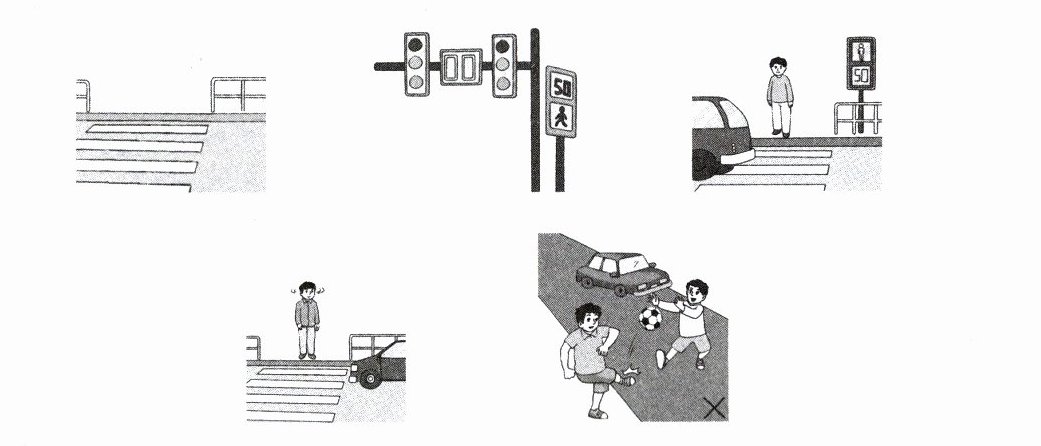
Road safety
______________________________
根据图片提示,以“Road safety”为题,写一篇英语短文。不少于5句话。
Road safety
______________________________
答案:
One possible version:
Road safety
There are many busy roads in the city. How can we cross them safely? First, we must look for a zebra crossing. Then, we must look at the traffic lights and wait for the green man. We must first look left, then right and then left again. Some children play football on the road. It’s not safe. We must not play on the road because there are many cars and buses.
Road safety
There are many busy roads in the city. How can we cross them safely? First, we must look for a zebra crossing. Then, we must look at the traffic lights and wait for the green man. We must first look left, then right and then left again. Some children play football on the road. It’s not safe. We must not play on the road because there are many cars and buses.
查看更多完整答案,请扫码查看

