

 搜索
搜索
第6页
- 第2页
- 第3页
- 第4页
- 第5页
- 第6页
- 第7页
- 第8页
- 第9页
- 第10页
- 第11页
- 第12页
- 第13页
- 第14页
- 第15页
- 第16页
- 第17页
- 第18页
- 第19页
- 第20页
- 第21页
- 第22页
- 第23页
- 第24页
- 第25页
- 第26页
- 第27页
- 第28页
- 第29页
- 第30页
- 第31页
- 第32页
- 第33页
- 第34页
- 第35页
- 第36页
- 第37页
- 第38页
- 第39页
- 第40页
- 第41页
- 第42页
- 第43页
- 第44页
- 第45页
- 第46页
- 第47页
- 第48页
- 第49页
- 第50页
- 第51页
- 第52页
- 第53页
- 第54页
- 第55页
- 第56页
- 第57页
- 第58页
- 第59页
- 第60页
- 第61页
- 第62页
- 第63页
- 第64页
- 第65页
- 第66页
- 第67页
- 第68页
- 第69页
- 第70页
- 第71页
- 第72页
- 第73页
- 第74页
- 第75页
- 第76页
- 第77页
- 第78页
- 第79页
- 第80页
- 第81页
- 第82页
- 第83页
- 第84页
- 第85页
- 第86页
- 第87页
- 第88页
- 第89页
- 第90页
- 第91页
- 第92页
- 第93页
- 第94页
- 第95页
- 第96页
- 第97页
- 第98页
- 第99页
- 第100页
- 第101页
- 第102页
- 第103页
- 第104页
- 第105页
- 第106页
一、请从方框中选择恰当的单词填空,每个单词只能用一次
start lab together
1. Don’t run in the
2. My family and I often cook dinner
3. The class will
start lab together
1. Don’t run in the
lab
! It’s dangerous.2. My family and I often cook dinner
together
on Sundays.3. The class will
start
at 8:30 am tomorrow, so don’t be late.
答案:
一、1. lab 2. together 3. start
二、根据汉语提示完成句子,每空一词
1. My parents like to
2. We do
3. Our
4. They play football with their friends
5. We eat lunch with our friends in the school
1. My parents like to
go around
(四处走动) the park after dinner.2. We do
morning exercises
(早操) in the playground every day.3. Our
teaching building
(教学楼) has five floors and a big library.4. They play football with their friends
after school
(放学后) every Monday.5. We eat lunch with our friends in the school
dining hall
(食堂) every day.
答案:
二、1. go around 2. morning exercises 3. teaching building 4. after school 5. dining hall
三、句型转换,每空一词
1. There is one glass of milk on the table. (改为一般疑问句并作否定回答)
—
—
2. There are some flowers in our garden. (改为否定句)
1. There is one glass of milk on the table. (改为一般疑问句并作否定回答)
—
Is there
one glass of milk on the table?—
No
,there isn’t
.2. There are some flowers in our garden. (改为否定句)
There aren’t any
flowers in our garden.
答案:
三、1. Is there No there isn’t 2. There aren’t any
四、判断下列句子属于哪种句型
1. Tom runs fast. →(
2. She has a red bag. →(
3. They made the room clean. → (
4. This song sounds good. → (
5. He tells me a story every night. → (
1. Tom runs fast. →(
主语+谓语
)2. She has a red bag. →(
主语+谓语+宾语
)3. They made the room clean. → (
主语+谓语+宾语+宾语补足语
)4. This song sounds good. → (
主语+系动词+表语
)5. He tells me a story every night. → (
主语+谓语+间接宾语+直接宾语
)
答案:
四、1. 主语+谓语
2. 主语+谓语+宾语
3. 主语+谓语+宾语+宾语补足语
4. 主语+系动词+表语
5. 主语+谓语+间接宾语+直接宾语
2. 主语+谓语+宾语
3. 主语+谓语+宾语+宾语补足语
4. 主语+系动词+表语
5. 主语+谓语+间接宾语+直接宾语
五、图表阅读
Chinese Culture Courses(文化课程)
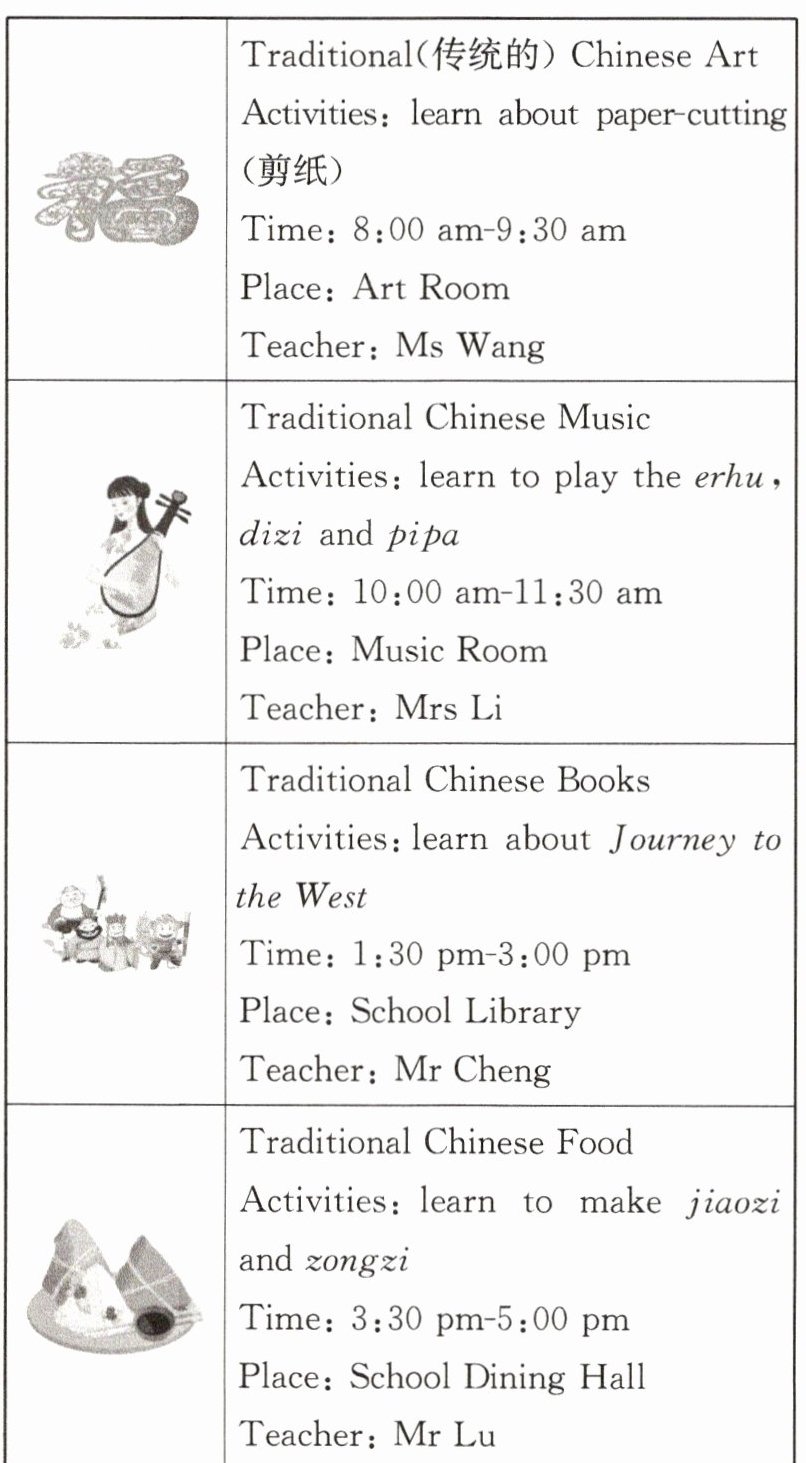
(
A. Four.
B. Five.
C. Six.
(
A. Learn to play the erhu.
B. Learn about paper-cutting.
C. Learn about Journey to the West.
(
A. Traditional Chinese Art.
B. Traditional Chinese Music.
C. Traditional Chinese Books.
(
A. Ms Wang.
B. Mrs Li.
C. Mr Cheng.
(
A. In the music room.
B. In the school library.
C. In the school dining hall.
Chinese Culture Courses(文化课程)
(
A
)1. How many Chinese culture courses are there in the poster(海报)?A. Four.
B. Five.
C. Six.
(
B
)2. What can students do in the art room?A. Learn to play the erhu.
B. Learn about paper-cutting.
C. Learn about Journey to the West.
(
B
)3. Which course do students have from 10:00 am to 11:30 am?A. Traditional Chinese Art.
B. Traditional Chinese Music.
C. Traditional Chinese Books.
(
C
)4. Who teaches Traditional Chinese Books?A. Ms Wang.
B. Mrs Li.
C. Mr Cheng.
(
C
)5. Where do students make zongzi?A. In the music room.
B. In the school library.
C. In the school dining hall.
答案:
五、1. A 2. B 3. B 4. C 5. C
查看更多完整答案,请扫码查看

