

 搜索
搜索
第70页
- 第1页
- 第2页
- 第3页
- 第4页
- 第5页
- 第6页
- 第7页
- 第8页
- 第9页
- 第10页
- 第11页
- 第12页
- 第13页
- 第14页
- 第15页
- 第16页
- 第17页
- 第18页
- 第19页
- 第20页
- 第21页
- 第22页
- 第23页
- 第24页
- 第25页
- 第26页
- 第27页
- 第28页
- 第29页
- 第30页
- 第31页
- 第32页
- 第33页
- 第34页
- 第35页
- 第36页
- 第37页
- 第38页
- 第39页
- 第40页
- 第41页
- 第42页
- 第43页
- 第44页
- 第45页
- 第46页
- 第47页
- 第48页
- 第49页
- 第50页
- 第51页
- 第52页
- 第53页
- 第54页
- 第55页
- 第56页
- 第57页
- 第58页
- 第59页
- 第60页
- 第61页
- 第62页
- 第63页
- 第64页
- 第65页
- 第66页
- 第67页
- 第68页
- 第69页
- 第70页
- 第71页
- 第72页
- 第73页
- 第74页
- 第75页
- 第76页
- 第77页
- 第78页
- 第79页
- 第80页
- 第81页
- 第82页
- 第83页
- 第84页
- 第85页
- 第86页
- 第87页
- 第88页
- 第89页
- 第90页
- 第91页
- 第92页
- 第93页
- 第94页
- 第95页
- 第96页
- 第97页
- 第98页
- 第99页
- 第100页
- 第101页
- 第102页
- 第103页
- 第104页
- 第105页
- 第106页
- 第107页
- 第108页
- 第109页
- 第110页
- 第111页
- 第112页
- 第113页
- 第114页
- 第115页
- 第116页
- 第117页
- 第118页
- 第119页
- 第120页
- 第121页
- 第122页
- 第123页
- 第124页
略读课本 Reading for writing 2 中的文章,将发明家和对应的发明连线。
Benjamin Franklin a “flying chair”
Wan Hu the first earthquake detector
Zhang Heng the lightning rod
Benjamin Franklin a “flying chair”
Wan Hu the first earthquake detector
Zhang Heng the lightning rod
答案:
Benjamin Franklin - a "flying chair" Wan Hu - the first earthquake detector Zhang Heng - the lightning rod
任务驱动 2 精读文章,完成思维导图
1. 细读课本 Reading for writing 2 中的文章,完成下面的思维导图。
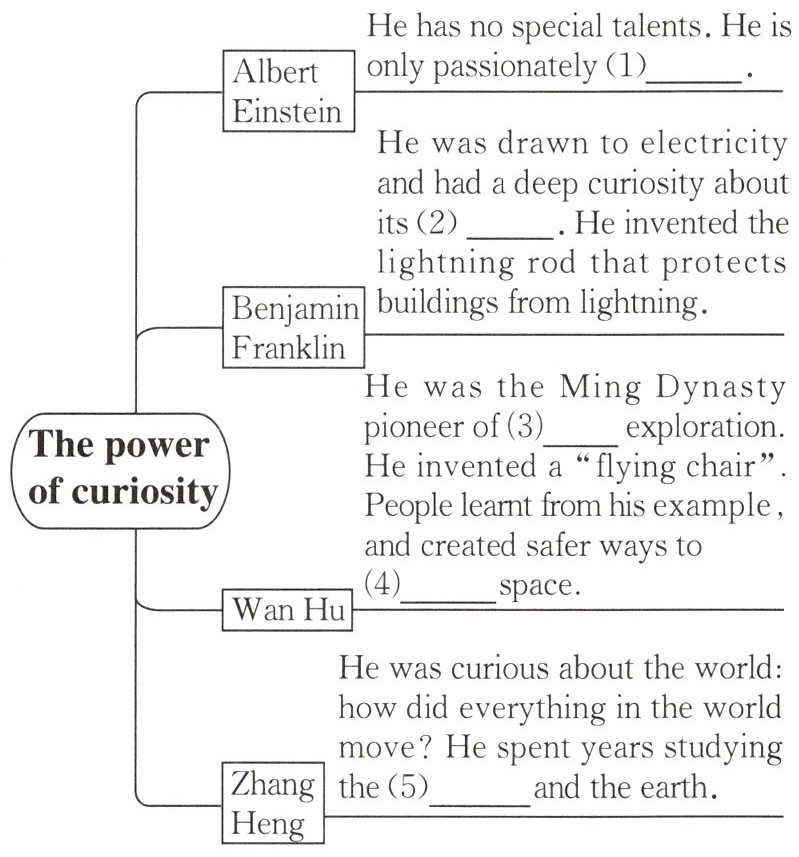
2. 再次细读课本 Reading for writing 2 中的文章,补全下面的思维导图。
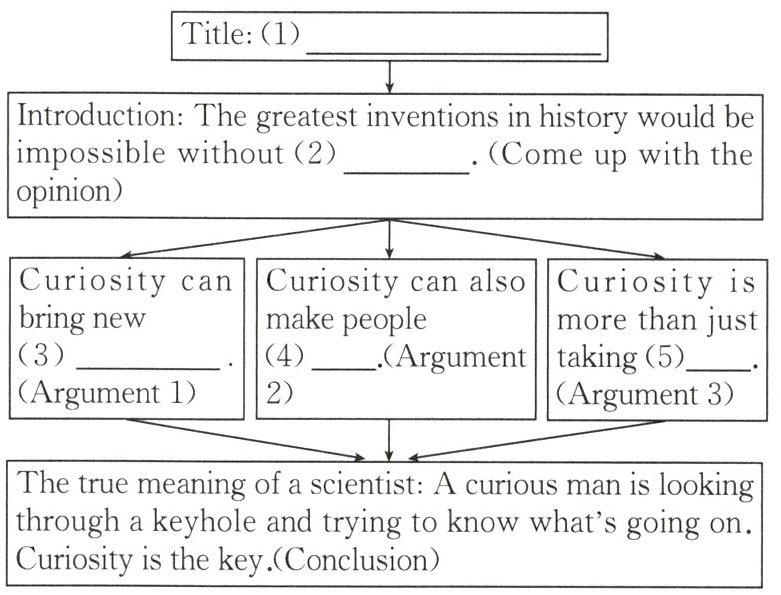
1. 细读课本 Reading for writing 2 中的文章,完成下面的思维导图。
2. 再次细读课本 Reading for writing 2 中的文章,补全下面的思维导图。
答案:
1.
(1)curious
(2) nature
(3) space
(4) explore
(5) sky 2.
(1)The power of curiosity
(2)curiosity
(3)discoveries
(4)brave
(5)risks
(1)curious
(2) nature
(3) space
(4) explore
(5) sky 2.
(1)The power of curiosity
(2)curiosity
(3)discoveries
(4)brave
(5)risks
通过探究名人故事,认识到好奇心是人类进步的驱动力与源泉。然后以“The Power of Curiosity”为题,写一篇英文短文,介绍好奇心的力量,并在班级展示,其他同学对作文进行点评并评选出优秀作文。
The Power of Curiosity______
The Power of Curiosity______
答案:
The Power of Curiosity
Curiosity is like a bright light that guides humans to explore the unknown. Many great discoveries start with a simple "why".
Take Thomas Edison as an example. As a child, he was curious about how things worked. He once asked his teacher why the wind blew and what fire was made of. His curiosity led him to try thousands of materials to invent the light bulb, which changed the world forever.
Another example is Marie Curie. She was curious about the mysterious uranium rays. Her endless questions and experiments helped her discover radium, saving millions of lives in medicine.
In our daily life, curiosity helps us learn and grow. When we wonder how plants grow or why the sky is blue, we start reading books or doing experiments. This not only increases our knowledge but also makes us creative.
In conclusion, curiosity is the key to progress. Let’s keep asking questions and exploring, for it is curiosity that pushes us forward.
Curiosity is like a bright light that guides humans to explore the unknown. Many great discoveries start with a simple "why".
Take Thomas Edison as an example. As a child, he was curious about how things worked. He once asked his teacher why the wind blew and what fire was made of. His curiosity led him to try thousands of materials to invent the light bulb, which changed the world forever.
Another example is Marie Curie. She was curious about the mysterious uranium rays. Her endless questions and experiments helped her discover radium, saving millions of lives in medicine.
In our daily life, curiosity helps us learn and grow. When we wonder how plants grow or why the sky is blue, we start reading books or doing experiments. This not only increases our knowledge but also makes us creative.
In conclusion, curiosity is the key to progress. Let’s keep asking questions and exploring, for it is curiosity that pushes us forward.
查看更多完整答案,请扫码查看

