

 搜索
搜索
第2页
- 第1页
- 第2页
- 第3页
- 第4页
- 第5页
- 第6页
- 第7页
- 第8页
- 第9页
- 第10页
- 第11页
- 第12页
- 第13页
- 第14页
- 第15页
- 第16页
- 第17页
- 第18页
- 第19页
- 第20页
- 第21页
- 第22页
- 第23页
- 第24页
- 第25页
- 第26页
- 第27页
- 第28页
- 第29页
- 第30页
- 第31页
- 第32页
- 第33页
- 第34页
- 第35页
- 第36页
- 第37页
- 第38页
- 第39页
- 第40页
- 第41页
- 第42页
- 第43页
- 第44页
- 第45页
- 第46页
- 第47页
- 第48页
- 第49页
- 第50页
- 第51页
- 第52页
- 第53页
- 第54页
- 第55页
- 第56页
- 第57页
- 第58页
- 第59页
- 第60页
- 第61页
- 第62页
- 第63页
- 第64页
- 第65页
- 第66页
- 第67页
- 第68页
- 第69页
- 第70页
- 第71页
- 第72页
- 第73页
- 第74页
- 第75页
- 第76页
- 第77页
- 第78页
- 第79页
- 第80页
- 第81页
- 第82页
- 第83页
- 第84页
- 第85页
- 第86页
- 第87页
- 第88页
- 第89页
- 第90页
- 第91页
- 第92页
- 第93页
- 第94页
- 第95页
- 第96页
- 第97页
- 第98页
- 第99页
- 第100页
- 第101页
- 第102页
- 第103页
- 第104页
- 第105页
- 第106页
- 第107页
- 第108页
- 第109页
Ways and Benefits of Taking a Vacation
As you start a new school year, it's important to think about how vacations can help you. Vacations are not just for fun, and they also help us relax and recharge. There are many ways to enjoy a vacation. Some students travel with their families to visit new places, like beaches or mountains. This helps them learn about the world and experience different cultures. Others enjoy outdoor activities, such as playing sports, hiking, or camping. These activities keep us healthy and active. Some students prefer staying at home, reading books, drawing or cooking. These activities can be just as enjoyable and relaxing.
Taking a vacation has many benefits. It helps reduce stress and gives our minds a break. It also allows us to spend quality time with family and friends. Vacations can even help us discover new interests and talents.
Remember, a good vacation doesn't have to be expensive or far away. What matters most is taking time to relax and enjoy yourself.
Questions:
1. What is your favorite way to spend a vacation?
2. How do you feel after a good vacation?
As you start a new school year, it's important to think about how vacations can help you. Vacations are not just for fun, and they also help us relax and recharge. There are many ways to enjoy a vacation. Some students travel with their families to visit new places, like beaches or mountains. This helps them learn about the world and experience different cultures. Others enjoy outdoor activities, such as playing sports, hiking, or camping. These activities keep us healthy and active. Some students prefer staying at home, reading books, drawing or cooking. These activities can be just as enjoyable and relaxing.
Taking a vacation has many benefits. It helps reduce stress and gives our minds a break. It also allows us to spend quality time with family and friends. Vacations can even help us discover new interests and talents.
Remember, a good vacation doesn't have to be expensive or far away. What matters most is taking time to relax and enjoy yourself.
Questions:
1. What is your favorite way to spend a vacation?
2. How do you feel after a good vacation?
答案:
Answers:
1. My favorite way to spend a vacation is traveling with my family to visit new places, such as beaches or mountains.
2. After a good vacation, I feel relaxed and refreshed.
1. My favorite way to spend a vacation is traveling with my family to visit new places, such as beaches or mountains.
2. After a good vacation, I feel relaxed and refreshed.
1. Did you do anything interesting on your holiday? 你在假期做了一些有趣的事情吗?
【感知】(1) Did you go anywhere interesting? 你去了一些有趣的地方吗?
(2) I did nothing special. But I met someone interesting. 我什么特别的事也没做,但我遇到一个有趣的人。
(3) Did you go with anyone? 你和别人一起去的吗?
(4) —Did you eat anything special? 你们吃了一些很特别的东西吗?
—Yes, we did! Everything tasted good. Everyone loved it. 是的。每一样东西都很好吃。每个人都很喜欢。
【思考】通过观察可知,由 some, any, no, every 加上 one, thing 构成的不定代词叫作
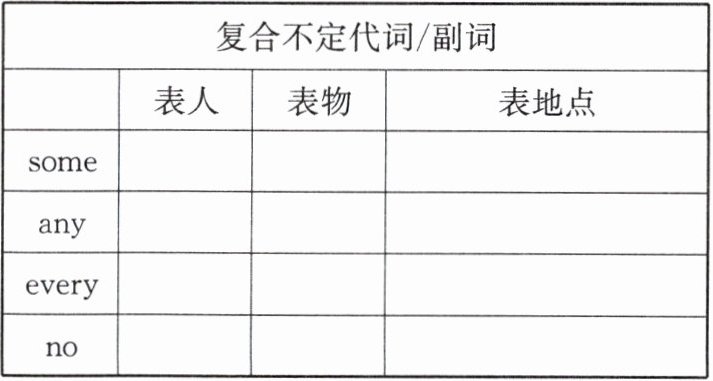
(1) 一般情况下,以 some 开头的复合不定代词用在
(2) 复合不定代词作主语时,谓语动词用
(3) 当形容词修饰不定代词时,位置应放在其
(4) somewhere 和 anywhere 主要作不定副词,因此表达去某地可以直接说
【运用】从方框中选择合适的单词完成句子。
nothing, anywhere, something, someone, everyone
(1)
(2) Gina lost her key. She can't find it
(3) David is new here, so we know
(4) There is
(5)
【感知】(1) Did you go anywhere interesting? 你去了一些有趣的地方吗?
(2) I did nothing special. But I met someone interesting. 我什么特别的事也没做,但我遇到一个有趣的人。
(3) Did you go with anyone? 你和别人一起去的吗?
(4) —Did you eat anything special? 你们吃了一些很特别的东西吗?
—Yes, we did! Everything tasted good. Everyone loved it. 是的。每一样东西都很好吃。每个人都很喜欢。
【思考】通过观察可知,由 some, any, no, every 加上 one, thing 构成的不定代词叫作
复合不定代词
;由 some, any, no, every 加上 where 构成的不定副词叫作复合不定副词
。结合上面的句子,将下面表格和句子的空白处补充完整。(1) 一般情况下,以 some 开头的复合不定代词用在
肯定的陈述句
中,但如果期望得到对方的肯定回答时,也可以用在疑问句中,如:Would you like something to eat? 以 any 开头的复合不定代词一般用于疑问句
、否定句
和条件句中。当其用于肯定句时,表示任何人、任何事。(2) 复合不定代词作主语时,谓语动词用
单数
。(3) 当形容词修饰不定代词时,位置应放在其
后
(前/后)面。(4) somewhere 和 anywhere 主要作不定副词,因此表达去某地可以直接说
go somewhere
。【运用】从方框中选择合适的单词完成句子。
nothing, anywhere, something, someone, everyone
(1)
Someone
left a cap on the playground after school.(2) Gina lost her key. She can't find it
anywhere
now.(3) David is new here, so we know
nothing
about him.(4) There is
something
important in today's newspaper.(5)
Everyone
can be successful(成功的) if he tries his best.
答案:
思考:复合不定代词;复合不定副词
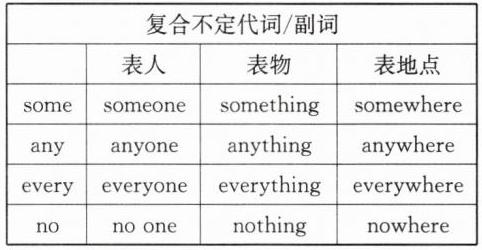
(1)肯定的陈述句;疑问句;否定句 (2)单数
(3)后 (4)go somewhere
运用:
(1) Someone (2)anywhere (3)nothing
(4)something (5)Everyone
思考:复合不定代词;复合不定副词
(1)肯定的陈述句;疑问句;否定句 (2)单数
(3)后 (4)go somewhere
运用:
(1) Someone (2)anywhere (3)nothing
(4)something (5)Everyone
查看更多完整答案,请扫码查看

