

 搜索
搜索
第10页
- 第1页
- 第2页
- 第3页
- 第4页
- 第5页
- 第6页
- 第7页
- 第8页
- 第9页
- 第10页
- 第11页
- 第12页
- 第13页
- 第14页
- 第15页
- 第16页
- 第17页
- 第18页
- 第19页
- 第20页
- 第21页
- 第22页
- 第23页
- 第24页
- 第25页
- 第26页
- 第27页
- 第28页
- 第29页
- 第30页
- 第31页
- 第32页
- 第33页
- 第34页
- 第35页
- 第36页
- 第37页
- 第38页
- 第39页
- 第40页
- 第41页
- 第42页
- 第43页
- 第44页
- 第45页
- 第46页
- 第47页
- 第48页
- 第49页
- 第50页
- 第51页
- 第52页
- 第53页
- 第54页
- 第55页
- 第56页
- 第57页
- 第58页
- 第59页
- 第60页
- 第61页
- 第62页
- 第63页
- 第64页
- 第65页
- 第66页
- 第67页
- 第68页
- 第69页
- 第70页
- 第71页
- 第72页
- 第73页
- 第74页
- 第75页
- 第76页
- 第77页
- 第78页
- 第79页
- 第80页
- 第81页
- 第82页
- 第83页
- 第84页
- 第85页
- 第86页
- 第87页
- 第88页
- 第89页
- 第90页
- 第91页
- 第92页
- 第93页
- 第94页
- 第95页
- 第96页
- 第97页
- 第98页
- 第99页
- 第100页
- 第101页
- 第102页
- 第103页
- 第104页
- 第105页
- 第106页
- 第107页
- 第108页
- 第109页
- 第110页
- 第111页
- 第112页
- 第113页
- 第114页
- 第115页
- 第116页
- 第117页
- 第118页
- 第119页
- 第120页
- 第121页
- 第122页
- 第123页
- 第124页
- 第125页
- 第126页
- 第127页
- 第128页
- 第129页
- 第130页
- 第131页
- 第132页
- 第133页
- 第134页
- 第135页
- 第136页
- 第137页
- 第138页
- 第139页
- 第140页
八 校园读书文化艺术节正在进行中,一起来参加丰富的活动吧。读一读,写一写。(46 分)
(A)Helen 准备和同学表演童话故事《白雪公主》。从方框中选择合适的选项完成剧本对话,将序号填在横线上。其中有一项是多余的。(5 分)举一反三
A: Apples, apples! Big and red apples!
B: Oh, what nice apples!
A: Yes. The apples are sweet. 1.
$ \begin{array}{|l|} \hline A. No. I can't eat it. \\ B. Yes, please give me one. \\ C. Do you think it is bad? \\ D. But my friend told me not to open the door. \\ E. I'll eat this half and the other half is for you. \\ F. Do you want to have one? \\ \hline \end{array}\\ \hline $
B: Yes. 2.
A: OK. I'll give you a big apple through the window.
B: 3.
A: Why? 4.
B: No ...
A: Well, I'll cut the apple in half. 5.
B: OK. I want to eat it.
A: Here you are.
B: Thank you.
(A)Helen 准备和同学表演童话故事《白雪公主》。从方框中选择合适的选项完成剧本对话,将序号填在横线上。其中有一项是多余的。(5 分)举一反三
A: Apples, apples! Big and red apples!
B: Oh, what nice apples!
A: Yes. The apples are sweet. 1.
F
$ \begin{array}{|l|} \hline A. No. I can't eat it. \\ B. Yes, please give me one. \\ C. Do you think it is bad? \\ D. But my friend told me not to open the door. \\ E. I'll eat this half and the other half is for you. \\ F. Do you want to have one? \\ \hline \end{array}\\ \hline $
B: Yes. 2.
D
A: OK. I'll give you a big apple through the window.
B: 3.
A
A: Why? 4.
C
B: No ...
A: Well, I'll cut the apple in half. 5.
E
B: OK. I want to eat it.
A: Here you are.
B: Thank you.
答案:
1. F 2. D 3. A 4. C 5. E
(B)新语篇活动策划 刘涛在帮老师张贴“用英语讲好中国故事”的比赛海报(poster)。根据海报内容,判断下列句子正(T)误(F)。(5 分)
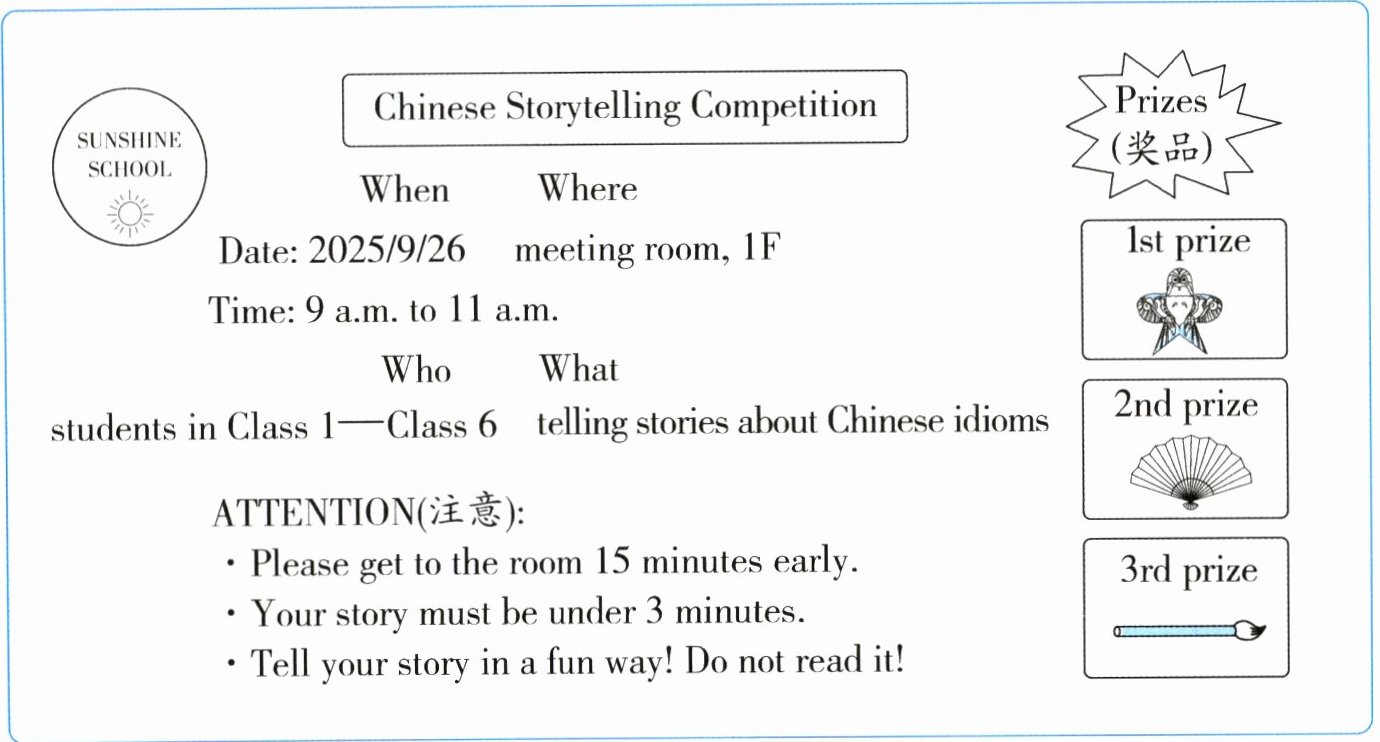
(
(
(
(
(
(
F
)1. The competition starts at 11:00 in the morning.(
T
)2. There is a meeting room on the first floor.(
F
)3. It's OK to read your story in the competition.(
F
)4. The first-prize winner can get a Chinese fan.(
T
)5. The competition can help students know more about Chinese idioms.
答案:
1. F 解析:根据海报中时间"9 a.m. to 11 a.m."可知,比赛在上午十一点结束,而不是在上午十一点开始,故填 F。2. T 解析:根据海报中地点"meeting room,1F"可知,一楼有会议室,故填 T。3. F 解析:根据海报中注意事项"Tell your story in a fun way! Do not read it!"可知,要有声有色地讲故事,富有趣味,而不是仅仅读故事,故填 F。4. F 解析:根据海报中的奖品可知,中国扇是二等奖奖品,而不是一等奖奖品,故填 F。5. T 解析:根据海报中"telling stories about Chinese idioms"可知,这个比赛可以帮助同学们了解更多的中国成语,故填 T。
(C)新情境传统文化 杨玲准备参加讲故事比赛。根据首字母和上下文提示填空。(12 分)
During the Warring States Period(战国时期), there
One day, Gongming Yi saw a cow in the countryside. He
"Maybe this song is too
"
"It is not because your music is
What can we learn from this story? If you talk to a wrong listener, you are wasting(浪费) time.
During the Warring States Period(战国时期), there
was
a man called Gongming Yi. He could play the guqin very well. Many people liked/loved
his music.One day, Gongming Yi saw a cow in the countryside. He
wanted
to play some music for it. He sat down and played
the guqin in front of the cow. But
the cow just kept(保持) eating grass."Maybe this song is too
difficult
for the cow," he thought. He started
to play an easy song. The cow still(仍然) showed no interest(兴趣). After many songs, the cow finished its meal and walked/went
away."
Why
didn't that cow like my music?" Gongming Yi asked
his friends."It is not because your music is
bad
. It is because the cow could not understand
music."What can we learn from this story? If you talk to a wrong listener, you are wasting(浪费) time.
答案:
was;liked/loved;wanted;played;But;difficult;started;walked/went;Why;asked;bad;understand 知识归纳 规则的动词过去式词尾-ed 的读音 1. 清辅音(声带不振动)后-ed 读/t/。例如:looked /lʊkt/。2. 元音、浊辅音(声带振动)后 ed 读/d/。例如:played /pleɪd/。3. t 和 d 后的-ed 读/ɪd/。例如:visited /'vɪzɪtɪd/,needed /'niːdɪd/。
查看更多完整答案,请扫码查看

