

 搜索
搜索
2025年阳光夺冠八年级英语下册
注:目前有些书本章节名称可能整理的还不是很完善,但都是按照顺序排列的,请同学们按照顺序仔细查找。练习册 2025年阳光夺冠八年级英语下册 答案主要是用来给同学们做完题方便对答案用的,请勿直接抄袭。
第20页
- 第1页
- 第2页
- 第3页
- 第4页
- 第5页
- 第6页
- 第7页
- 第8页
- 第9页
- 第10页
- 第11页
- 第12页
- 第13页
- 第14页
- 第15页
- 第16页
- 第17页
- 第18页
- 第19页
- 第20页
- 第21页
- 第22页
- 第23页
- 第24页
- 第25页
- 第26页
- 第27页
- 第28页
- 第29页
- 第30页
- 第31页
- 第32页
- 第33页
- 第34页
- 第35页
- 第36页
- 第37页
- 第38页
- 第39页
- 第40页
- 第41页
- 第42页
- 第43页
- 第44页
- 第45页
- 第46页
- 第47页
- 第48页
- 第49页
- 第50页
- 第51页
- 第52页
- 第53页
- 第54页
- 第55页
- 第56页
- 第57页
- 第58页
- 第59页
- 第60页
- 第61页
- 第62页
- 第63页
- 第64页
- 第65页
- 第66页
- 第67页
- 第68页
- 第69页
- 第70页
- 第71页
- 第72页
- 第73页
- 第74页
- 第75页
- 第76页
- 第77页
- 第78页
- 第79页
- 第80页
- 第81页
- 第82页
- 第83页
- 第84页
- 第85页
- 第86页
- 第87页
- 第88页
- 第89页
- 第90页
- 第91页
- 第92页
- 第93页
- 第94页
- 第95页
- 第96页
- 第97页
- 第98页
- 第99页
- 第100页
- 第101页
- 第102页
- 第103页
- 第104页
- 第105页
- 第106页
- 第107页
- 第108页
- 第109页
- 第110页
- 第111页
二、阅读理解(40分)
A(黔东南州中考)
What do you usually do in your free time? Last month we asked 100 students about their free time activities. Here are the results.
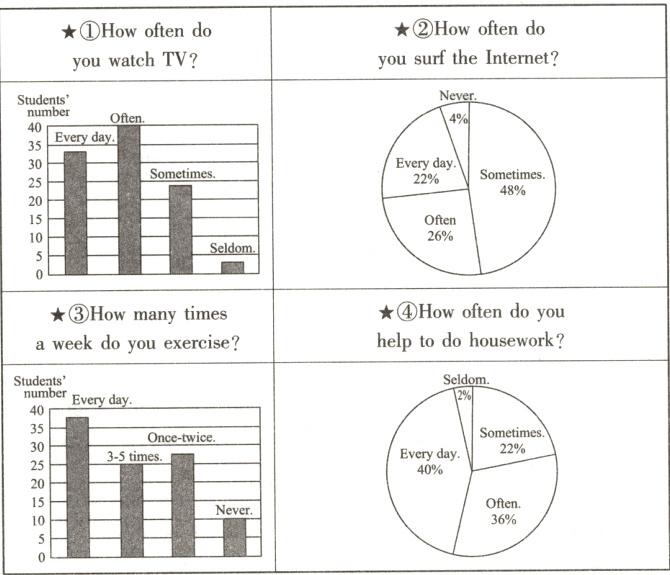
11. How many students often watch TV?
A. About 3. B. About 24. C. About 33. D. About 40.
12. According to the second chart(表格), ______ students surf the Internet every day.
A. 4% B. 22% C. 26% D. 48%
13. Which activity is NOT mentioned above?
A. Reading. B. Watching TV. C. Exercising. D. Doing housework.
14. Which activities does everybody take part in?
A. ①③. B. ①④. C. ②④. D. ③④.
15. Which of the following is RIGHT according to the survey?
A. They did the survey among 200 students.
B. The survey is about students' study.
C. About 27% of the students exercise once or twice a week.
D. Four students never do housework.
A(黔东南州中考)
What do you usually do in your free time? Last month we asked 100 students about their free time activities. Here are the results.
11. How many students often watch TV?
A. About 3. B. About 24. C. About 33. D. About 40.
12. According to the second chart(表格), ______ students surf the Internet every day.
A. 4% B. 22% C. 26% D. 48%
13. Which activity is NOT mentioned above?
A. Reading. B. Watching TV. C. Exercising. D. Doing housework.
14. Which activities does everybody take part in?
A. ①③. B. ①④. C. ②④. D. ③④.
15. Which of the following is RIGHT according to the survey?
A. They did the survey among 200 students.
B. The survey is about students' study.
C. About 27% of the students exercise once or twice a week.
D. Four students never do housework.
答案:
11. D 12. B 13. A 14. B 15.
B
Josh and Amy are like many teenagers these days. They have jobs to do to help out around the home. Josh washes cars for his neighbors while Amy helps their neighbor's kids with their homework. Like many families, both of Josh and Amy's parents work outside the home.
Everyone in Josh and Amy's family is busy. Their mom works in an office and often has to stay late for meetings. Their father owns his own small business and stays late to finish his work. Josh and Amy go to school. Both belong to clubs and sports teams. They also have lots of friends with whom they want to spend time.
Josh and Amy's mom leaves for work at 7:00 in the morning and does not get home most days until 6:30 p.m. The same is true for their dad, but he leaves home in the morning even earlier.
Josh and Amy's parents work to be able to provide for their family. They need money to pay for their home and to pay their bills. Next year they want to buy a new car. The family also wants to go on a vacation to California. Josh and Amy need clothes, books, and other things for school. Their parents are also saving money so Josh and Amy can go to college when they finish high school.
16. How many people are there in the family?
A. One. B. Two. C. Three. D. Four.
17. What does the father do?
A. Work in an office. B. Run his own business. C. Plan vacations to California. D. Drive kids to school.
18. What do the kids do to help their parents?
A. Take part-time jobs. B. Join clubs and sports teams. C. Spend time with their friends. D. Go to school early.
19. Where do the parents spend most of their daytime?
A. At home. B. At workplace. C. In their kids' school. D. On business trips.
20. What's the best title for this passage?
A. Lovely Kids B. Hard-Working Parents C. Family Wishes D. A Busy Family
Josh and Amy are like many teenagers these days. They have jobs to do to help out around the home. Josh washes cars for his neighbors while Amy helps their neighbor's kids with their homework. Like many families, both of Josh and Amy's parents work outside the home.
Everyone in Josh and Amy's family is busy. Their mom works in an office and often has to stay late for meetings. Their father owns his own small business and stays late to finish his work. Josh and Amy go to school. Both belong to clubs and sports teams. They also have lots of friends with whom they want to spend time.
Josh and Amy's mom leaves for work at 7:00 in the morning and does not get home most days until 6:30 p.m. The same is true for their dad, but he leaves home in the morning even earlier.
Josh and Amy's parents work to be able to provide for their family. They need money to pay for their home and to pay their bills. Next year they want to buy a new car. The family also wants to go on a vacation to California. Josh and Amy need clothes, books, and other things for school. Their parents are also saving money so Josh and Amy can go to college when they finish high school.
16. How many people are there in the family?
A. One. B. Two. C. Three. D. Four.
17. What does the father do?
A. Work in an office. B. Run his own business. C. Plan vacations to California. D. Drive kids to school.
18. What do the kids do to help their parents?
A. Take part-time jobs. B. Join clubs and sports teams. C. Spend time with their friends. D. Go to school early.
19. Where do the parents spend most of their daytime?
A. At home. B. At workplace. C. In their kids' school. D. On business trips.
20. What's the best title for this passage?
A. Lovely Kids B. Hard-Working Parents C. Family Wishes D. A Busy Family
答案:
C 16. D 17. B 18. A 19. B 20. D
C(福建中考)
In the past nine years, Li Jin, who was born in Guangxi but raised in Sanya, has made great efforts to protect the waters of Sanya city in Hainan. He is now spreading the knowledge of environmental protection through new media platforms(媒体平台).
Around 2014, he began doing volunteer work to clear rubbish from the beaches and officially registered(注册) as a volunteer in May, 2017. Li Jin immediately took the lead in a cleanup activity on the Sanya River.
In April, 2021, he used his own money to set up a volunteer service center which has 1,170 registered members who take part in activities without asking for payment. So far, he has spent about 3,800 hours on volunteer activities in over 550 events. More than 2,300 people have joined in with his encouragement. They've drawn the attention of both the adults(成年人) and the children to the importance of protecting the oceans and beaches. Since it was set up, his center has organized 51 beach - cleaning activities that have seen about 1,800 people join in. In 2021, because of Li's growing influence in environmental protection circles, the city government invited him to make a number of short videos, in which he uses simple words to explain how to protect the environment. Several of the videos have been watched millions of times.
“My volunteer work would be meaningless if I got paid. But the work itself is of great value. So I will continue doing the environmental protection work,” he said.
21. What is Li Jin trying hard to protect?
A. The beaches in Guangxi. B. The waters of Sanya. C. The wildlife on the Sanya River. D. The cities in Hainan.
22. How many people join Li Jin's volunteer service center?
A. 550. B. 1,170. C. 1,800. D. 2,300.
23. What can we know from paragraph 3?
A. Millions of people join in Li Jin's activities. B. Members in Li Jin's service center get paid. C. Most activities are organized for children. D. Some videos Li Jin made are a success.
24. Which of the following best describes Li Jin?
A. Quiet and kind - hearted. B. Patient and humorous. C. Strong - minded and selfless. D. Honest and easygoing.
25. What is the text mainly about?
A. A hero praised for volunteer work. B. The leader in a cleanup activity. C. The meaning of protecting water. D. A volunteer service center.
In the past nine years, Li Jin, who was born in Guangxi but raised in Sanya, has made great efforts to protect the waters of Sanya city in Hainan. He is now spreading the knowledge of environmental protection through new media platforms(媒体平台).
Around 2014, he began doing volunteer work to clear rubbish from the beaches and officially registered(注册) as a volunteer in May, 2017. Li Jin immediately took the lead in a cleanup activity on the Sanya River.
In April, 2021, he used his own money to set up a volunteer service center which has 1,170 registered members who take part in activities without asking for payment. So far, he has spent about 3,800 hours on volunteer activities in over 550 events. More than 2,300 people have joined in with his encouragement. They've drawn the attention of both the adults(成年人) and the children to the importance of protecting the oceans and beaches. Since it was set up, his center has organized 51 beach - cleaning activities that have seen about 1,800 people join in. In 2021, because of Li's growing influence in environmental protection circles, the city government invited him to make a number of short videos, in which he uses simple words to explain how to protect the environment. Several of the videos have been watched millions of times.
“My volunteer work would be meaningless if I got paid. But the work itself is of great value. So I will continue doing the environmental protection work,” he said.
21. What is Li Jin trying hard to protect?
A. The beaches in Guangxi. B. The waters of Sanya. C. The wildlife on the Sanya River. D. The cities in Hainan.
22. How many people join Li Jin's volunteer service center?
A. 550. B. 1,170. C. 1,800. D. 2,300.
23. What can we know from paragraph 3?
A. Millions of people join in Li Jin's activities. B. Members in Li Jin's service center get paid. C. Most activities are organized for children. D. Some videos Li Jin made are a success.
24. Which of the following best describes Li Jin?
A. Quiet and kind - hearted. B. Patient and humorous. C. Strong - minded and selfless. D. Honest and easygoing.
25. What is the text mainly about?
A. A hero praised for volunteer work. B. The leader in a cleanup activity. C. The meaning of protecting water. D. A volunteer service center.
答案:
21. B 22. B 23. D 24. C 25.
D
When you have a cold, your friends can't visit you because they don't want to get a cold. When you are part of a family, if one of you gets a cold, often all of you get it.
26. ______ Below are four ways to help stop a cold spreading and to feel better again.
●Wash your hands.
Washing your hands is the most important way to stop the spread of colds. Cold germs(病菌) are spread by touch. The germs get onto your hands and from there into your eyes, nose and mouth. Wash your hands carefully using soap and hot water. 27. ______ they will be much less likely to get the cold.
●Cover your nose and mouth.
There is a saying that “coughs and sneezes spread illness”. 28. ______ when coughing and your nose if sneezing. That way, the cold germs won't get onto your hands and spread to things you touch such as doorknobs, tap handles or cups and plates.
●29. ______
Cold germs are spread very easily. You can use a disinfectant (消毒的) cleaner to clean doorknobs, taps, toilet handles. Be sure to use only your own towel, toothbrush and cup.
●Take care of yourself.
30. ______ Eat healthy simple foods such as soup or rice. Get enough rest and sleep. Stay in bed, read a book. Do your schoolwork and practice your English!
Remember that a common cold only lasts a few days. You will feel better soon.
A. Some cold medicines can help stop aches and fever.
B. Cold germs can be spread by coughing and sneezing.
C. If all the members of your family wash their hands too,
D. Always use a piece of soft paper to cover your mouth
E. When you wash your hands every half an hour,
F. Clean your house
G. There is no good method of treating the common cold.
When you have a cold, your friends can't visit you because they don't want to get a cold. When you are part of a family, if one of you gets a cold, often all of you get it.
26. ______ Below are four ways to help stop a cold spreading and to feel better again.
●Wash your hands.
Washing your hands is the most important way to stop the spread of colds. Cold germs(病菌) are spread by touch. The germs get onto your hands and from there into your eyes, nose and mouth. Wash your hands carefully using soap and hot water. 27. ______ they will be much less likely to get the cold.
●Cover your nose and mouth.
There is a saying that “coughs and sneezes spread illness”. 28. ______ when coughing and your nose if sneezing. That way, the cold germs won't get onto your hands and spread to things you touch such as doorknobs, tap handles or cups and plates.
●29. ______
Cold germs are spread very easily. You can use a disinfectant (消毒的) cleaner to clean doorknobs, taps, toilet handles. Be sure to use only your own towel, toothbrush and cup.
●Take care of yourself.
30. ______ Eat healthy simple foods such as soup or rice. Get enough rest and sleep. Stay in bed, read a book. Do your schoolwork and practice your English!
Remember that a common cold only lasts a few days. You will feel better soon.
A. Some cold medicines can help stop aches and fever.
B. Cold germs can be spread by coughing and sneezing.
C. If all the members of your family wash their hands too,
D. Always use a piece of soft paper to cover your mouth
E. When you wash your hands every half an hour,
F. Clean your house
G. There is no good method of treating the common cold.
答案:
A 26. G 27. C 28. D 29. F 30. A
查看更多完整答案,请扫码查看

