

 搜索
搜索
第145页
- 第1页
- 第2页
- 第3页
- 第4页
- 第5页
- 第6页
- 第7页
- 第8页
- 第9页
- 第10页
- 第11页
- 第12页
- 第13页
- 第14页
- 第15页
- 第16页
- 第17页
- 第18页
- 第19页
- 第20页
- 第21页
- 第22页
- 第23页
- 第24页
- 第25页
- 第26页
- 第27页
- 第28页
- 第29页
- 第30页
- 第31页
- 第32页
- 第33页
- 第34页
- 第35页
- 第36页
- 第37页
- 第38页
- 第39页
- 第40页
- 第41页
- 第42页
- 第43页
- 第44页
- 第45页
- 第46页
- 第47页
- 第48页
- 第49页
- 第50页
- 第51页
- 第52页
- 第53页
- 第54页
- 第55页
- 第56页
- 第57页
- 第58页
- 第59页
- 第60页
- 第61页
- 第62页
- 第63页
- 第64页
- 第65页
- 第66页
- 第67页
- 第68页
- 第69页
- 第70页
- 第71页
- 第72页
- 第73页
- 第74页
- 第75页
- 第76页
- 第77页
- 第78页
- 第79页
- 第80页
- 第81页
- 第82页
- 第83页
- 第84页
- 第85页
- 第86页
- 第87页
- 第88页
- 第89页
- 第90页
- 第91页
- 第92页
- 第93页
- 第94页
- 第95页
- 第96页
- 第97页
- 第98页
- 第99页
- 第100页
- 第101页
- 第102页
- 第103页
- 第104页
- 第105页
- 第106页
- 第107页
- 第108页
- 第109页
- 第110页
- 第111页
- 第112页
- 第113页
- 第114页
- 第115页
- 第116页
- 第117页
- 第118页
- 第119页
- 第120页
- 第121页
- 第122页
- 第123页
- 第124页
- 第125页
- 第126页
- 第127页
- 第128页
- 第129页
- 第130页
- 第131页
- 第132页
- 第133页
- 第134页
- 第135页
- 第136页
- 第137页
- 第138页
- 第139页
- 第140页
- 第141页
- 第142页
- 第143页
- 第144页
- 第145页
- 第146页
- 第147页
- 第148页
- 第149页
- 第150页
- 第151页
- 第152页
- 第153页
- 第154页
- 第155页
- 第156页
- 第157页
- 第158页
- 第159页
- 第160页
- 第161页
- 第162页
- 第163页
- 第164页
- 第165页
- 第166页
- 第167页
- 第168页
- 第169页
- 第170页
- 第171页
- 第172页
- 第173页
- 第174页
- 第175页
- 第176页
- 第177页
- 第178页
- 第179页
- 第180页
三、阅读理解(共20小题;每小题2分,满分40分)
A
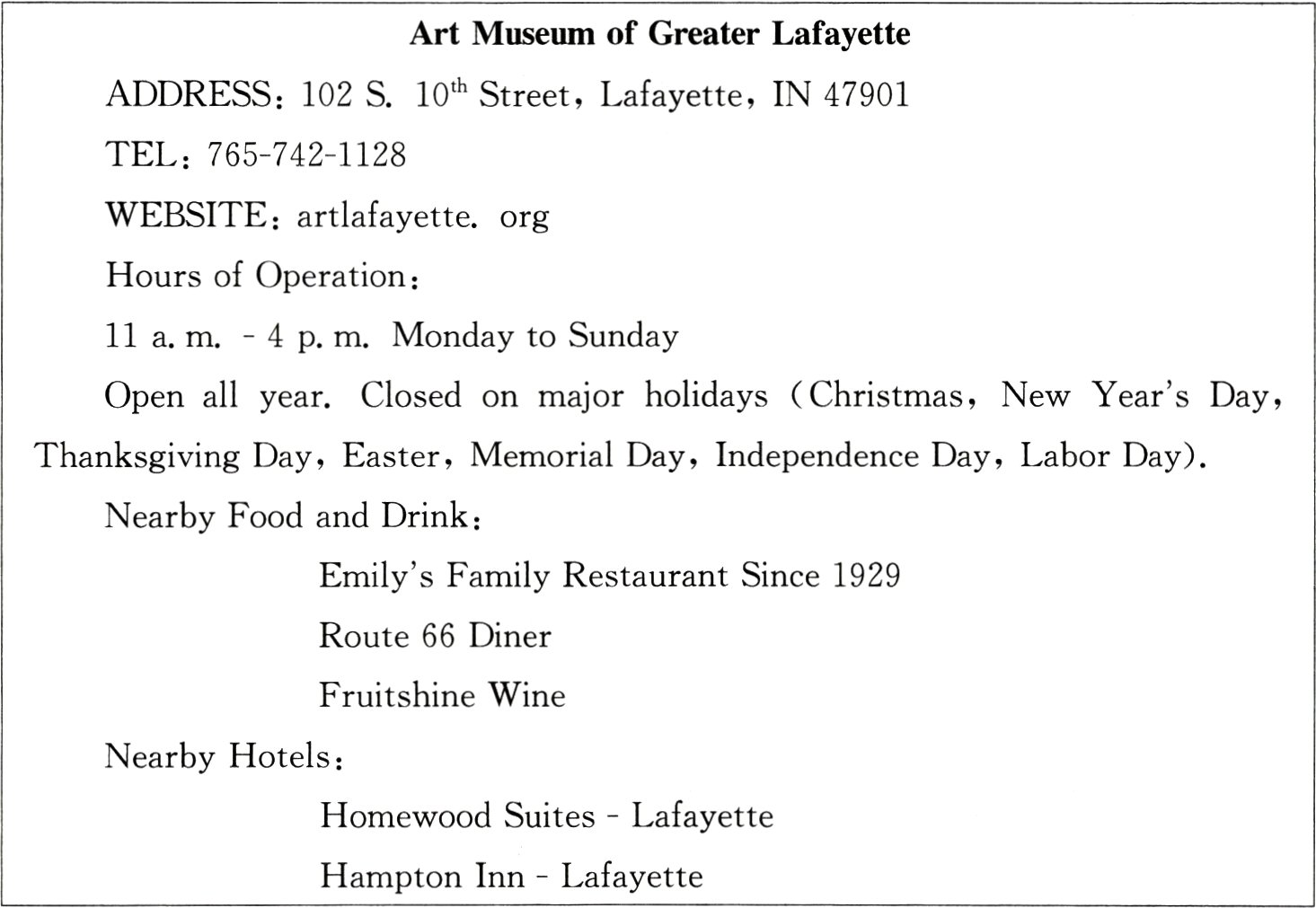
Art Museum of Greater Lafayette
ADDRESS: 102 S.$10^{th}$ Street, Lafayette, IN 47901
TEL:765 -742 -1128
WEBSITE: artlafayette.org
Hours of Operation:
11 a.m.-4 p.m. Monday to Sunday
Open all year. Closed on major holidays (Christmas, New Year’s Day, Thanksgiving Day, Easter, Memorial Day, Independence Day, Labor Day).
Nearby Food and Drink:
Emily’s Family Restaurant Since 1929
Route 66 Diner
Fruitshine Wine
Nearby Hotels:
Homewood Suites - Lafayette
Hampton Inn - Lafayette
( )26. People can’t get in touch with the museum by _________.
A. making a phone call
B. sending a letter to its address
C. visiting artlafayette.org
D. leaving a message on its social platform
( )27. The museum opens at _________ every day.
A. 8 a.m. B. 9 a.m. C. 10 a.m. D. 11 a.m.
( )28. Visitors can’t visit the museum on _________.
A. January 1 B. June 1 C. October 1 D. December 23
B
Once upon a time, a king offered a prize to the artist who could paint the best picture of peace. The king got thousands of paintings from different artists. He studied each one carefully and finally decided upon two that he really liked. He now had to choose between them.
The first was a painting of a beautiful calm lake with clear water. And there were green forests and high mountains. The sky was blue with white clouds.
The other painting had mountains too, but these mountains were rugged(崎岖的). A huge waterfall(瀑布) fell down from one side of the mountain around. Above them was an angry sky, lit by lightning, from which heavy rain fell.
Most people agreed that the first painting clearly showed a place of perfect peace. It can make people calm down. However, when the king looked at the second painting more closely, he found a small bush growing behind the waterfall. There, in the small bush, a mother bird built her nest. In the middle of the angry water, in the wind and the noise, she sat still on her nest — in perfect peace.
The king chose the second painting. When asked why, he said, “Peace does not mean being in a place where there is no noise, trouble or hard work. It means being in the middle of all these things and yet still being able to find calm and quiet in your heart, and to carry on with your life. This is the true meaning of peace.”
( )29. According to the story, the first painting gave people a feeling of _________.
A. warmth B. anger C. noise D. calm
( )30. Which of the following describes the second painting correctly?
A. It was sunny and the sky was blue.
B. The weather made the bird angry.
C. It had high, smooth mountains.
D. The bird wasn’t afraid of the noise.
( )31. The king chose the second painting because _________.
A. it showed a new idea of peace B. there was no noise in it
C. the artist worked hard on it D. it was close to nature
( )32. What can we learn from the story?
A. Being quiet means staying in a peaceful environment.
B. Real peace means spending more time in nature.
C. We should find real peace in our hearts.
D. Birds do better in finding peace than humans do.
C
A man was walking through the woods with his axe (斧头) when a small tree called to him. It said, “Hello friend. Can you cut down those bigger trees? They’re stopping the sun. It is so crowded here that I have no room to spread my roots. I can’t feel the wind.”
The little tree held out its tiny leaves. It looked so sad. It continued, “If those trees were gone, I’d be able to grow. A year from now, I’d be the biggest tree here. But for now, I’m just a small tree.”
The man thought for a while and then agreed. He walked over to the big trees and started cutting them down. Soon he cleared lots of place around the small tree. Now it would be able to feel the sun and wind. It would grow bigger and become the biggest tree in that area.
But something else happened instead. The sun’s heat came first, burning the small tree, which wasn’t used to so much sunlight. Heavy wind and rain came — without the bigger trees to protect it, the small tree was hit by the storm. Soon, the tree was nearly dead.
“You’ve been quite foolish.” said a snake that saw what had happened. “You thought this on yourself. If you’d left the bigger trees alone, the sun and storm wouldn’t have hurt you so badly. They protected you. If you had just waited longer, you would have grown to be just as big as them. You’ll be strong. But now, you’re nearly gone.”
( ) 33. Why was the little tree so sad at first?
A. Because the sunlight was too bright.
B. Because the man would cut it down.
C. Because the wind here was too heavy.
D. Because the space was too small to grow.
( ) 34. What happened to the small tree after the man cut down the bigger trees?
A. It was almost dead.
B. It enjoyed the heat of the sun.
C. It enjoyed heavy wind and rain.
D. It became the biggest tree in that area.
( ) 35. What does the underlined word “They” in paragraph 5 refer to?
A. The bigger trees. B. The sun and storm.
C. The wind and rain. D. The sun and wind.
( ) 36. From the passage, we can learn that ________.
A. every dog has its day B. practice makes perfect
C. we need a hand sometimes D. do as Romans do when in Rome
D
Five years ago, a restaurant owner took pity on a homeless dog and served her dinner. No one knew at the time that this one act of kindness would turn into a tradition of feeding homeless dogs in the community each night.
It all began when a hungry, homeless dog looked through the window of a restaurant called Ajilalo, in Peru. The restaurant owner, Gerardo Oritz, saw the hunger in the dog’s eyes and was moved with compassion (怜悯) so he cooked a special dinner just for her. From that day on, the hungry dog arrived for her evening meal, which she paid for with a wag (摇摆) of her tail. The young dog could have been refused at any time, however, the kind Mr. Ortiz began a nightly tradition of feeding the thankful dog.
Like all happy restaurant customers, the dog must have spread the word about the good food being served at Ajialo because soon more homeless dogs began arriving at the restaurant door. Of course, they were also served a meal.
Mr. Ortiz said these dogs become his best customers. All the young dogs are thankful to be fed and he never minds when he sees a new dog look through the window and waiting there, it will be shown kindness and be fed by Mr. Ortiz.
The kindness toward the dogs doesn’t end with Mr. Ortiz, either. Soon his customers began bringing food to feed the dogs. Thankfully, the customers enjoy the compassion that the restaurant is showing the hungry dogs.
Mr. Ortiz is clearly an animal lover and thanks to him, plenty of dogs have a better life. Of course, it would be best if all could find loving homes but at least each dog is shown love, kindness, and go to sleep each night with a full stomach, all thanks to Mr. Ortiz and his wonderful customers.
( ) 37. What did Mr. Ortiz do when he first saw the hungry dog?
A. He didn’t noticed her at all. B. He left her where she was.
C. He drove her away at once. D. He served her with a dinner.
( ) 38. What happened to other homeless dogs that came to the restaurant?
A. They were brought home as pets.
B. They were refused at the restaurant door.
C. The hungry dog asked them to wag tails.
D. Mr. Ortiz and his customers fed them.
( ) 39. Which words best describe Mr. Ortiz?
A. Powerful and modest. B. Helpful and generous.
C. Energetic and fantastic. D. Confident and creative.
( ) 40. What’s the author’s purpose in writing the text?
A. To make dogs become people’s pets.
B. To make the restaurant more popular.
C. To make customers realize value of food.
D. To make people spread kindness for animals.
E
Have you heard about an idiom of tuibi sanshe?
In ancient times, she was a unit of distance. One she is equal to 30 li. One li is 500 metres and 30 li is 15,000 metres. __41__
There is a story behind this idiom. During the Spring and Autumn Period (770 - 476 BC), Prince Chong’er of the Jin state ran away from his home state. __42__
Once, he went to the state of Chu. King Chengwang of Chu saw him as an important guest and served him a large meal. He asked Chong’er, “If you rule the state of Jin one day, how would you thank me?” “__43__ I have nothing that you like.” Chong’er said. However, the king still asked for something. Finally, Chong’er said, “I would ask my army to retreat (撤退) sanshe if we ever fight.”
__44__ He became its ruler Wengong. Both of the two states wanted to become stronger and get more land. They went to war with each other. Jin Wengong didn’t break his promise. He asked his army to retreat sanshe and stay in Chengpu. The Chu army thought the Jin soldiers were afraid to fight, so they followed them. To their surprise, the Jin army surrounded (包围) them. __45__ This was the famous Battle of Chengpu. After this war, people used “tuibi sanshe” to mean retreating to avoid a conflict (冲突).
A. Finally Jin lost the war.
B. In the end, Jin won the war.
C. He had to travel to other states.
D. He must stay in his own country.
E. So sanshe, meaning three she, is 45 km.
F. It seems your state has everything you want.
G. Later, Chong’er returned to his home state Jin
41. __________ 42. __________ 43. __________ 44. __________ 45. __________
A
Art Museum of Greater Lafayette
ADDRESS: 102 S.$10^{th}$ Street, Lafayette, IN 47901
TEL:765 -742 -1128
WEBSITE: artlafayette.org
Hours of Operation:
11 a.m.-4 p.m. Monday to Sunday
Open all year. Closed on major holidays (Christmas, New Year’s Day, Thanksgiving Day, Easter, Memorial Day, Independence Day, Labor Day).
Nearby Food and Drink:
Emily’s Family Restaurant Since 1929
Route 66 Diner
Fruitshine Wine
Nearby Hotels:
Homewood Suites - Lafayette
Hampton Inn - Lafayette
( )26. People can’t get in touch with the museum by _________.
A. making a phone call
B. sending a letter to its address
C. visiting artlafayette.org
D. leaving a message on its social platform
( )27. The museum opens at _________ every day.
A. 8 a.m. B. 9 a.m. C. 10 a.m. D. 11 a.m.
( )28. Visitors can’t visit the museum on _________.
A. January 1 B. June 1 C. October 1 D. December 23
B
Once upon a time, a king offered a prize to the artist who could paint the best picture of peace. The king got thousands of paintings from different artists. He studied each one carefully and finally decided upon two that he really liked. He now had to choose between them.
The first was a painting of a beautiful calm lake with clear water. And there were green forests and high mountains. The sky was blue with white clouds.
The other painting had mountains too, but these mountains were rugged(崎岖的). A huge waterfall(瀑布) fell down from one side of the mountain around. Above them was an angry sky, lit by lightning, from which heavy rain fell.
Most people agreed that the first painting clearly showed a place of perfect peace. It can make people calm down. However, when the king looked at the second painting more closely, he found a small bush growing behind the waterfall. There, in the small bush, a mother bird built her nest. In the middle of the angry water, in the wind and the noise, she sat still on her nest — in perfect peace.
The king chose the second painting. When asked why, he said, “Peace does not mean being in a place where there is no noise, trouble or hard work. It means being in the middle of all these things and yet still being able to find calm and quiet in your heart, and to carry on with your life. This is the true meaning of peace.”
( )29. According to the story, the first painting gave people a feeling of _________.
A. warmth B. anger C. noise D. calm
( )30. Which of the following describes the second painting correctly?
A. It was sunny and the sky was blue.
B. The weather made the bird angry.
C. It had high, smooth mountains.
D. The bird wasn’t afraid of the noise.
( )31. The king chose the second painting because _________.
A. it showed a new idea of peace B. there was no noise in it
C. the artist worked hard on it D. it was close to nature
( )32. What can we learn from the story?
A. Being quiet means staying in a peaceful environment.
B. Real peace means spending more time in nature.
C. We should find real peace in our hearts.
D. Birds do better in finding peace than humans do.
C
A man was walking through the woods with his axe (斧头) when a small tree called to him. It said, “Hello friend. Can you cut down those bigger trees? They’re stopping the sun. It is so crowded here that I have no room to spread my roots. I can’t feel the wind.”
The little tree held out its tiny leaves. It looked so sad. It continued, “If those trees were gone, I’d be able to grow. A year from now, I’d be the biggest tree here. But for now, I’m just a small tree.”
The man thought for a while and then agreed. He walked over to the big trees and started cutting them down. Soon he cleared lots of place around the small tree. Now it would be able to feel the sun and wind. It would grow bigger and become the biggest tree in that area.
But something else happened instead. The sun’s heat came first, burning the small tree, which wasn’t used to so much sunlight. Heavy wind and rain came — without the bigger trees to protect it, the small tree was hit by the storm. Soon, the tree was nearly dead.
“You’ve been quite foolish.” said a snake that saw what had happened. “You thought this on yourself. If you’d left the bigger trees alone, the sun and storm wouldn’t have hurt you so badly. They protected you. If you had just waited longer, you would have grown to be just as big as them. You’ll be strong. But now, you’re nearly gone.”
( ) 33. Why was the little tree so sad at first?
A. Because the sunlight was too bright.
B. Because the man would cut it down.
C. Because the wind here was too heavy.
D. Because the space was too small to grow.
( ) 34. What happened to the small tree after the man cut down the bigger trees?
A. It was almost dead.
B. It enjoyed the heat of the sun.
C. It enjoyed heavy wind and rain.
D. It became the biggest tree in that area.
( ) 35. What does the underlined word “They” in paragraph 5 refer to?
A. The bigger trees. B. The sun and storm.
C. The wind and rain. D. The sun and wind.
( ) 36. From the passage, we can learn that ________.
A. every dog has its day B. practice makes perfect
C. we need a hand sometimes D. do as Romans do when in Rome
D
Five years ago, a restaurant owner took pity on a homeless dog and served her dinner. No one knew at the time that this one act of kindness would turn into a tradition of feeding homeless dogs in the community each night.
It all began when a hungry, homeless dog looked through the window of a restaurant called Ajilalo, in Peru. The restaurant owner, Gerardo Oritz, saw the hunger in the dog’s eyes and was moved with compassion (怜悯) so he cooked a special dinner just for her. From that day on, the hungry dog arrived for her evening meal, which she paid for with a wag (摇摆) of her tail. The young dog could have been refused at any time, however, the kind Mr. Ortiz began a nightly tradition of feeding the thankful dog.
Like all happy restaurant customers, the dog must have spread the word about the good food being served at Ajialo because soon more homeless dogs began arriving at the restaurant door. Of course, they were also served a meal.
Mr. Ortiz said these dogs become his best customers. All the young dogs are thankful to be fed and he never minds when he sees a new dog look through the window and waiting there, it will be shown kindness and be fed by Mr. Ortiz.
The kindness toward the dogs doesn’t end with Mr. Ortiz, either. Soon his customers began bringing food to feed the dogs. Thankfully, the customers enjoy the compassion that the restaurant is showing the hungry dogs.
Mr. Ortiz is clearly an animal lover and thanks to him, plenty of dogs have a better life. Of course, it would be best if all could find loving homes but at least each dog is shown love, kindness, and go to sleep each night with a full stomach, all thanks to Mr. Ortiz and his wonderful customers.
( ) 37. What did Mr. Ortiz do when he first saw the hungry dog?
A. He didn’t noticed her at all. B. He left her where she was.
C. He drove her away at once. D. He served her with a dinner.
( ) 38. What happened to other homeless dogs that came to the restaurant?
A. They were brought home as pets.
B. They were refused at the restaurant door.
C. The hungry dog asked them to wag tails.
D. Mr. Ortiz and his customers fed them.
( ) 39. Which words best describe Mr. Ortiz?
A. Powerful and modest. B. Helpful and generous.
C. Energetic and fantastic. D. Confident and creative.
( ) 40. What’s the author’s purpose in writing the text?
A. To make dogs become people’s pets.
B. To make the restaurant more popular.
C. To make customers realize value of food.
D. To make people spread kindness for animals.
E
Have you heard about an idiom of tuibi sanshe?
In ancient times, she was a unit of distance. One she is equal to 30 li. One li is 500 metres and 30 li is 15,000 metres. __41__
There is a story behind this idiom. During the Spring and Autumn Period (770 - 476 BC), Prince Chong’er of the Jin state ran away from his home state. __42__
Once, he went to the state of Chu. King Chengwang of Chu saw him as an important guest and served him a large meal. He asked Chong’er, “If you rule the state of Jin one day, how would you thank me?” “__43__ I have nothing that you like.” Chong’er said. However, the king still asked for something. Finally, Chong’er said, “I would ask my army to retreat (撤退) sanshe if we ever fight.”
__44__ He became its ruler Wengong. Both of the two states wanted to become stronger and get more land. They went to war with each other. Jin Wengong didn’t break his promise. He asked his army to retreat sanshe and stay in Chengpu. The Chu army thought the Jin soldiers were afraid to fight, so they followed them. To their surprise, the Jin army surrounded (包围) them. __45__ This was the famous Battle of Chengpu. After this war, people used “tuibi sanshe” to mean retreating to avoid a conflict (冲突).
A. Finally Jin lost the war.
B. In the end, Jin won the war.
C. He had to travel to other states.
D. He must stay in his own country.
E. So sanshe, meaning three she, is 45 km.
F. It seems your state has everything you want.
G. Later, Chong’er returned to his home state Jin
41. __________ 42. __________ 43. __________ 44. __________ 45. __________
答案:
26. D 27. D 28. A 29. D 30. D 31. A 32. C 33. D 34. A 35. A 36. C 37. D 38. D 39. B 40. D 41. E 42. C 43. F 44. G 45. B
查看更多完整答案,请扫码查看

