

 搜索
搜索
第21页
- 第1页
- 第2页
- 第3页
- 第4页
- 第5页
- 第6页
- 第7页
- 第8页
- 第9页
- 第10页
- 第11页
- 第12页
- 第13页
- 第14页
- 第15页
- 第16页
- 第17页
- 第18页
- 第19页
- 第20页
- 第21页
- 第22页
- 第23页
- 第24页
- 第25页
- 第26页
- 第27页
- 第28页
- 第29页
- 第30页
- 第31页
- 第32页
- 第33页
- 第34页
- 第35页
- 第36页
- 第37页
- 第38页
- 第39页
- 第40页
- 第41页
- 第42页
- 第43页
- 第44页
- 第45页
- 第46页
- 第47页
- 第48页
- 第49页
- 第50页
- 第51页
- 第52页
- 第53页
- 第54页
- 第55页
- 第56页
- 第57页
- 第58页
- 第59页
- 第60页
- 第61页
- 第62页
- 第63页
- 第64页
- 第65页
- 第66页
- 第67页
- 第68页
- 第69页
- 第70页
- 第71页
- 第72页
- 第73页
- 第74页
- 第75页
- 第76页
- 第77页
- 第78页
- 第79页
- 第80页
- 第81页
- 第82页
- 第83页
- 第84页
- 第85页
- 第86页
- 第87页
- 第88页
- 第89页
- 第90页
- 第91页
- 第92页
- 第93页
- 第94页
- 第95页
- 第96页
- 第97页
- 第98页
- 第99页
- 第100页
- 第101页
- 第102页
- 第103页
- 第104页
3. I saw him
A.go past
B.went past
C.passed
D.past
go past
me without saying anything this morning. (A
)A.go past
B.went past
C.passed
D.past
答案:
3. A
4. The girls walked
A.through
B.across
C.over
D.after
through
the gate with Miss Li. (A
)A.through
B.across
C.over
D.after
答案:
4. A
5. —Would you like
—Sorry, I have to help my mother do some chores. (
A.see
B.seeing
C.to see
D.to seeing
to see
a movie with us tonight?—Sorry, I have to help my mother do some chores. (
C
)A.see
B.seeing
C.to see
D.to seeing
答案:
5. C
Ⅳ. 阅读短文,从下面方框内的七个选项中,选择五个还原到文中,使短文意思通顺、结构完整。
American people like to say "Thank you" when others help them or say something kind to them. People of other countries do so, too. 1.
You should say "Thank you" when someone passes you the salt on the table, 2.
"Thank you" is used not only between friends, but also between parents and children, brothers and sisters, husbands and wives.
3.
4.
5.
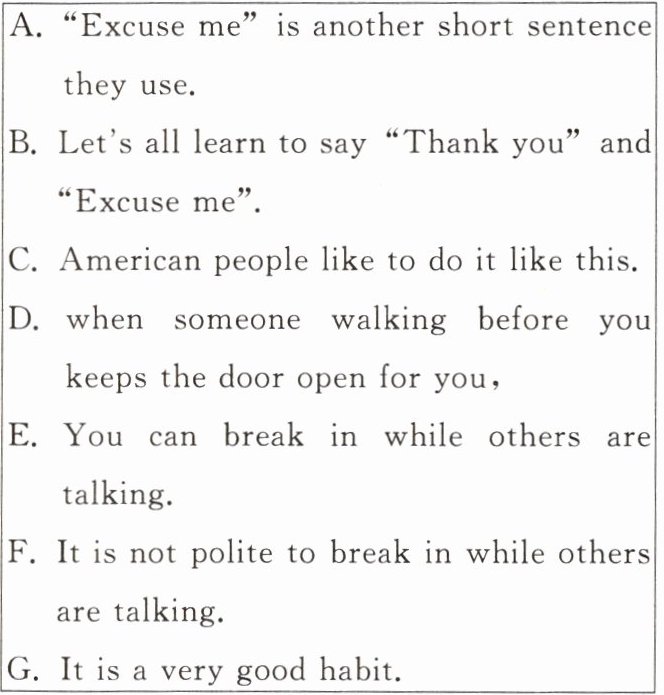
A. "Excuse me" is another short sentence they use.
B. Let's all learn to say "Thank you" and "Excuse me".
C. American people like to do it like this.
D. when someone walking before you keeps the door open for you,
E. You can break in while others are talking.
F. It is not polite to break in while others are talking.
G. It is a very good habit.
American people like to say "Thank you" when others help them or say something kind to them. People of other countries do so, too. 1.
G
You should say "Thank you" when someone passes you the salt on the table, 2.
D
when someone says you have done well, or you have bought a nice thing, or your city is very beautiful."Thank you" is used not only between friends, but also between parents and children, brothers and sisters, husbands and wives.
3.
A
When you hear someone say so behind you, you know that somebody wants to walk past you.4.
F
If you want to speak to one of them, say "Excuse me" first, and then begin talking. You should also do so when you want to cough or make any unpleasant noise before others.5.
B
A. "Excuse me" is another short sentence they use.
B. Let's all learn to say "Thank you" and "Excuse me".
C. American people like to do it like this.
D. when someone walking before you keeps the door open for you,
E. You can break in while others are talking.
F. It is not polite to break in while others are talking.
G. It is a very good habit.
答案:
Ⅳ. 1~5 GDAFB
Ⅰ. 翻译单词。
1. 葡萄
2. 中心的;中央的
3. 附近的;邻近的;在附近;附近
4. 邮寄;发电子邮件;邮件;信件
5. 向东;朝东;东方的;东部的;东;东方
1. 葡萄
grape
2. 中心的;中央的
central
3. 附近的;邻近的;在附近;附近
nearby
4. 邮寄;发电子邮件;邮件;信件
mail
5. 向东;朝东;东方的;东部的;东;东方
east
答案:
Ⅰ. 1. grape 2. central 3. nearby 4. mail 5. east
Ⅱ. 翻译短语。
1. 做某事很兴奋
2. 在某人去……的路上
3. 直到……才……
4. 路过;经过
5. 抱歉,对不起;什么,请再说一遍
1. 做某事很兴奋
be excited to do sth.
2. 在某人去……的路上
on one’s way to ...
3. 直到……才……
not ... until ...
4. 路过;经过
pass by
5. 抱歉,对不起;什么,请再说一遍
pardon me
答案:
Ⅱ. 1. be excited to do sth. 2. on one’s way to ... 3. not ... until ... 4. pass by 5. pardon me
查看更多完整答案,请扫码查看

