

 搜索
搜索
第74页
- 第4页
- 第5页
- 第6页
- 第7页
- 第8页
- 第9页
- 第10页
- 第11页
- 第12页
- 第13页
- 第14页
- 第15页
- 第16页
- 第17页
- 第18页
- 第19页
- 第20页
- 第21页
- 第22页
- 第23页
- 第24页
- 第25页
- 第26页
- 第27页
- 第28页
- 第29页
- 第30页
- 第31页
- 第32页
- 第33页
- 第34页
- 第35页
- 第36页
- 第37页
- 第38页
- 第39页
- 第40页
- 第41页
- 第42页
- 第43页
- 第44页
- 第45页
- 第46页
- 第47页
- 第48页
- 第49页
- 第50页
- 第51页
- 第52页
- 第53页
- 第54页
- 第55页
- 第56页
- 第57页
- 第58页
- 第59页
- 第60页
- 第61页
- 第62页
- 第63页
- 第64页
- 第65页
- 第66页
- 第67页
- 第68页
- 第69页
- 第70页
- 第71页
- 第72页
- 第73页
- 第74页
- 第75页
- 第76页
- 第77页
- 第78页
- 第79页
- 第80页
- 第81页
- 第82页
- 第83页
- 第84页
- 第85页
- 第86页
- 第87页
- 第88页
一、选用方框内的单词或词组填空,其中有一个单词或词组是多余的。
uniforms pushed into guns twin receive a message background
1. — Do you know the
2. Our school asks us to wear school
3. Kate is her
4. Justin and Luke were
5. When did you
uniforms pushed into guns twin receive a message background
1. — Do you know the
background
of that young man? — Yes.2. Our school asks us to wear school
uniforms
every day.3. Kate is her
twin
sister, so they look the same.4. Justin and Luke were
pushed into
a minibus.5. When did you
receive a message
from Andy?
答案:
1. background 2. uniforms 3. twin 4. pushed into 5. receive a message
1. I saw her
A.to water
B.water
C.watering
D.watered
C
flowers in the garden when I passed by yesterday.A.to water
B.water
C.watering
D.watered
答案:
1. C
2. The man
A.is called
B.was called
C.calling
D.called
D
Li Huang was put into prison.A.is called
B.was called
C.calling
D.called
答案:
2. D
3. — Do you watch Peppa Pig on TV? It’s so funny! — Oh no! I think it’s quite
A.curious
B.brave
C.gentle
D.silly
D
.A.curious
B.brave
C.gentle
D.silly
答案:
3. D
4. My mother doesn’t like stories
A.that
B.who
C.where
D.those
A
have sad endings.A.that
B.who
C.where
D.those
答案:
4. A
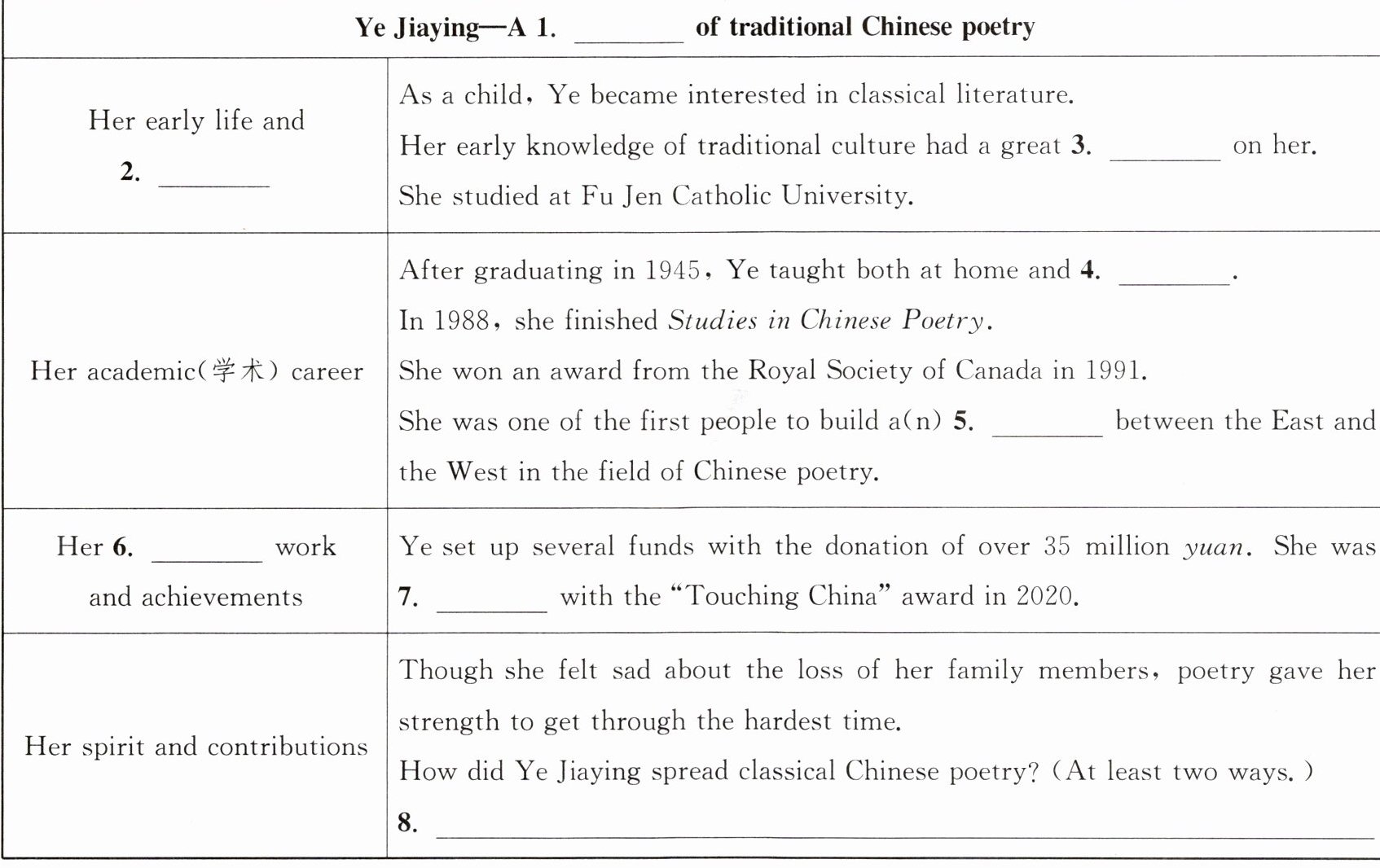
三、[新题型](2025·南京鼓楼区期末改编)请认真阅读下面短文,并根据所读内容在文章后表格中的空格里填入最恰当的单词。注意:第1~7小题每空一词,第8小题词数不限。
Ye Jiaying, a world-famous Chinese master of traditional Chinese culture, passed away at the age of 100, according to Nankai University, where she worked for a large part of her life.
Born in Beijing in 1924, Ye grew up in a family that deeply valued education and culture. From a young age, she showed a great interest in classical literature and art. Her father played an important role in shaping her early education, encouraging her to read widely. Her early contact with traditional culture gave her a strong love for protecting and sharing China’s literary traditions.
Ye graduated from Fu Jen Catholic University in 1945 and later began her teaching career. In 1969, she moved to Vancouver, Canada, where she joined the University of British Columbia (UBC) as a professor. She was one of the first scholars to introduce classical Chinese poetry to Western readers. Studies in Chinese Poetry, the book she co-wrote with Harvard professor James Hightower in 1988, is one of the greatest works on classical Chinese poetry.
Her pioneering work earned her an award from the Royal Society of Canada in 1991, making her the first Chinese scholar in classical literature to receive this honor. Ye also taught at some top universities like Harvard, Yale, and Columbia as a visiting professor.
Driven by a deep love for her homeland, Ye began returning to China. Starting in 1979, she travelled to the mainland each year to give talks, and later decided to teach at Nankai University.
Throughout her life, Ye received numerous awards, but her contributions were far more than that. In 2018 and 2019, she donated over 35 million yuan to set up several funds(基金) at Nankai University. She was given the “Touching China” award in 2020.
“I’ve never cared about personal wealth. I’ve faced many challenges and had many losses in my life. My family members have passed away one after another. In my darkest moments, it was poetry that supported me through difficulties,” she once said.
Ye devoted all her life to developing and spreading classical Chinese culture. She is remembered for her contributions to classical Chinese literature, education, and cultural preservation(保护), leaving lasting value worldwide.
Ye Jiaying, a world-famous Chinese master of traditional Chinese culture, passed away at the age of 100, according to Nankai University, where she worked for a large part of her life.
Born in Beijing in 1924, Ye grew up in a family that deeply valued education and culture. From a young age, she showed a great interest in classical literature and art. Her father played an important role in shaping her early education, encouraging her to read widely. Her early contact with traditional culture gave her a strong love for protecting and sharing China’s literary traditions.
Ye graduated from Fu Jen Catholic University in 1945 and later began her teaching career. In 1969, she moved to Vancouver, Canada, where she joined the University of British Columbia (UBC) as a professor. She was one of the first scholars to introduce classical Chinese poetry to Western readers. Studies in Chinese Poetry, the book she co-wrote with Harvard professor James Hightower in 1988, is one of the greatest works on classical Chinese poetry.
Her pioneering work earned her an award from the Royal Society of Canada in 1991, making her the first Chinese scholar in classical literature to receive this honor. Ye also taught at some top universities like Harvard, Yale, and Columbia as a visiting professor.
Driven by a deep love for her homeland, Ye began returning to China. Starting in 1979, she travelled to the mainland each year to give talks, and later decided to teach at Nankai University.
Throughout her life, Ye received numerous awards, but her contributions were far more than that. In 2018 and 2019, she donated over 35 million yuan to set up several funds(基金) at Nankai University. She was given the “Touching China” award in 2020.
“I’ve never cared about personal wealth. I’ve faced many challenges and had many losses in my life. My family members have passed away one after another. In my darkest moments, it was poetry that supported me through difficulties,” she once said.
Ye devoted all her life to developing and spreading classical Chinese culture. She is remembered for her contributions to classical Chinese literature, education, and cultural preservation(保护), leaving lasting value worldwide.
答案:
1. master 2. education 3. influence 4. abroad 5. bridge 6. social 7. honored 8. By introducing classical Chinese poetry to Western readers. By giving talks in the mainland.
查看更多完整答案,请扫码查看

