

 搜索
搜索
第90页
- 第1页
- 第2页
- 第3页
- 第4页
- 第5页
- 第6页
- 第7页
- 第8页
- 第9页
- 第10页
- 第11页
- 第12页
- 第13页
- 第14页
- 第15页
- 第16页
- 第17页
- 第18页
- 第19页
- 第20页
- 第21页
- 第22页
- 第23页
- 第24页
- 第25页
- 第26页
- 第27页
- 第28页
- 第29页
- 第30页
- 第31页
- 第32页
- 第33页
- 第34页
- 第35页
- 第36页
- 第37页
- 第38页
- 第39页
- 第40页
- 第41页
- 第42页
- 第43页
- 第44页
- 第45页
- 第46页
- 第47页
- 第48页
- 第49页
- 第50页
- 第51页
- 第52页
- 第53页
- 第54页
- 第55页
- 第56页
- 第57页
- 第58页
- 第59页
- 第60页
- 第61页
- 第62页
- 第63页
- 第64页
- 第65页
- 第66页
- 第67页
- 第68页
- 第69页
- 第70页
- 第71页
- 第72页
- 第73页
- 第74页
- 第75页
- 第76页
- 第77页
- 第78页
- 第79页
- 第80页
- 第81页
- 第82页
- 第83页
- 第84页
- 第85页
- 第86页
- 第87页
- 第88页
- 第89页
- 第90页
- 第91页
- 第92页
- 第93页
- 第94页
- 第95页
- 第96页
Week 12 Tuesday 阅读理解A
主题:人物故事 语篇类型:记叙文 词数:151 难度:★★★★ 建议用时:8分钟 答案页码:P31 文章音频 精讲视频
Granny Nyima is 79 years old this year. She lives in a village near the China-Mongolia border (边境). She has done a great job. She was rewarded (授予) "Model Individual for National Ethnic Unity and Progress". She deserves this honor.
In 1971, Nyima became a border guard. She has walked over 180,000 kilometers along the border. She has stopped about 1,000 people from crossing the border without permission (允许). People call her "Living Boundary Stone".
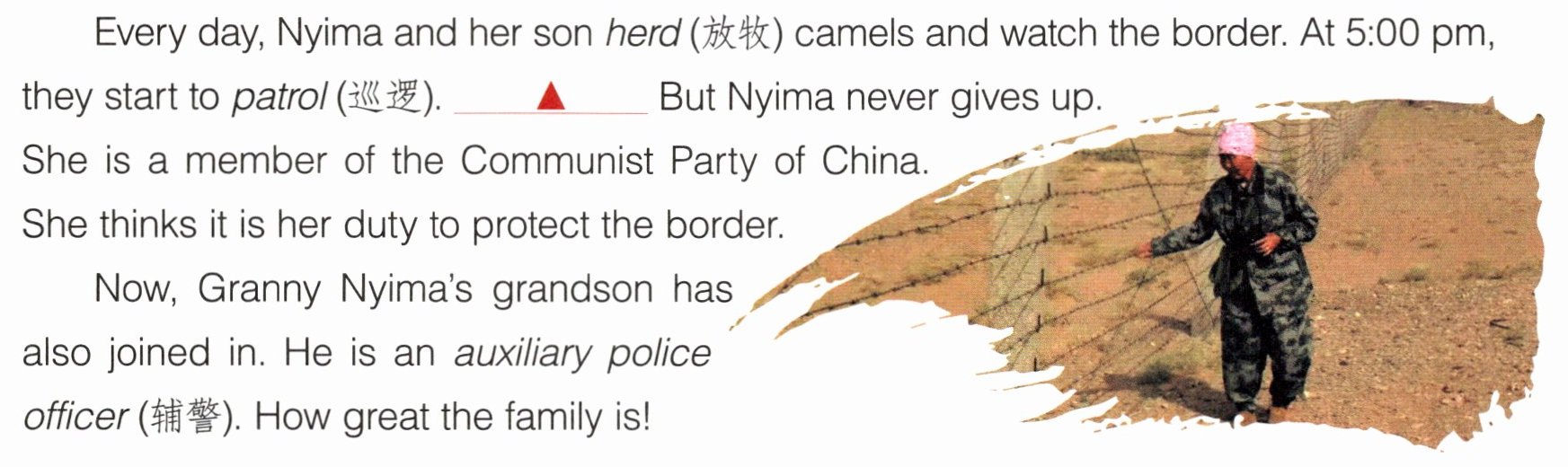
▶ Why do people call Granny Nyima "Living Boundary Stone"?
① Because she always takes a small boundary stone with her.
② Because she has walked a long way along the border.
③ Because she always watches the border on boundary stones.
④ Because she has stopped many border-crossing people without permission.
A. ①② B. ①③ C. ②③ D. ②④
▶ When do Nyima and her son start to patrol every day?
A. At 5:00 am. B. At 11:00 am. C. At 5:00 pm. D. At 9:00 pm.
▶ Which can be put in " ▲ " in Paragraph 3?
A. The life here is very hard. B. Many villagers join them to help.
C. They learned a lot from that. D. They always have a good time.
▶ How many people in Nyima's family guard the border?
A. One. B. Two. C. Three. D. Four.
▶ Which of the following is NOT right?
A. Nyima lives near the China-Mongolia border.
B. Nyima got a lot of money for protecting the border.
C. Nyima became a border guard when she was young.
D. Nyima thinks protecting the border is her duty.
主题:人物故事 语篇类型:记叙文 词数:151 难度:★★★★ 建议用时:8分钟 答案页码:P31 文章音频 精讲视频
Granny Nyima is 79 years old this year. She lives in a village near the China-Mongolia border (边境). She has done a great job. She was rewarded (授予) "Model Individual for National Ethnic Unity and Progress". She deserves this honor.
In 1971, Nyima became a border guard. She has walked over 180,000 kilometers along the border. She has stopped about 1,000 people from crossing the border without permission (允许). People call her "Living Boundary Stone".
▶ Why do people call Granny Nyima "Living Boundary Stone"?
① Because she always takes a small boundary stone with her.
② Because she has walked a long way along the border.
③ Because she always watches the border on boundary stones.
④ Because she has stopped many border-crossing people without permission.
A. ①② B. ①③ C. ②③ D. ②④
▶ When do Nyima and her son start to patrol every day?
A. At 5:00 am. B. At 11:00 am. C. At 5:00 pm. D. At 9:00 pm.
▶ Which can be put in " ▲ " in Paragraph 3?
A. The life here is very hard. B. Many villagers join them to help.
C. They learned a lot from that. D. They always have a good time.
▶ How many people in Nyima's family guard the border?
A. One. B. Two. C. Three. D. Four.
▶ Which of the following is NOT right?
A. Nyima lives near the China-Mongolia border.
B. Nyima got a lot of money for protecting the border.
C. Nyima became a border guard when she was young.
D. Nyima thinks protecting the border is her duty.
答案:
1. D 细节理解题。由第二段第二、三句 She has walked over 180,000 kilometers along the border. She has stopped about 1,000 people from crossing the border without permission. 可知,人们称她为“活界碑”是因为她沿着边境走了很长的路并且阻止了很多非法越境的人。
2. C 细节理解题。由第三段第二句 At 5:00 pm, they start to patrol. 可知,尼玛和她的儿子每天下午 5 点开始巡逻。
3. A 句子还原题。由第三段第四句 But Nyima never gives up. 可知,横线处所填的内容与此处语义存在转折。再结合第一段第二句 She lives in a village near the China-Mongolia border. 可知,她居住在边境附近,故 A 项“这个地方生活条件很苦”符合语境。
4. C 细节理解题。由第三段第一句 Every day, Nyima and her son herd camels and watch the border. 以及最后一段第一句 Now, Granny Nyima's grandson has also joined in. 可知,尼玛家有她、她儿子和她孙子三个人守护边境。
5. B 细节理解题。由第一段第二句 She lives in a village near the China-Mongolia border. 可知,A 项正确;文章未提及尼玛因保护边境得到很多钱,B 项错误;由第二段第一句 In 1971, Nyima became a border guard. 可知,C 项正确;由第三段最后一句 She thinks it is her duty to protect the border. 可知,D 项正确。
2. C 细节理解题。由第三段第二句 At 5:00 pm, they start to patrol. 可知,尼玛和她的儿子每天下午 5 点开始巡逻。
3. A 句子还原题。由第三段第四句 But Nyima never gives up. 可知,横线处所填的内容与此处语义存在转折。再结合第一段第二句 She lives in a village near the China-Mongolia border. 可知,她居住在边境附近,故 A 项“这个地方生活条件很苦”符合语境。
4. C 细节理解题。由第三段第一句 Every day, Nyima and her son herd camels and watch the border. 以及最后一段第一句 Now, Granny Nyima's grandson has also joined in. 可知,尼玛家有她、她儿子和她孙子三个人守护边境。
5. B 细节理解题。由第一段第二句 She lives in a village near the China-Mongolia border. 可知,A 项正确;文章未提及尼玛因保护边境得到很多钱,B 项错误;由第二段第一句 In 1971, Nyima became a border guard. 可知,C 项正确;由第三段最后一句 She thinks it is her duty to protect the border. 可知,D 项正确。
查看更多完整答案,请扫码查看

