

 搜索
搜索
2025年暑假总动员宁夏人民教育出版社七年级英语人教版
注:目前有些书本章节名称可能整理的还不是很完善,但都是按照顺序排列的,请同学们按照顺序仔细查找。练习册 2025年暑假总动员宁夏人民教育出版社七年级英语人教版 答案主要是用来给同学们做完题方便对答案用的,请勿直接抄袭。
第22页
- 第1页
- 第2页
- 第3页
- 第4页
- 第5页
- 第6页
- 第7页
- 第8页
- 第9页
- 第10页
- 第11页
- 第12页
- 第13页
- 第14页
- 第15页
- 第16页
- 第17页
- 第18页
- 第19页
- 第20页
- 第21页
- 第22页
- 第23页
- 第24页
- 第25页
- 第26页
- 第27页
- 第28页
- 第29页
- 第30页
- 第31页
- 第32页
- 第33页
- 第34页
- 第35页
- 第36页
- 第37页
- 第38页
- 第39页
- 第40页
- 第41页
- 第42页
- 第43页
- 第44页
- 第45页
- 第46页
- 第47页
- 第48页
- 第49页
- 第50页
- 第51页
- 第52页
- 第53页
- 第54页
- 第55页
- 第56页
- 第57页
- 第58页
- 第59页
- 第60页
- 第61页
- 第62页
- 第63页
- 第64页
- 第65页
- 第66页
- 第67页
- 第68页
- 第69页
- 第70页
- 第71页
- 第72页
- 第73页
- 第74页
- 第75页
- 第76页
- 第77页
- 第78页
- 第79页
- 第80页
- 第81页
- 第82页
- 第83页
- 第84页
- 第85页
- 第86页
- 第87页
- 第88页
- 第89页
- 第90页
- 第91页
- 第92页
- 第93页
- 第94页
Ⅳ. 完形填空
(2025·无锡期末改编) Bebeto's parents were discussing his sister Anna's birthday. It was just two days away. Birthdays were always lots of fun, even though there was no money for store-bought gifts. Most of their toys were 1, but there was nothing wrong with that. Like many families in this part of the country, they were poor.
This birthday would be 2. Anna was old enough and Bebeto had seen how her eyes lit up when she saw the new doll at Zulma's Store.
A(n) 3 came to him. The next day, Bebeto placed a tin can in a bag, tied(捆,绑) the bag to his bicycle and headed toward the countryside. The road became steeper(陡峭) so he had to get off and 4 the bike the rest of the way. After a long journey, he reached the mango grove(果园).
When the sun was high overhead, the hard work began. Almost all of the taller trees held fresh mangoes, but they were all out of his 5. Bebeto climbed up to the mango trees and used his knife to pick the mangoes. After a while, his neck ached from looking upward and his arms grew sore. He kept at it, and by late afternoon his bag was nearly 6.
On the way back, Bebeto was 7 that he would be too late, but he reached the store just in time to change some of his mangoes for the doll.
The following morning, Anna walked into the kitchen and took a seat. “Good morning, birthday girl,” said her mother. “I hear your brother has a special surprise for you today.”
Just then, Bebeto came in, 8 a large bowl of mangoes, and placed it on the table before Anna. “Happy birthday, sister!” he said.
“My favourite 9. Thank you!” Anna reached for the bowl and picked up the top mango. Then her eyes widened and her smile was even 10. There, among the fruit, was the new doll.
1. A. handwritten
B. eye-catching
C. homemade
D. time-saving
2. A. same
B. different
C. strange
D. dangerous
3. A. duty
B. wish
C. idea
D. example
4. A. sell
B. ride
C. break
D. push
5. A. reach
B. way
C. hand
D. mind
6. A. large
B. wise
C. half
D. full
7. A. excited
B. worried
C. amazed
D. bored
8. A. carrying
B. counting
C. changing
D. cutting
9. A. toy
B. fruit
C. doll
D. bowl
10. A. louder
B. luckier
C. brighter
D. lighter
(2025·无锡期末改编) Bebeto's parents were discussing his sister Anna's birthday. It was just two days away. Birthdays were always lots of fun, even though there was no money for store-bought gifts. Most of their toys were 1, but there was nothing wrong with that. Like many families in this part of the country, they were poor.
This birthday would be 2. Anna was old enough and Bebeto had seen how her eyes lit up when she saw the new doll at Zulma's Store.
A(n) 3 came to him. The next day, Bebeto placed a tin can in a bag, tied(捆,绑) the bag to his bicycle and headed toward the countryside. The road became steeper(陡峭) so he had to get off and 4 the bike the rest of the way. After a long journey, he reached the mango grove(果园).
When the sun was high overhead, the hard work began. Almost all of the taller trees held fresh mangoes, but they were all out of his 5. Bebeto climbed up to the mango trees and used his knife to pick the mangoes. After a while, his neck ached from looking upward and his arms grew sore. He kept at it, and by late afternoon his bag was nearly 6.
On the way back, Bebeto was 7 that he would be too late, but he reached the store just in time to change some of his mangoes for the doll.
The following morning, Anna walked into the kitchen and took a seat. “Good morning, birthday girl,” said her mother. “I hear your brother has a special surprise for you today.”
Just then, Bebeto came in, 8 a large bowl of mangoes, and placed it on the table before Anna. “Happy birthday, sister!” he said.
“My favourite 9. Thank you!” Anna reached for the bowl and picked up the top mango. Then her eyes widened and her smile was even 10. There, among the fruit, was the new doll.
1. A. handwritten
B. eye-catching
C. homemade
D. time-saving
2. A. same
B. different
C. strange
D. dangerous
3. A. duty
B. wish
C. idea
D. example
4. A. sell
B. ride
C. break
D. push
5. A. reach
B. way
C. hand
D. mind
6. A. large
B. wise
C. half
D. full
7. A. excited
B. worried
C. amazed
D. bored
8. A. carrying
B. counting
C. changing
D. cutting
9. A. toy
B. fruit
C. doll
D. bowl
10. A. louder
B. luckier
C. brighter
D. lighter
答案:
1. C;2. B;3. C;4. D;5. A;6. D;7. B;8. A;9. B;10. C
Ⅴ. 阅读理解
(2025·浙江期末) Which is the happiest day of a week? Saturday or Sunday? And which is the worst(最糟糕的) day? Is it Monday? On Mondays everyone goes back to school or work.
Two teachers in the US did research about the happiest and worst days of a week. Peter Dodds and Chris Danforth studied 10,000,000 sentences on social media(社交媒体). All of them have the words “I feel” or “I'm feeling”. Then, the teachers had a way of giving scores(分数) for words, between 1 and 9. Words like “excited” and “relaxed” could get high scores(6-9), but scores for words like “bad” and “terrible” were low(1-3). At last, they used these numbers to know which is the happiest day of the week. The research shows that Sunday is the happiest day. On that day, people think and write about the fun things they do on Saturday. Monday is also a happy day because people still remember their weekends. And the worst day of the week for most people is Wednesday. There are still two days for work before the weekend.
The research finds another surprising fact: people between 45 and 60 are the happiest people online, but the unhappiest group is students in junior high.
1. How does the writer begin the passage?
A. By telling a story.
B. By asking questions.
C. By giving numbers.
D. By talking about a picture.
2. Which of the following shows people's feelings in a week?
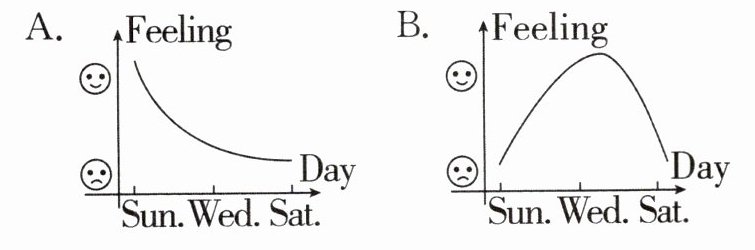
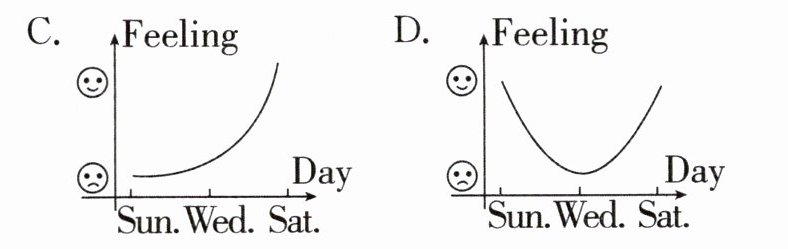
3. Who may be the happiest online according to the research?
A. A junior high student.
B. A fifty-year-old man.
C. An American teacher.
D. A primary school student.
4. What's the passage mainly about?
A. People's feelings on social media.
B. Two hard-working American teachers.
C. The happiest and worst days of a week.
D. Students' different feelings about study.
(2025·浙江期末) Which is the happiest day of a week? Saturday or Sunday? And which is the worst(最糟糕的) day? Is it Monday? On Mondays everyone goes back to school or work.
Two teachers in the US did research about the happiest and worst days of a week. Peter Dodds and Chris Danforth studied 10,000,000 sentences on social media(社交媒体). All of them have the words “I feel” or “I'm feeling”. Then, the teachers had a way of giving scores(分数) for words, between 1 and 9. Words like “excited” and “relaxed” could get high scores(6-9), but scores for words like “bad” and “terrible” were low(1-3). At last, they used these numbers to know which is the happiest day of the week. The research shows that Sunday is the happiest day. On that day, people think and write about the fun things they do on Saturday. Monday is also a happy day because people still remember their weekends. And the worst day of the week for most people is Wednesday. There are still two days for work before the weekend.
The research finds another surprising fact: people between 45 and 60 are the happiest people online, but the unhappiest group is students in junior high.
1. How does the writer begin the passage?
A. By telling a story.
B. By asking questions.
C. By giving numbers.
D. By talking about a picture.
2. Which of the following shows people's feelings in a week?
3. Who may be the happiest online according to the research?
A. A junior high student.
B. A fifty-year-old man.
C. An American teacher.
D. A primary school student.
4. What's the passage mainly about?
A. People's feelings on social media.
B. Two hard-working American teachers.
C. The happiest and worst days of a week.
D. Students' different feelings about study.
答案:
1. B
2. D
3. B
4. C
2. D
3. B
4. C
查看更多完整答案,请扫码查看

