

 搜索
搜索
第76页
- 第2页
- 第3页
- 第4页
- 第5页
- 第6页
- 第7页
- 第8页
- 第9页
- 第10页
- 第11页
- 第12页
- 第13页
- 第14页
- 第15页
- 第16页
- 第17页
- 第18页
- 第19页
- 第20页
- 第21页
- 第22页
- 第23页
- 第24页
- 第25页
- 第26页
- 第27页
- 第28页
- 第29页
- 第30页
- 第31页
- 第32页
- 第33页
- 第34页
- 第35页
- 第36页
- 第37页
- 第38页
- 第39页
- 第40页
- 第41页
- 第42页
- 第43页
- 第44页
- 第45页
- 第46页
- 第47页
- 第48页
- 第49页
- 第50页
- 第51页
- 第52页
- 第53页
- 第54页
- 第55页
- 第56页
- 第57页
- 第58页
- 第59页
- 第60页
- 第61页
- 第62页
- 第63页
- 第64页
- 第65页
- 第66页
- 第67页
- 第68页
- 第69页
- 第70页
- 第71页
- 第72页
- 第73页
- 第74页
- 第75页
- 第76页
- 第77页
- 第78页
- 第79页
- 第80页
- 第81页
- 第82页
- 第83页
- 第84页
- 第85页
- 第86页
- 第87页
- 第88页
- 第89页
- 第90页
- 第91页
- 第92页
- 第93页
- 第94页
- 第95页
- 第96页
- 第97页
- 第98页
- 第99页
- 第100页
- 第101页
- 第102页
- 第103页
- 第104页
- 第105页
- 第106页
- 第107页
- 第108页
- 第109页
- 第110页
- 第111页
- 第112页
- 第113页
- 第114页
- 第115页
- 第116页
- 第117页
- 第118页
- 第119页
- 第120页
Recently, a research on how a new virtual reality (VR,虚拟现实) experience educated children about the fire disasters was done. The new VR experience was developed by the University of South Australia, hoping to educate children to learn how to be safe in a fire. It presents a situation for children aged 10 - 12. In the situation, they are tasked to look after a friend's dog just before a fire event begins. They take part in a set of problem - solving activities to help save and protect themselves and the dog.
The findings showed that over 80% of children could calmly tell the advantages and disadvantages of different choices. They also learned to make wise decisions to protect themselves from a fire. Children thought it especially important and meaningful, because 91% of them didn't have knowledge of fires in the beginning, and 67% had said that they were too young to make safety decisions in a fire.
The researchers believed such VR experiences made it possible to engage, educate and empower the young. “As children born in modern times, they are interested in such technology and they can experience events in a real situation yet within the safe environment,” said Delene Weber, one of the researchers. “Well - designed VR can provide children with surprisingly valuable learning tools.” Meanwhile, because children have fewer life experiences, aren't so physically strong and are less likely to have learned much about fire safety, they're often most at risk. However, the role that children play in the fire safety at their homes should not be underestimated (低估). “Children don't need to be always waiting for help in disasters. With these VR experiences, we can make children understand the risks and realize they can help,” said Weber.
( )1. What's the purpose of the new VR experience?
A. To describe how children act in fire disasters.
B. To teach children to save themselves in a fire.
C. To introduce ways of avoiding a fire to children.
D. To increase children's interest in VR experiences.
( )2. From the findings, what's the children's attitude (态度) towards the new VR experience?
A. Doubtful. B. Worried. C. Uncertain. D. Supportive.
( )3. Which of the following in the dictionary best explains the underlined word “engage” in Paragraph 3?
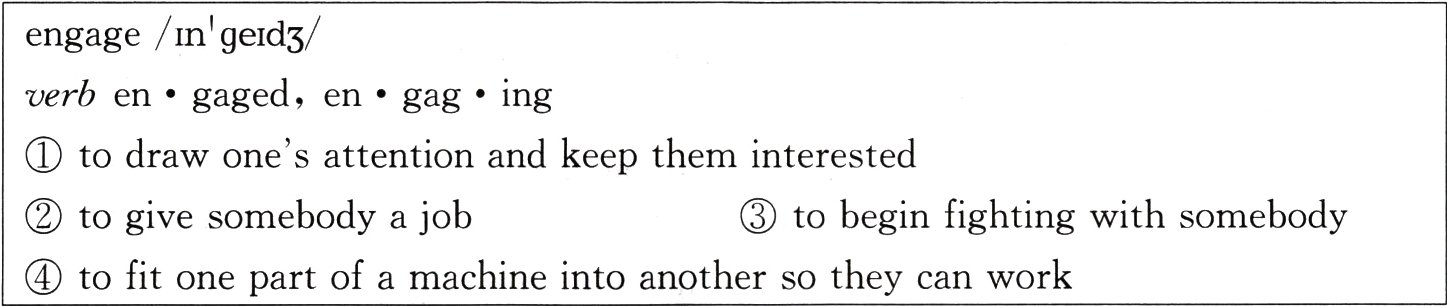
A. ① B. ② C. ③ D. ④
( )4. From Paragraph 3, we mainly get to know the ________ of the new VR experience.
A. development B. advantages C. quality D. introduction
( )5. According to the passage, which of the following is TRUE?
A. Children make no difference in the fire safety at their homes.
B. VR experiences are mainly designed for children in high school.
C. Well - designed VR can offer children amazingly valuable learning tools.
D. 91% of children believed they weren't old enough to make safety decisions.
The findings showed that over 80% of children could calmly tell the advantages and disadvantages of different choices. They also learned to make wise decisions to protect themselves from a fire. Children thought it especially important and meaningful, because 91% of them didn't have knowledge of fires in the beginning, and 67% had said that they were too young to make safety decisions in a fire.
The researchers believed such VR experiences made it possible to engage, educate and empower the young. “As children born in modern times, they are interested in such technology and they can experience events in a real situation yet within the safe environment,” said Delene Weber, one of the researchers. “Well - designed VR can provide children with surprisingly valuable learning tools.” Meanwhile, because children have fewer life experiences, aren't so physically strong and are less likely to have learned much about fire safety, they're often most at risk. However, the role that children play in the fire safety at their homes should not be underestimated (低估). “Children don't need to be always waiting for help in disasters. With these VR experiences, we can make children understand the risks and realize they can help,” said Weber.
( )1. What's the purpose of the new VR experience?
A. To describe how children act in fire disasters.
B. To teach children to save themselves in a fire.
C. To introduce ways of avoiding a fire to children.
D. To increase children's interest in VR experiences.
( )2. From the findings, what's the children's attitude (态度) towards the new VR experience?
A. Doubtful. B. Worried. C. Uncertain. D. Supportive.
( )3. Which of the following in the dictionary best explains the underlined word “engage” in Paragraph 3?
A. ① B. ② C. ③ D. ④
( )4. From Paragraph 3, we mainly get to know the ________ of the new VR experience.
A. development B. advantages C. quality D. introduction
( )5. According to the passage, which of the following is TRUE?
A. Children make no difference in the fire safety at their homes.
B. VR experiences are mainly designed for children in high school.
C. Well - designed VR can offer children amazingly valuable learning tools.
D. 91% of children believed they weren't old enough to make safety decisions.
答案:
1-5 BDABC
查看更多完整答案,请扫码查看

