

 搜索
搜索
第146页
- 第1页
- 第2页
- 第3页
- 第4页
- 第5页
- 第6页
- 第7页
- 第8页
- 第9页
- 第10页
- 第11页
- 第12页
- 第13页
- 第14页
- 第15页
- 第16页
- 第17页
- 第18页
- 第19页
- 第20页
- 第21页
- 第22页
- 第23页
- 第24页
- 第25页
- 第26页
- 第27页
- 第28页
- 第29页
- 第30页
- 第31页
- 第32页
- 第33页
- 第34页
- 第35页
- 第36页
- 第37页
- 第38页
- 第39页
- 第40页
- 第41页
- 第42页
- 第43页
- 第44页
- 第45页
- 第46页
- 第47页
- 第48页
- 第49页
- 第50页
- 第51页
- 第52页
- 第53页
- 第54页
- 第55页
- 第56页
- 第57页
- 第58页
- 第59页
- 第60页
- 第61页
- 第62页
- 第63页
- 第64页
- 第65页
- 第66页
- 第67页
- 第68页
- 第69页
- 第70页
- 第71页
- 第72页
- 第73页
- 第74页
- 第75页
- 第76页
- 第77页
- 第78页
- 第79页
- 第80页
- 第81页
- 第82页
- 第83页
- 第84页
- 第85页
- 第86页
- 第87页
- 第88页
- 第89页
- 第90页
- 第91页
- 第92页
- 第93页
- 第94页
- 第95页
- 第96页
- 第97页
- 第98页
- 第99页
- 第100页
- 第101页
- 第102页
- 第103页
- 第104页
- 第105页
- 第106页
- 第107页
- 第108页
- 第109页
- 第110页
- 第111页
- 第112页
- 第113页
- 第114页
- 第115页
- 第116页
- 第117页
- 第118页
- 第119页
- 第120页
- 第121页
- 第122页
- 第123页
- 第124页
- 第125页
- 第126页
- 第127页
- 第128页
- 第129页
- 第130页
- 第131页
- 第132页
- 第133页
- 第134页
- 第135页
- 第136页
- 第137页
- 第138页
- 第139页
- 第140页
- 第141页
- 第142页
- 第143页
- 第144页
- 第145页
- 第146页
- 第147页
- 第148页
- 第149页
- 第150页
- 第151页
- 第152页
- 第153页
- 第154页
- 第155页
- 第156页
- 第157页
- 第158页
- 第159页
- 第160页
- 第161页
- 第162页
- 第163页
- 第164页
- 第165页
- 第166页
- 第167页
- 第168页
- 第169页
- 第170页
- 第171页
- 第172页
- 第173页
考向五 非谓语动词
22. [2024河南70题改编] You can also ask your friends ________ think about it. (盲填)
23. [2023河南66题改编] I love this great museum. It is a wonderful place ________ learn about Chinese characters. (盲填)
24. [2022河南69题改编] That was my greatest weakness. So I try ________ correct it by finding an enjoyable way to study. (盲填)
25. [2021河南69题改编] In China, it is interesting ________ see people eating with chopsticks.(盲填)
26. [2020河南67题改编]To get some peace, I tried a trick ________ keep her busy for a little while. (盲填)
27. [2023河南59题改编]They say I can choose whatever I want to do in the end if I keep ________ (work) hard at school.
28. [2016河南69题改编] I'm not saying that I am not an example of this, but it always amazes (使惊愕) me how people can spend so much time on their phones without ________ (talk) to others.
考法总结
自2020年河南中考设立语篇填空第二节盲填新题型,动词不定式为该题型必考点,且5年考了5种用法,其分别作宾语补足语、定语、宾语、主语、目的状语。
①第22题考查动词不定式作宾语补足语的用法。
②第23题考查动词不定式作定语的用法。
③第24和第26题考查动词不定式作宾语和目的状语的用法。
④第25题考查动词不定式作主语的用法。
⑤第27和第28题考查动词/介词后接动名词作宾语的用法。
河南中考对非谓语动词的要求为:掌握动词不定式作宾语、宾语补足语及目的状语的用法。但从往年真题中可看出,考生还需了解动词不定式作定语和主语的用法,并熟记一些后接动名词形式作宾语的动词用法。
必背考点8(动词不定式)
1.动词不定式的构成与特征
动词不定式不能在句中单独作谓语,其基本形式为“to+动词原形”,否定形式为“not to+动词原形”,在句中使用时具有名词、形容词或副词的特征。
2.动词不定式的基本用法
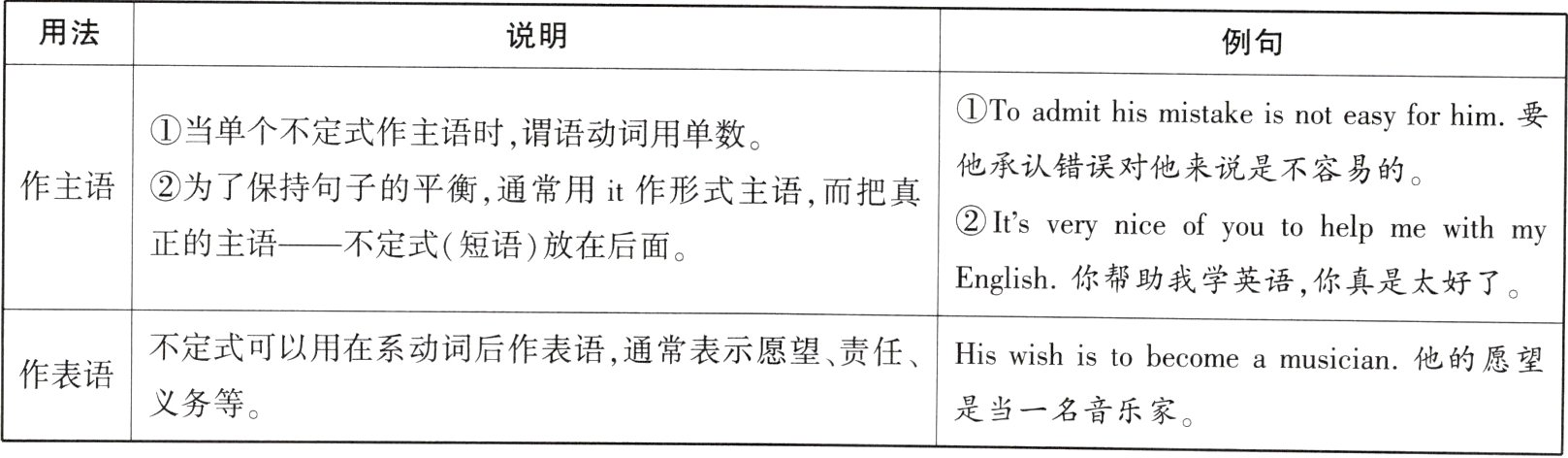
|用法|说明|例句|
| ---- | ---- | ---- |
|作主语|①当单个不定式作主语时,谓语动词用单数。
②为了保持句子的平衡,通常用it作形式主语,而把真正的主语——不定式(短语)放在后面。|①To admit his mistake is not easy for him. 要他承认错误对他来说是不容易的。
②It's very nice of you to help me with my English. 你帮助我学英语,你真是太好了。|
|作表语|不定式可以用在系动词后作表语,通常表示愿望、责任、义务等。|His wish is to become a musician. 他的愿望是当一名音乐家。|
必背考点8(动词不定式) 续表
|用法|说明|例句|
| ---- | ---- | ---- |
|作宾语|①一些表示命令、打算、希望、决心等的动词后常接不定式作宾语。此类动词巧记如下:
想要干:want, wish, hope, expect, would like/love, like
早打算:plan, prepare, mean
同意否:agree, offer, refuse
问问看:ask, afford
决定了:decide, make up one's mind, promise
开始学:begin/start, learn
尽力干:manage(反义词fail), try
努力做:make an effort
莫等待:wait
别忘记:forget(反义词remember)
②在find, think等词后跟不定式作宾语时,常用it作形式宾语,而将真正的宾语后置。|①He agreed to meet me at the station. 他同意在车站接我。
②I think it difficult to finish the program in two weeks. 我觉得要在两周内完成这个项目很难。|
|作宾语补足语|①常在“动词+宾语+不定式”结构中使用。常见此类动词有advise, allow, ask, encourage, force, help, invite, order, teach, tell, warn, wish, want/would like, expect, get等。
②在表示感官及使役等意义的动词后,要用不带to的不定式作补语。常见的此类动词有:一感(feel)、二听(hear, listen)、三让(let, make, have)、四看(look, see, notice, watch)。help后用带to或不带to的不定式均可。|①His mother warns him not to play computer games anymore. 他的妈妈警告他不要再玩电脑游戏了。
②They heard him sing a song in the meeting room. 他们听见他在会议室唱了一首歌。|
|作定语|不定式(短语)作定语时,应放在被修饰的名词或代词之后。|He was the first to come to the classroom. 他是第一个来到教室的人。|
|作状语|不定式可作目的状语、结果状语和原因状语。|①He returned home to see what happened. 他返回家去看发生了什么。(目的状语)
②She opened the box to find it empty. 她打开盒子,结果却发现它是空的。(结果状语)
③I'm glad to see you. 见到你很高兴。(原因状语)|
【拓展】
1.当有两个并列不定式作宾补时,后一个不定式往往省略to。如:
The boss asked Tim to go and find out if there was anyone else absent. (2016河南29题)
2.省略to的常见句型:
①Why not do sth.? = Why don't you do sth.? 为什么不……呢?
②Could/Would/Will you please (not) do sth.? 你可以(不)做……吗?
③had better (not) do sth. 最好(不要)做某事
④would rather do A than do B 宁愿做A也不愿做B
⑤let's do sth. 让我们做某事吧。
⑥prefer to do...rather than do... 宁愿做……而不愿做……
3.含动词不定式的特殊句型(2022.68考查):
①It takes/took sb. some time to do sth. 做某事花费某人多长时间。(2022.68)
②It's one's turn to do sth. 轮到某人做某事。
③It's time to do sth. 到做某事的时间了。
④adj.+enough to do sth. 足够……做某事
⑤too...to... 太……而不能……
易错提醒:非谓语和祈使句的辨析
若逗号后无连词,直接跟一个句子,则前半句用非谓语动词;若有逗号,且逗号后有and或or等并列连词,则前半句为祈使句。
如:①To catch the early bus, Lucy got up very early today. 为了赶上早班公交车,露西今天早上起得很早。
②Hurry up, or we will miss the train. 快点儿,否则我们就赶不上火车了。
必背考点9(动名词)
1.动名词的构成与特征
动名词由“动词原形(do)+-ing”构成,其形式与现在分词的构成相同,否定形式为“not+动词原形+-ing”。动名词既有动词的特征,又有名词的特征,可以在句子中充当主语、表语、宾语和定语。如:
①Staying up late is bad for your health. 熬夜对你的健康有害。
②Her hobby is playing the violin. 她的爱好是拉小提琴。
2.动名词的用法(2022版课标仅作理解要求,但往年真题考查过4次动名词作宾语的用法)
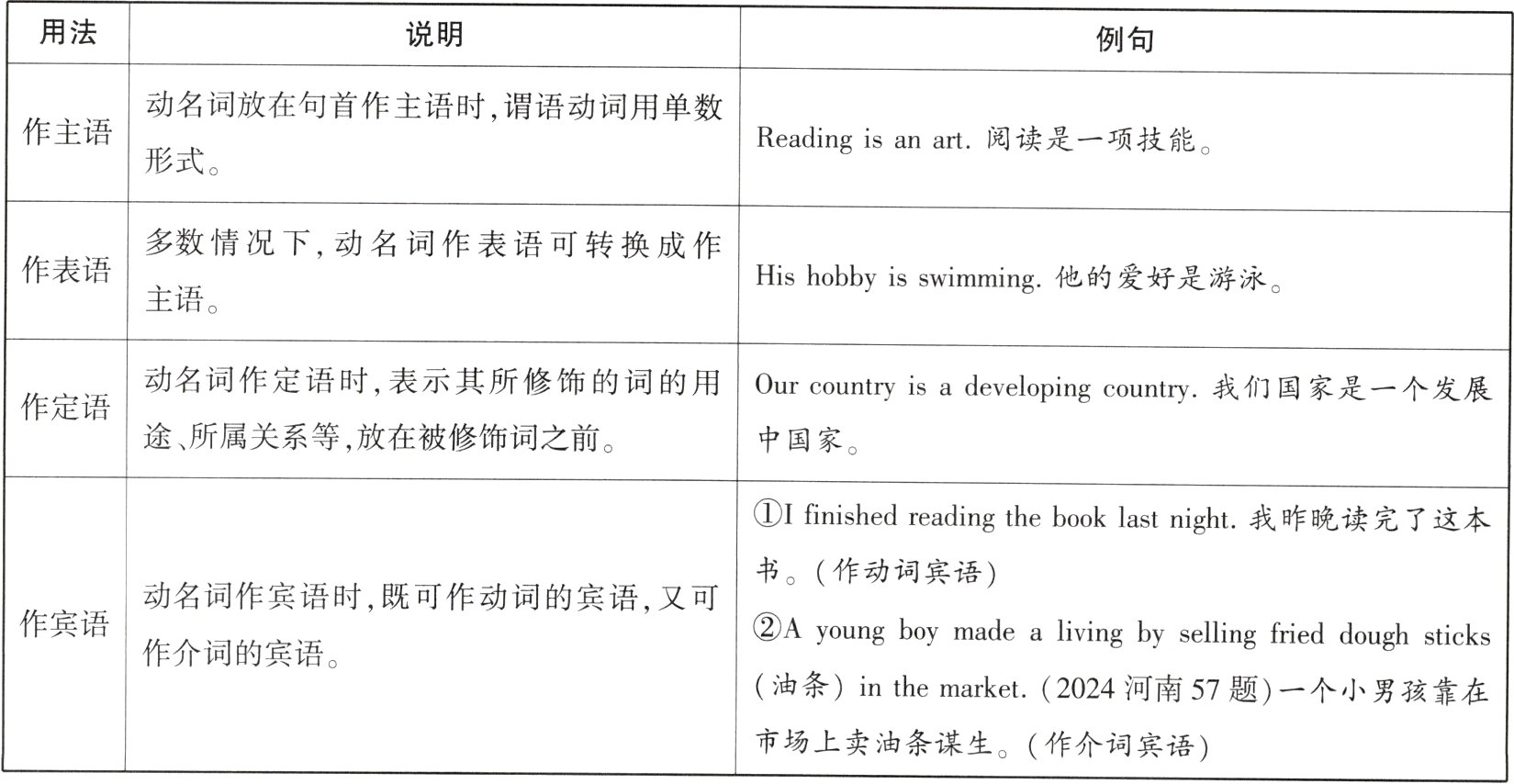
|用法|说明|例句|
| ---- | ---- | ---- |
|作主语|动名词放在句首作主语时,谓语动词用单数形式。|Reading is an art. 阅读是一项技能。|
|作表语|多数情况下,动名词作表语可转换成作主语。|His hobby is swimming. 他的爱好是游泳。|
|作定语|动名词作定语时,表示其所修饰的词的用途、所属关系等,放在被修饰词之前。|Our country is a developing country. 我们国家是一个发展中国家。|
|作宾语|动名词作宾语时,既可作动词的宾语,又可作介词的宾语。|①I finished reading the book last night. 我昨晚读完了这本书。(作动词宾语)
②A young boy made a living by selling fried dough sticks (油条) in the market. (2024河南57题)一个小男孩靠在市场上卖油条谋生。(作介词宾语)|
必背考点9(动名词)
3.常见接动名词作宾语的结构如下:
avoid doing sth. 避免做某事 begin/start doing sth. 开始做某事 consider doing sth. 考虑做某事
enjoy doing sth. 喜欢做某事 finish doing sth. 完成做某事 imagine doing sth. 想象做某事
mind doing sth. 介意做某事 practice doing sth. 练习做某事 suggest doing sth. 建议做某事
can't help doing sth. 情不自禁做某事 can't stand doing sth. 无法忍受做某事
put off doing sth. 推迟做某事 feel like doing sth. 想要做某事 give up doing sth. 放弃做某事
have trouble/difficulty doing sth. 做某事有困难 have fun doing sth. 做某事有乐趣
stop/keep/prevent sb. from doing sth. 阻止某人做某事 be busy doing sth. 忙于做某事
be worth doing sth. 值得做某事 What/How about doing sth.? 做某事怎么样?
succeed in doing sth. 成功地做了某事 be good at/do well in doing sth. 擅长做某事
spend...doing sth. 花费……做某事 look forward to doing sth. 盼望做某事
stick to doing sth. 坚持做某事 get/be used to doing sth. 习惯做某事
pay attention to doing sth. 注意做某事
【拓展】既可接不定式也可接动名词的动词(短语)
$\begin{cases}go\ on\ to\ do\ sth.\ (完成某事后)接着做另一件事 \\ go\ on\ doing\ sth.\ 继续做同一件事\end{cases}$ $\begin{cases}forget\ to\ do\ sth.\ 忘记要去做某事(动作未发生) \\ forget\ doing\ sth.\ 忘记已经做过某事(动作已发生)\end{cases}$
$\begin{cases}mean\ to\ do\ sth.\ 打算做某事 \\ mean\ doing\ sth.\ 意味着做某事\end{cases}$ $\begin{cases}remember\ to\ do\ sth.\ 记得要去做某事(事情还未做) \\ remember\ doing\ sth.\ 记得曾经做过某事(事情已做)\end{cases}$
$\begin{cases}stop\ to\ do\ sth.\ 停下手中的事去做另一件事 \\ stop\ doing\ sth.\ 停下手中正在做的事\end{cases}$ $\begin{cases}try\ to\ do\ sth.\ 努力去做某事 \\ try\ doing\ sth.\ 试着去做某事\end{cases}$
22. [2024河南70题改编] You can also ask your friends ________ think about it. (盲填)
23. [2023河南66题改编] I love this great museum. It is a wonderful place ________ learn about Chinese characters. (盲填)
24. [2022河南69题改编] That was my greatest weakness. So I try ________ correct it by finding an enjoyable way to study. (盲填)
25. [2021河南69题改编] In China, it is interesting ________ see people eating with chopsticks.(盲填)
26. [2020河南67题改编]To get some peace, I tried a trick ________ keep her busy for a little while. (盲填)
27. [2023河南59题改编]They say I can choose whatever I want to do in the end if I keep ________ (work) hard at school.
28. [2016河南69题改编] I'm not saying that I am not an example of this, but it always amazes (使惊愕) me how people can spend so much time on their phones without ________ (talk) to others.
考法总结
自2020年河南中考设立语篇填空第二节盲填新题型,动词不定式为该题型必考点,且5年考了5种用法,其分别作宾语补足语、定语、宾语、主语、目的状语。
①第22题考查动词不定式作宾语补足语的用法。
②第23题考查动词不定式作定语的用法。
③第24和第26题考查动词不定式作宾语和目的状语的用法。
④第25题考查动词不定式作主语的用法。
⑤第27和第28题考查动词/介词后接动名词作宾语的用法。
河南中考对非谓语动词的要求为:掌握动词不定式作宾语、宾语补足语及目的状语的用法。但从往年真题中可看出,考生还需了解动词不定式作定语和主语的用法,并熟记一些后接动名词形式作宾语的动词用法。
必背考点8(动词不定式)
1.动词不定式的构成与特征
动词不定式不能在句中单独作谓语,其基本形式为“to+动词原形”,否定形式为“not to+动词原形”,在句中使用时具有名词、形容词或副词的特征。
2.动词不定式的基本用法
|用法|说明|例句|
| ---- | ---- | ---- |
|作主语|①当单个不定式作主语时,谓语动词用单数。
②为了保持句子的平衡,通常用it作形式主语,而把真正的主语——不定式(短语)放在后面。|①To admit his mistake is not easy for him. 要他承认错误对他来说是不容易的。
②It's very nice of you to help me with my English. 你帮助我学英语,你真是太好了。|
|作表语|不定式可以用在系动词后作表语,通常表示愿望、责任、义务等。|His wish is to become a musician. 他的愿望是当一名音乐家。|
必背考点8(动词不定式) 续表
|用法|说明|例句|
| ---- | ---- | ---- |
|作宾语|①一些表示命令、打算、希望、决心等的动词后常接不定式作宾语。此类动词巧记如下:
想要干:want, wish, hope, expect, would like/love, like
早打算:plan, prepare, mean
同意否:agree, offer, refuse
问问看:ask, afford
决定了:decide, make up one's mind, promise
开始学:begin/start, learn
尽力干:manage(反义词fail), try
努力做:make an effort
莫等待:wait
别忘记:forget(反义词remember)
②在find, think等词后跟不定式作宾语时,常用it作形式宾语,而将真正的宾语后置。|①He agreed to meet me at the station. 他同意在车站接我。
②I think it difficult to finish the program in two weeks. 我觉得要在两周内完成这个项目很难。|
|作宾语补足语|①常在“动词+宾语+不定式”结构中使用。常见此类动词有advise, allow, ask, encourage, force, help, invite, order, teach, tell, warn, wish, want/would like, expect, get等。
②在表示感官及使役等意义的动词后,要用不带to的不定式作补语。常见的此类动词有:一感(feel)、二听(hear, listen)、三让(let, make, have)、四看(look, see, notice, watch)。help后用带to或不带to的不定式均可。|①His mother warns him not to play computer games anymore. 他的妈妈警告他不要再玩电脑游戏了。
②They heard him sing a song in the meeting room. 他们听见他在会议室唱了一首歌。|
|作定语|不定式(短语)作定语时,应放在被修饰的名词或代词之后。|He was the first to come to the classroom. 他是第一个来到教室的人。|
|作状语|不定式可作目的状语、结果状语和原因状语。|①He returned home to see what happened. 他返回家去看发生了什么。(目的状语)
②She opened the box to find it empty. 她打开盒子,结果却发现它是空的。(结果状语)
③I'm glad to see you. 见到你很高兴。(原因状语)|
【拓展】
1.当有两个并列不定式作宾补时,后一个不定式往往省略to。如:
The boss asked Tim to go and find out if there was anyone else absent. (2016河南29题)
2.省略to的常见句型:
①Why not do sth.? = Why don't you do sth.? 为什么不……呢?
②Could/Would/Will you please (not) do sth.? 你可以(不)做……吗?
③had better (not) do sth. 最好(不要)做某事
④would rather do A than do B 宁愿做A也不愿做B
⑤let's do sth. 让我们做某事吧。
⑥prefer to do...rather than do... 宁愿做……而不愿做……
3.含动词不定式的特殊句型(2022.68考查):
①It takes/took sb. some time to do sth. 做某事花费某人多长时间。(2022.68)
②It's one's turn to do sth. 轮到某人做某事。
③It's time to do sth. 到做某事的时间了。
④adj.+enough to do sth. 足够……做某事
⑤too...to... 太……而不能……
易错提醒:非谓语和祈使句的辨析
若逗号后无连词,直接跟一个句子,则前半句用非谓语动词;若有逗号,且逗号后有and或or等并列连词,则前半句为祈使句。
如:①To catch the early bus, Lucy got up very early today. 为了赶上早班公交车,露西今天早上起得很早。
②Hurry up, or we will miss the train. 快点儿,否则我们就赶不上火车了。
必背考点9(动名词)
1.动名词的构成与特征
动名词由“动词原形(do)+-ing”构成,其形式与现在分词的构成相同,否定形式为“not+动词原形+-ing”。动名词既有动词的特征,又有名词的特征,可以在句子中充当主语、表语、宾语和定语。如:
①Staying up late is bad for your health. 熬夜对你的健康有害。
②Her hobby is playing the violin. 她的爱好是拉小提琴。
2.动名词的用法(2022版课标仅作理解要求,但往年真题考查过4次动名词作宾语的用法)
|用法|说明|例句|
| ---- | ---- | ---- |
|作主语|动名词放在句首作主语时,谓语动词用单数形式。|Reading is an art. 阅读是一项技能。|
|作表语|多数情况下,动名词作表语可转换成作主语。|His hobby is swimming. 他的爱好是游泳。|
|作定语|动名词作定语时,表示其所修饰的词的用途、所属关系等,放在被修饰词之前。|Our country is a developing country. 我们国家是一个发展中国家。|
|作宾语|动名词作宾语时,既可作动词的宾语,又可作介词的宾语。|①I finished reading the book last night. 我昨晚读完了这本书。(作动词宾语)
②A young boy made a living by selling fried dough sticks (油条) in the market. (2024河南57题)一个小男孩靠在市场上卖油条谋生。(作介词宾语)|
必背考点9(动名词)
3.常见接动名词作宾语的结构如下:
avoid doing sth. 避免做某事 begin/start doing sth. 开始做某事 consider doing sth. 考虑做某事
enjoy doing sth. 喜欢做某事 finish doing sth. 完成做某事 imagine doing sth. 想象做某事
mind doing sth. 介意做某事 practice doing sth. 练习做某事 suggest doing sth. 建议做某事
can't help doing sth. 情不自禁做某事 can't stand doing sth. 无法忍受做某事
put off doing sth. 推迟做某事 feel like doing sth. 想要做某事 give up doing sth. 放弃做某事
have trouble/difficulty doing sth. 做某事有困难 have fun doing sth. 做某事有乐趣
stop/keep/prevent sb. from doing sth. 阻止某人做某事 be busy doing sth. 忙于做某事
be worth doing sth. 值得做某事 What/How about doing sth.? 做某事怎么样?
succeed in doing sth. 成功地做了某事 be good at/do well in doing sth. 擅长做某事
spend...doing sth. 花费……做某事 look forward to doing sth. 盼望做某事
stick to doing sth. 坚持做某事 get/be used to doing sth. 习惯做某事
pay attention to doing sth. 注意做某事
【拓展】既可接不定式也可接动名词的动词(短语)
$\begin{cases}go\ on\ to\ do\ sth.\ (完成某事后)接着做另一件事 \\ go\ on\ doing\ sth.\ 继续做同一件事\end{cases}$ $\begin{cases}forget\ to\ do\ sth.\ 忘记要去做某事(动作未发生) \\ forget\ doing\ sth.\ 忘记已经做过某事(动作已发生)\end{cases}$
$\begin{cases}mean\ to\ do\ sth.\ 打算做某事 \\ mean\ doing\ sth.\ 意味着做某事\end{cases}$ $\begin{cases}remember\ to\ do\ sth.\ 记得要去做某事(事情还未做) \\ remember\ doing\ sth.\ 记得曾经做过某事(事情已做)\end{cases}$
$\begin{cases}stop\ to\ do\ sth.\ 停下手中的事去做另一件事 \\ stop\ doing\ sth.\ 停下手中正在做的事\end{cases}$ $\begin{cases}try\ to\ do\ sth.\ 努力去做某事 \\ try\ doing\ sth.\ 试着去做某事\end{cases}$
答案:
to
查看更多完整答案,请扫码查看

