

 搜索
搜索
第62页
- 第1页
- 第2页
- 第3页
- 第4页
- 第5页
- 第6页
- 第7页
- 第8页
- 第9页
- 第10页
- 第11页
- 第12页
- 第13页
- 第14页
- 第15页
- 第16页
- 第17页
- 第18页
- 第19页
- 第20页
- 第21页
- 第22页
- 第23页
- 第24页
- 第25页
- 第26页
- 第27页
- 第28页
- 第29页
- 第30页
- 第31页
- 第32页
- 第33页
- 第34页
- 第35页
- 第36页
- 第37页
- 第38页
- 第39页
- 第40页
- 第41页
- 第42页
- 第43页
- 第44页
- 第45页
- 第46页
- 第47页
- 第48页
- 第49页
- 第50页
- 第51页
- 第52页
- 第53页
- 第54页
- 第55页
- 第56页
- 第57页
- 第58页
- 第59页
- 第60页
- 第61页
- 第62页
- 第63页
- 第64页
四、词汇运用(每小题1分,共10分)
1. There is a place in my heart where all nations will live
2.
3. Jimmy was a lucky dog today as he was
4. Alice will play the lead role in the film
5. Our success went
6. My parents
7. What do you think
8. He has just bought an
9. The key is one of the
10. It’s the
1. There is a place in my heart where all nations will live
peacefully
(peace) some day.2.
Romantic
(浪漫的) films can usually become very popular among young people.3. Jimmy was a lucky dog today as he was
mistaken
(mistake) for the superstar.4. Alice will play the lead role in the film
based
(base) on a famous novel.5. Our success went
beyond
(超出) what we had expected.6. My parents
insist
(坚持) that I should go to the best school to study.7. What do you think
attacked
(袭击) him in the forest yesterday?8. He has just bought an
up-to-date
(最新的) mobile phone.9. The key is one of the
directors'
(导演) over there.10. It’s the
silliest
(silly) thing that I’ve ever heard.
答案:
1. peacefully 2. Romantic 3. mistaken 4. based 5. beyond
6. insist 7. attacked 8. up-to-date 9. directors' 10. silliest
6. insist 7. attacked 8. up-to-date 9. directors' 10. silliest
五、任务型阅读(每空2分,共10分)
British people pride themselves on their polite manners towards one another in public. They often use the word “sorry”—even when they don’t really mean it!
Usually, if they want to ask a stranger for the time, they would start by saying “Sorry to bother you. Do you know what time it is?” If they’re five minutes late for an appointment(约会), they would generally greet the person by saying “Sorry I’m late!”
They use the word “sorry” in so many different situations that the meaning of the word has changed a little over time. The two main dictionary definitions(释义) of “sorry” are: (1) feeling sad for someone else because of their problems or bad luck; (2) feeling regret because you’ve done something wrong. Now, think about this. Normally, when they want to ask a stranger a question, they start with “Sorry to bother you. ” In this situation, they aren’t saying sorry because they feel sad for that person or because they feel regret.
So what does “sorry” really mean? And why do British people use it so much?
Well, in the British culture, saying “sorry” is a way to be polite, especially to people who they don’t know very well. It’s also a very clever way to get what they want. In a recent experiment, an actor went up to different strangers on a rainy day to ask if he could use their mobile phones in order to make a call. When he went up to one group of strangers and asked them without saying “sorry” first, he was only 9 percent successful in borrowing their phones. However, when he said “sorry” to another group of strangers about the bad weather before asking if he could use their mobile phones, he was 47 percent successful. So maybe saying “sorry” is not just being polite, but it is also a good method to get what they want too!
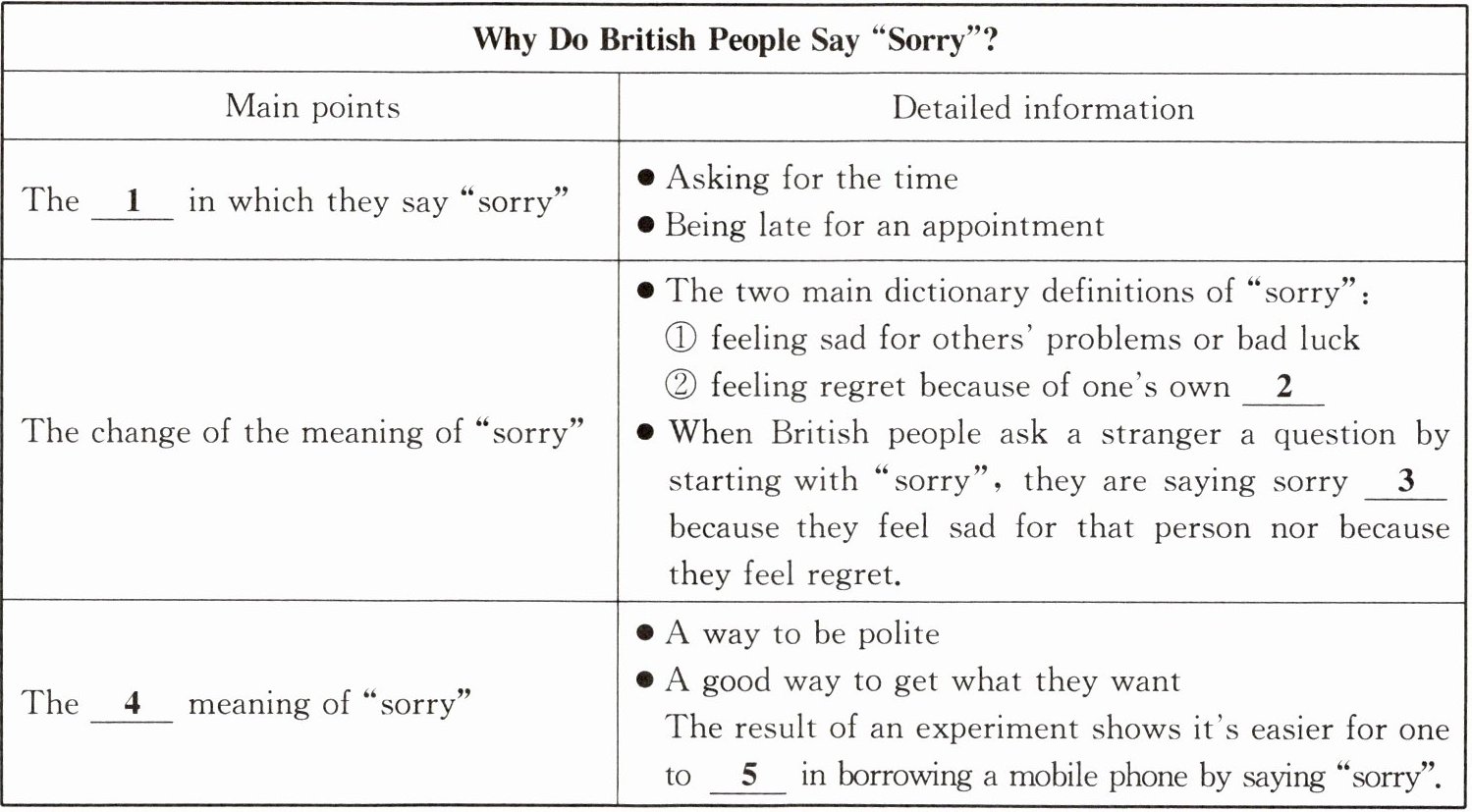
1.
British people pride themselves on their polite manners towards one another in public. They often use the word “sorry”—even when they don’t really mean it!
Usually, if they want to ask a stranger for the time, they would start by saying “Sorry to bother you. Do you know what time it is?” If they’re five minutes late for an appointment(约会), they would generally greet the person by saying “Sorry I’m late!”
They use the word “sorry” in so many different situations that the meaning of the word has changed a little over time. The two main dictionary definitions(释义) of “sorry” are: (1) feeling sad for someone else because of their problems or bad luck; (2) feeling regret because you’ve done something wrong. Now, think about this. Normally, when they want to ask a stranger a question, they start with “Sorry to bother you. ” In this situation, they aren’t saying sorry because they feel sad for that person or because they feel regret.
So what does “sorry” really mean? And why do British people use it so much?
Well, in the British culture, saying “sorry” is a way to be polite, especially to people who they don’t know very well. It’s also a very clever way to get what they want. In a recent experiment, an actor went up to different strangers on a rainy day to ask if he could use their mobile phones in order to make a call. When he went up to one group of strangers and asked them without saying “sorry” first, he was only 9 percent successful in borrowing their phones. However, when he said “sorry” to another group of strangers about the bad weather before asking if he could use their mobile phones, he was 47 percent successful. So maybe saying “sorry” is not just being polite, but it is also a good method to get what they want too!
1.
situations
2. mistakes/fault
3. neither
4. real
5. succeed
答案:
1. situations 2. mistakes/fault 3. neither 4. real 5. succeed
查看更多完整答案,请扫码查看

