

 搜索
搜索
第53页
- 第1页
- 第2页
- 第3页
- 第4页
- 第5页
- 第6页
- 第7页
- 第8页
- 第9页
- 第10页
- 第11页
- 第12页
- 第13页
- 第14页
- 第15页
- 第16页
- 第17页
- 第18页
- 第19页
- 第20页
- 第21页
- 第22页
- 第23页
- 第24页
- 第25页
- 第26页
- 第27页
- 第28页
- 第29页
- 第30页
- 第31页
- 第32页
- 第33页
- 第34页
- 第35页
- 第36页
- 第37页
- 第38页
- 第39页
- 第40页
- 第41页
- 第42页
- 第43页
- 第44页
- 第45页
- 第46页
- 第47页
- 第48页
- 第49页
- 第50页
- 第51页
- 第52页
- 第53页
- 第54页
- 第55页
- 第56页
- 第57页
- 第58页
- 第59页
- 第60页
- 第61页
- 第62页
- 第63页
- 第64页
- 第65页
- 第66页
- 第67页
- 第68页
- 第69页
- 第70页
- 第71页
- 第72页
- 第73页
- 第74页
- 第75页
- 第76页
- 第77页
- 第78页
- 第79页
- 第80页
- 第81页
- 第82页
- 第83页
- 第84页
- 第85页
- 第86页
- 第87页
探究点① thanks for 的用法
thanks for 意为“为……而感谢”,相当于 thank you for,其中 for 是介词,后接名词、代词或动词 - ing 形式。
Thanks for your help. 谢谢你的帮助。
Thanks for showing me around your school. = Thank you for showing me around your school. 谢谢你带我参观你的学校。
【情境应用】
1. Many thanks
A. in
B. of
C. for
D. with
2. Thank you for
thanks for 意为“为……而感谢”,相当于 thank you for,其中 for 是介词,后接名词、代词或动词 - ing 形式。
Thanks for your help. 谢谢你的帮助。
Thanks for showing me around your school. = Thank you for showing me around your school. 谢谢你带我参观你的学校。
【情境应用】
1. Many thanks
C
your gift. I love it.A. in
B. of
C. for
D. with
2. Thank you for
helping
(help) me, Mr Li.
答案:
1. C 2. helping
探究点② exercise 的用法
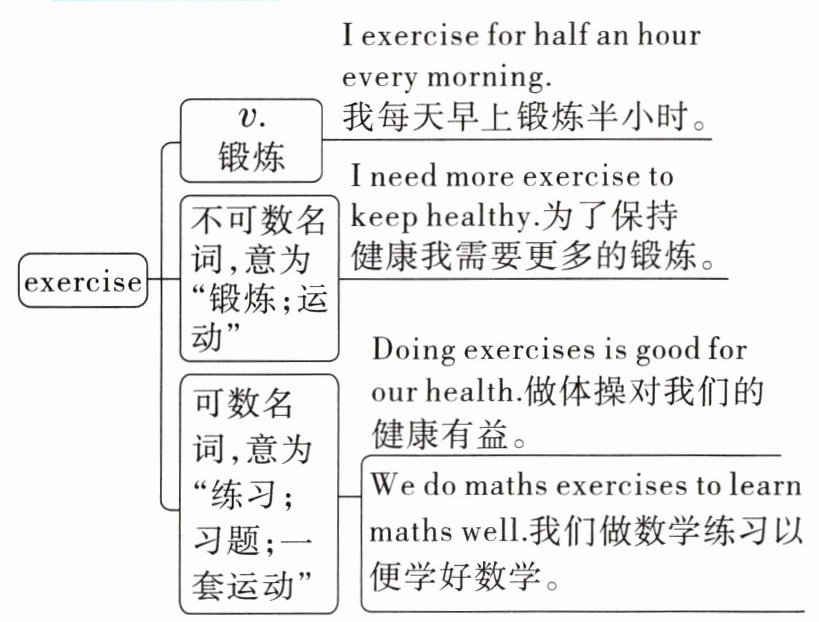
mindmap
v. 锻炼
I exercise for half an hour every morning. 我每天早上锻炼半小时。
不可数名词,意为“锻炼;运动”
I need more exercise to keep healthy. 为了保持健康我需要更多的锻炼。
可数名词,意为“练习;习题;一套运动”
Doing exercises is good for our health. 做体操对我们的健康有益。
We do maths exercises to learn maths well. 我们做数学练习以便学好数学。
【情境应用】
1. 饮食和锻炼都很重要。
Diet and
2. 在我们学校,我们通常一天做两次眼保健操。
In our school, we usually
mindmap
v. 锻炼
I exercise for half an hour every morning. 我每天早上锻炼半小时。
不可数名词,意为“锻炼;运动”
I need more exercise to keep healthy. 为了保持健康我需要更多的锻炼。
可数名词,意为“练习;习题;一套运动”
Doing exercises is good for our health. 做体操对我们的健康有益。
We do maths exercises to learn maths well. 我们做数学练习以便学好数学。
【情境应用】
1. 饮食和锻炼都很重要。
Diet and
exercise
are both important.2. 在我们学校,我们通常一天做两次眼保健操。
In our school, we usually
do
eye
exercises
twice a day.
答案:
1. exercise 2. do eye exercises
探究点③ raise 的用法
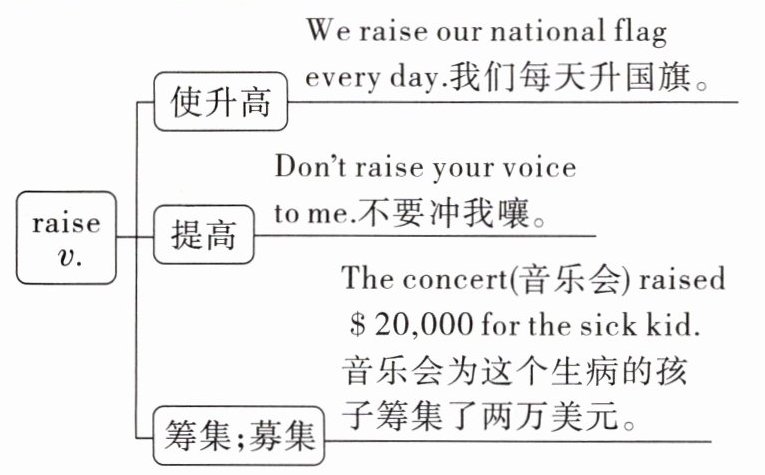
mindmap
v. 使升高
We raise our national flag every day. 我们每天升国旗。
提高
Don't raise your voice to me. 不要冲我嚷。
筹集;募集
The concert(音乐会) raised 20,000 for the sick kid. 音乐会为这个生病的孩子筹集了两万美元。
【情境应用】
1. Please
A. remember
B. raise
C. greet
D. mean
2. They need to
mindmap
v. 使升高
We raise our national flag every day. 我们每天升国旗。
提高
Don't raise your voice to me. 不要冲我嚷。
筹集;募集
The concert(音乐会) raised 20,000 for the sick kid. 音乐会为这个生病的孩子筹集了两万美元。
【情境应用】
1. Please
B
your heads and look at the blackboard.A. remember
B. raise
C. greet
D. mean
2. They need to
raise
(筹集)enough money to build a new school.
答案:
1. B 2. raise
探究点④ “How about...?”的用法
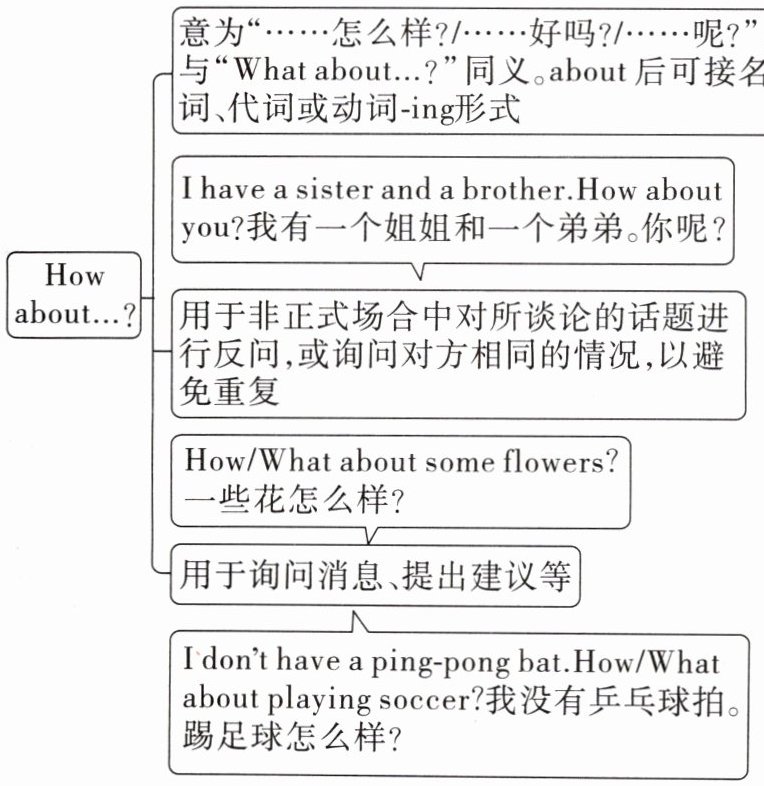
mindmap
意为“……怎么样?/……好吗?/……呢?”,与“What about...?”同义。about 后可接名词、代词或动词 - ing 形式
I have a sister and a brother. How about you? 我有一个姐姐和一个弟弟。你呢?
用于非正式场合中对所谈论的话题进行反问,或询问对方相同的情况,以避免重复
How/What about some flowers? 一些花怎么样?
用于询问消息、提出建议等
I don't have a ping - pong bat. How/What about playing soccer? 我没有乒乓球拍。踢足球怎么样?
【情境应用】
1. —My schoolbag is blue.
—Mine is blue too.
A. What's this?
B. What about yours?
C. What colour is his?
D. How are you?
2. —Mary, how about
—Good idea. We can read lots of books there.
A. go
B. going
C. to go
D. goes
mindmap
意为“……怎么样?/……好吗?/……呢?”,与“What about...?”同义。about 后可接名词、代词或动词 - ing 形式
I have a sister and a brother. How about you? 我有一个姐姐和一个弟弟。你呢?
用于非正式场合中对所谈论的话题进行反问,或询问对方相同的情况,以避免重复
How/What about some flowers? 一些花怎么样?
用于询问消息、提出建议等
I don't have a ping - pong bat. How/What about playing soccer? 我没有乒乓球拍。踢足球怎么样?
【情境应用】
1. —My schoolbag is blue.
B
—Mine is blue too.
A. What's this?
B. What about yours?
C. What colour is his?
D. How are you?
2. —Mary, how about
B
to the library?—Good idea. We can read lots of books there.
A. go
B. going
C. to go
D. goes
答案:
1. B 2. B
查看更多完整答案,请扫码查看

