

 搜索
搜索
Ⅰ.词汇运用
将方框中所给词语的适当形式填入短文中,每词仅用一次。
teach arrive clean up tiring perhaps
What do you think of doing housework? I thought 1.
On a weekend,Mum told me that a neighbour would come soon,so I helped with the housework. Then,I sat on the sofa,waiting for the 3.
4.
将方框中所给词语的适当形式填入短文中,每词仅用一次。
teach arrive clean up tiring perhaps
What do you think of doing housework? I thought 1.
cleaning up
the house was not interesting before. Why? Because it was 2.tiring
. But one thing changed my idea.On a weekend,Mum told me that a neighbour would come soon,so I helped with the housework. Then,I sat on the sofa,waiting for the 3.
arrival
of the neighbour. When he came to our house,he said,“What a clean house it is!” When I heard the neighbour's words,I felt happy.4.
Perhaps
doing housework is not that difficult. This experience 5.teaches
me a lot. It is important for us to share the housework with our parents.
答案:
Ⅰ.1.cleaning up 2.tiring 3.arrival 4.Perhaps 5.teaches
Ⅱ.阅读理解
研究表明,城市和乡村的孩子在家做家务的情况截然不同,让我们一起来看看相应的研究结果吧!
Do teenagers in small villages do chores at home? How about the teenagers in big cities? Here is a survey(民意调查). A team asked 4,000 teenagers in China several questions. Half of them come from big cities like Beijing,Shanghai and Guangzhou. The others are from small villages. They made a diagram(图表)of the result of the survey. Let's have a look at it.
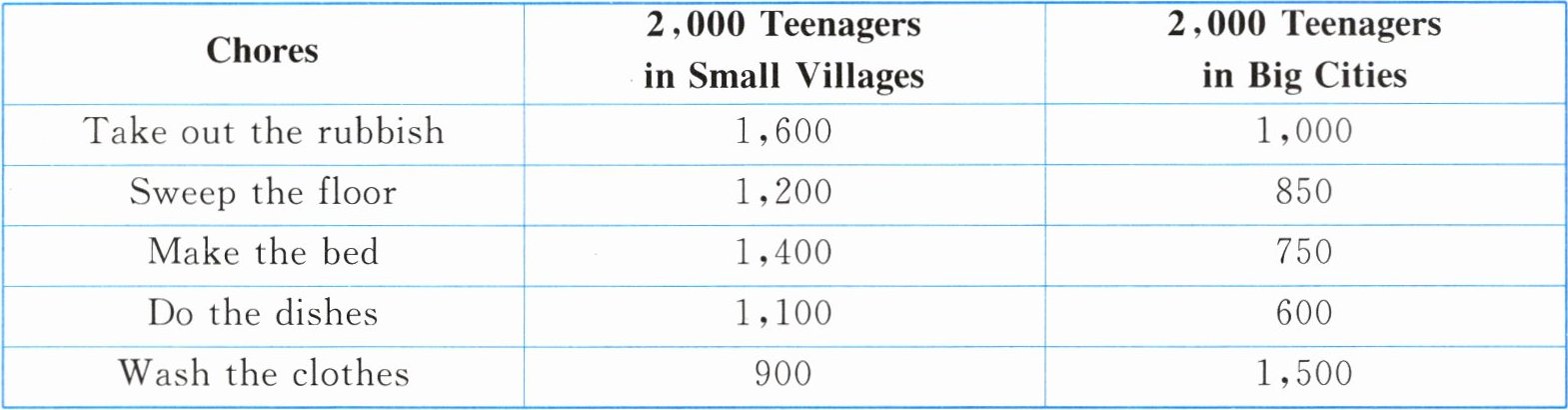
They found out that teenagers from small villages do more chores. Maybe it is because they live a hard life. Their advice to parents in big cities is that parents should give their children some chores to do. Doing chores teaches teenagers to take care of themselves.
(
A. 1,000.
B. 2,000.
C. 3,000.
D. 4,000.
(
A. Take out the rubbish.
B. Make the bed.
C. Wash the clothes.
D. Do the dishes.
(
A. There are more teenagers washing the clothes in big cities.
B. 50% of the teenagers in small villages do the dishes at home.
C. Over 2,000 teenagers in big cities sweep the floor and make the bed.
D. Only the number of teenagers doing the dishes is no more than 2,500.
(
A. Because they didn't want teenagers in China to do chores at home.
B. Because they thought it could help teenagers to take care of themselves.
C. Because they wanted to know what chores teenagers in China did at home.
D. Because they wanted to know whether(是否)teenagers looked after themselves well.
研究表明,城市和乡村的孩子在家做家务的情况截然不同,让我们一起来看看相应的研究结果吧!
Do teenagers in small villages do chores at home? How about the teenagers in big cities? Here is a survey(民意调查). A team asked 4,000 teenagers in China several questions. Half of them come from big cities like Beijing,Shanghai and Guangzhou. The others are from small villages. They made a diagram(图表)of the result of the survey. Let's have a look at it.
They found out that teenagers from small villages do more chores. Maybe it is because they live a hard life. Their advice to parents in big cities is that parents should give their children some chores to do. Doing chores teaches teenagers to take care of themselves.
(
B
)1. How many teenagers from small villages joined the survey?A. 1,000.
B. 2,000.
C. 3,000.
D. 4,000.
(
C
)2. What do over 1,000 teenagers from the cities do?A. Take out the rubbish.
B. Make the bed.
C. Wash the clothes.
D. Do the dishes.
(
A
)3. Which of the following is TRUE according to the survey?A. There are more teenagers washing the clothes in big cities.
B. 50% of the teenagers in small villages do the dishes at home.
C. Over 2,000 teenagers in big cities sweep the floor and make the bed.
D. Only the number of teenagers doing the dishes is no more than 2,500.
(
B
)4. Why did the team make the survey?A. Because they didn't want teenagers in China to do chores at home.
B. Because they thought it could help teenagers to take care of themselves.
C. Because they wanted to know what chores teenagers in China did at home.
D. Because they wanted to know whether(是否)teenagers looked after themselves well.
答案:
Ⅱ.1—4 BCAB
查看更多完整答案,请扫码查看

