

 搜索
搜索
第31页
- 第1页
- 第2页
- 第3页
- 第4页
- 第5页
- 第6页
- 第7页
- 第8页
- 第9页
- 第10页
- 第11页
- 第12页
- 第13页
- 第14页
- 第15页
- 第16页
- 第17页
- 第18页
- 第19页
- 第20页
- 第21页
- 第22页
- 第23页
- 第24页
- 第25页
- 第26页
- 第27页
- 第28页
- 第29页
- 第30页
- 第31页
- 第32页
- 第33页
- 第34页
- 第35页
- 第36页
- 第37页
- 第38页
- 第39页
- 第40页
- 第41页
- 第42页
- 第43页
- 第44页
- 第45页
- 第46页
- 第47页
- 第48页
- 第49页
- 第50页
- 第51页
- 第52页
- 第53页
- 第54页
- 第55页
- 第56页
- 第57页
- 第58页
- 第59页
- 第60页
- 第61页
- 第62页
- 第63页
- 第64页
- 第65页
- 第66页
- 第67页
- 第68页
- 第69页
- 第70页
- 第71页
- 第72页
- 第73页
- 第74页
- 第75页
- 第76页
- 第77页
- 第78页
- 第79页
- 第80页
- 第81页
- 第82页
- 第83页
- 第84页
- 第85页
- 第86页
- 第87页
- 第88页
- 第89页
- 第90页
- 第91页
- 第92页
- 第93页
- 第94页
- 第95页
- 第96页
- 第97页
- 第98页
- 第99页
- 第100页
- 第101页
- 第102页
- 第103页
- 第104页
- 第105页
- 第106页
- 第107页
- 第108页
- 第109页
- 第110页
- 第111页
- 第112页
- 第113页
- 第114页
- 第115页
- 第116页
- 第117页
- 第118页
- 第119页
- 第120页
- 第121页
- 第122页
- 第123页
- 第124页
- 第125页
听一段对话,回答第6—7小题
( ) 6. What's the woman's problem?
A. She feels nervous about the test.
B. She doesn't work hard.
C. She has never taken any test.
( ) 7. What is the man's suggestion for getting more confident in exams?
A. Talking with others.
B. Often taking tests.
C. Using orange school things.
( ) 6. What's the woman's problem?
A. She feels nervous about the test.
B. She doesn't work hard.
C. She has never taken any test.
( ) 7. What is the man's suggestion for getting more confident in exams?
A. Talking with others.
B. Often taking tests.
C. Using orange school things.
答案:
A
C
C
听一篇短文,回答第8—10小题,完成信息记录表
| Four types of personality | |
| Red |$ You are a (^8)______ friend, but you don't like rules. $|
| Blue |$ You are good at (^9)______, but you like to be alone. $|
| Yellow |$ You want to be more (^1⁰)______ and may care little about others. $|
| Green | You are friendly, but you are not willing to change. |
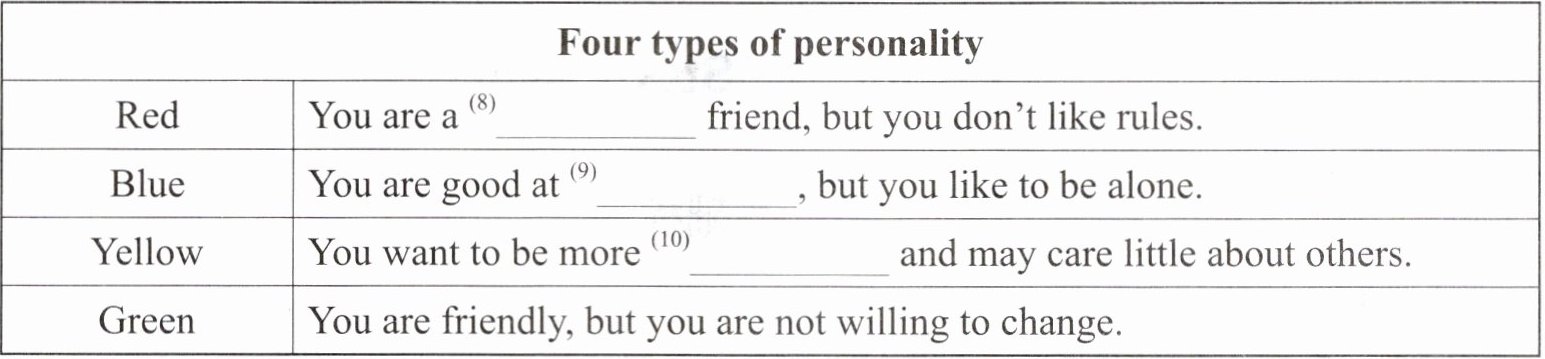
( ) 8. A. true
B. nice
C. bad
( ) 9. A. making a speech
B. solving problems
C. making friends
( ) 10. A. organized
B. careful
C. successful
| Four types of personality | |
| Red |$ You are a (^8)______ friend, but you don't like rules. $|
| Blue |$ You are good at (^9)______, but you like to be alone. $|
| Yellow |$ You want to be more (^1⁰)______ and may care little about others. $|
| Green | You are friendly, but you are not willing to change. |
( ) 8. A. true
B. nice
C. bad
( ) 9. A. making a speech
B. solving problems
C. making friends
( ) 10. A. organized
B. careful
C. successful
答案:
A
B
C
A
B
C
二、完形填空
Home design is based on colours— 1 you'll always have in every room. Knowing how to manage colour in your spaces is one of the first steps to create rooms you'll love to live in. Do you want a room that's full of life? Or are you just looking for a place to relax after a long day? 2 you are looking for, colour is the key to making a room feel the way you want it to feel.
Over the years, there have been a number of different ways to help designers reach this important point. While all of them are 3 , they can get a little complex (复杂). But good news is that there are really only three kinds of decisions you need to 4 about colour in your home: the small ones, the medium ones, and the large ones.
Small colour 5 are the ones we're most familiar with. They are the little spots of colour like throw pillows, mirrors and baskets that most of us use to add visual (可见的) interest to our rooms. Less tiring than painting your walls and 6 than buying a colourful sofa, small colour choices bring with them the advantages of being 7 changeable.
Medium colour choices are generally furniture pieces such as sofas, dinner tables or bookshelves. Colour choices in this range are a step up from the small ones in two major ways. They 8 a bigger devotion than smaller ones, and they have a more 9 influence on the feeling of a space.
The large colour decisions in your rooms concern the walls, ceilings, and floors. Whether you're looking at wallpaper or paint, the time, 10 and money put into it are meaningful. So it pays to be sure, because you want to get it right the first time.
( ) 1. A. something
B. anything
C. nothing
D. everything
( ) 2. A. Whenever
B. Whatever
C. Wherever
D. However
( ) 3. A. helpful
B. hopeful
C. careful
D. useful
( ) 4. A. know
B. make
C. find
D. check
( ) 5. A. decisions
B. advantages
C. ways
D. choices
( ) 6. A. less interesting
B. less expensive
C. more interesting
D. more expensive
( ) 7. A. easily
B. quickly
C. difficultly
D. slowly
( ) 8. A. use
B. work
C. discover
D. require
( ) 9. A. energetic
B. powerful
C. relaxed
D. cheerful
( ) 10. A. place
B. balance
C. effort
D. strength
Home design is based on colours— 1 you'll always have in every room. Knowing how to manage colour in your spaces is one of the first steps to create rooms you'll love to live in. Do you want a room that's full of life? Or are you just looking for a place to relax after a long day? 2 you are looking for, colour is the key to making a room feel the way you want it to feel.
Over the years, there have been a number of different ways to help designers reach this important point. While all of them are 3 , they can get a little complex (复杂). But good news is that there are really only three kinds of decisions you need to 4 about colour in your home: the small ones, the medium ones, and the large ones.
Small colour 5 are the ones we're most familiar with. They are the little spots of colour like throw pillows, mirrors and baskets that most of us use to add visual (可见的) interest to our rooms. Less tiring than painting your walls and 6 than buying a colourful sofa, small colour choices bring with them the advantages of being 7 changeable.
Medium colour choices are generally furniture pieces such as sofas, dinner tables or bookshelves. Colour choices in this range are a step up from the small ones in two major ways. They 8 a bigger devotion than smaller ones, and they have a more 9 influence on the feeling of a space.
The large colour decisions in your rooms concern the walls, ceilings, and floors. Whether you're looking at wallpaper or paint, the time, 10 and money put into it are meaningful. So it pays to be sure, because you want to get it right the first time.
( ) 1. A. something
B. anything
C. nothing
D. everything
( ) 2. A. Whenever
B. Whatever
C. Wherever
D. However
( ) 3. A. helpful
B. hopeful
C. careful
D. useful
( ) 4. A. know
B. make
C. find
D. check
( ) 5. A. decisions
B. advantages
C. ways
D. choices
( ) 6. A. less interesting
B. less expensive
C. more interesting
D. more expensive
( ) 7. A. easily
B. quickly
C. difficultly
D. slowly
( ) 8. A. use
B. work
C. discover
D. require
( ) 9. A. energetic
B. powerful
C. relaxed
D. cheerful
( ) 10. A. place
B. balance
C. effort
D. strength
答案:
A
B
D
B
D
B
A
D
B
C
A
B
D
B
D
B
A
D
B
C
查看更多完整答案,请扫码查看

