

 搜索
搜索
第19页
- 第1页
- 第2页
- 第3页
- 第4页
- 第5页
- 第6页
- 第7页
- 第8页
- 第9页
- 第10页
- 第11页
- 第12页
- 第13页
- 第14页
- 第15页
- 第16页
- 第17页
- 第18页
- 第19页
- 第20页
- 第21页
- 第22页
- 第23页
- 第24页
- 第25页
- 第26页
- 第27页
- 第28页
- 第29页
- 第30页
- 第31页
- 第32页
- 第33页
- 第34页
- 第35页
- 第36页
- 第37页
- 第38页
- 第39页
- 第40页
- 第41页
- 第42页
- 第43页
- 第44页
- 第45页
- 第46页
- 第47页
- 第48页
- 第49页
- 第50页
- 第51页
- 第52页
- 第53页
- 第54页
- 第55页
- 第56页
- 第57页
- 第58页
- 第59页
- 第60页
- 第61页
- 第62页
- 第63页
- 第64页
- 第65页
- 第66页
- 第67页
- 第68页
- 第69页
- 第70页
- 第71页
- 第72页
- 第73页
- 第74页
- 第75页
- 第76页
- 第77页
- 第78页
- 第79页
- 第80页
- 第81页
- 第82页
- 第83页
- 第84页
- 第85页
- 第86页
- 第87页
- 第88页
- 第89页
- 第90页
- 第91页
- 第92页
一、用人称代词及物主代词完成表格。
| 人称代词 | 第一人称单数 | 第一人称复数 | 第二人称 | 第三人称单数 | 第三人称复数 |
| 主格 | I | 1. ______ | 2. ______ | he | she | it | 3. ______ |
| 宾格 | me | 4. ______ | 5. ______ | 6. ______ | 7. ______ | 8. ______ | 9. ______ |
| 物主代词 | 第一人称单数 | 第一人称复数 | 第二人称 | 第三人称单数 | 第三人称复数 |
| 形容词性 | my | 10. ______ | 11. ______ | 12. ______ | 13. ______ | 14. ______ | 15. ______ |
| 名词性 | mine | 16. ______ | 17. ______ | 18. ______ | 19. ______ | 20. ______ | 21. ______ |
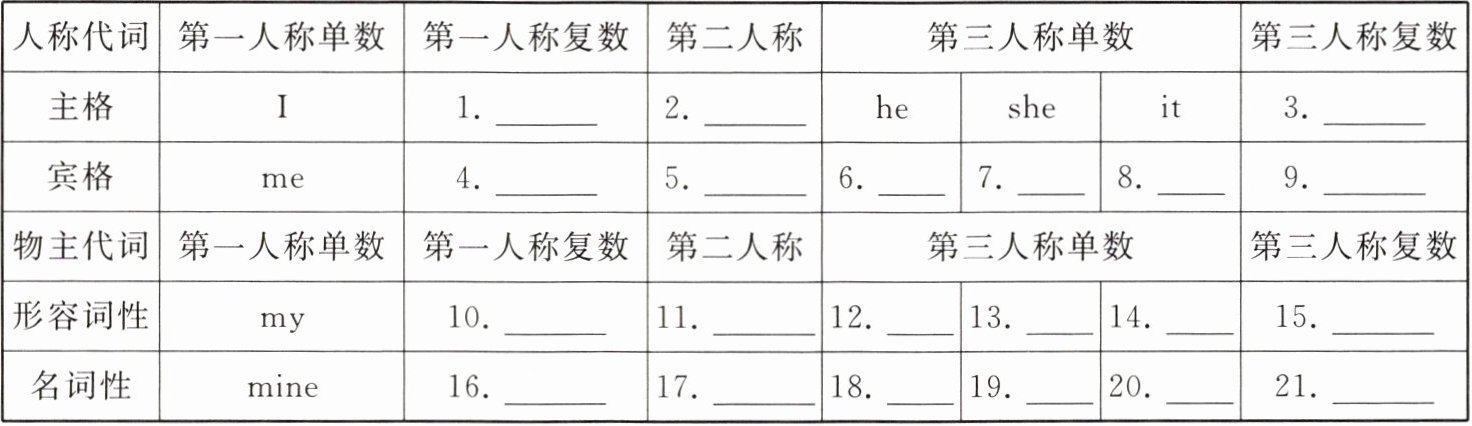
| 人称代词 | 第一人称单数 | 第一人称复数 | 第二人称 | 第三人称单数 | 第三人称复数 |
| 主格 | I | 1. ______ | 2. ______ | he | she | it | 3. ______ |
| 宾格 | me | 4. ______ | 5. ______ | 6. ______ | 7. ______ | 8. ______ | 9. ______ |
| 物主代词 | 第一人称单数 | 第一人称复数 | 第二人称 | 第三人称单数 | 第三人称复数 |
| 形容词性 | my | 10. ______ | 11. ______ | 12. ______ | 13. ______ | 14. ______ | 15. ______ |
| 名词性 | mine | 16. ______ | 17. ______ | 18. ______ | 19. ______ | 20. ______ | 21. ______ |
答案:
1. we 2. you 3. they 4. us 5. you 6. him 7. her 8. it 9. them 10. our 11. your 12. his 13. her 14. its 15. their 16. ours 17. yours 18. his 19. hers 20. its 21. theirs
二、用括号内所给代词的适当形式完成句子。
1. —Is this your football?
—No, it’s not ______ (I). It’s ______ (he).
2. The white eraser on the floor isn’t ______ (I) eraser. ______ (I) is green.
3. May I use ______ (you) pen? ______ (you) works better.
4. Li Jun is ______ (we) English teacher. ______ (us) like him very much.
5. Look at these paper boats. The blue ones are ______ (we) and the red ones are ______ (they).
6. The head teacher in his school is talking with ______ (his).
7. Most of ______ (they) are from South America.
8. Let ______ (we) join the dancing club.
9. It’s very important for ______ (she) to make good friends in junior high.
10. When we go through the forest, we see ______ (they) swimming in the stream.
1. —Is this your football?
—No, it’s not ______ (I). It’s ______ (he).
2. The white eraser on the floor isn’t ______ (I) eraser. ______ (I) is green.
3. May I use ______ (you) pen? ______ (you) works better.
4. Li Jun is ______ (we) English teacher. ______ (us) like him very much.
5. Look at these paper boats. The blue ones are ______ (we) and the red ones are ______ (they).
6. The head teacher in his school is talking with ______ (his).
7. Most of ______ (they) are from South America.
8. Let ______ (we) join the dancing club.
9. It’s very important for ______ (she) to make good friends in junior high.
10. When we go through the forest, we see ______ (they) swimming in the stream.
答案:
1. mine;his 2. my;Mine 3. your;Yours 4. our;We 5. ours;theirs 6. him 7. them 8. us 9. her 10. them
三、用适当的代词补全短文。
English is 1. ______ (I) first lesson in junior high. Ms Chen lets 2. ______ (we) know the meaning of the sentence “Learning without thinking is of no use.” In junior high, I have more subjects and activities. I find 3. ______ (its) is hard to plan my time. Lingling gives us a talk. 4. ______ (her) gives us some advice. We will try 5. ______ (we) best and work hard. No pain, no gain.
English is 1. ______ (I) first lesson in junior high. Ms Chen lets 2. ______ (we) know the meaning of the sentence “Learning without thinking is of no use.” In junior high, I have more subjects and activities. I find 3. ______ (its) is hard to plan my time. Lingling gives us a talk. 4. ______ (her) gives us some advice. We will try 5. ______ (we) best and work hard. No pain, no gain.
答案:
1. my 2. us 3. it 4. She 5. our
查看更多完整答案,请扫码查看

