

 搜索
搜索
Ⅱ. Read and judge.(阅读短文,判断句子的正误,正确的写“T”,错误的写“F”。)
In China, most students go to school by bike or by bus. Some live near their school. They often walk to school every day. What about the students in other countries? Do they go to school by bike? In the USA, many students go to school by car or school bus. In Finland and Iceland, it snows a lot. The students in villages far from the school have to go by sled. If it snows heavily, the students can study at home. In Venice, the students go to school by boat. What fun it is!
(
(
(
(
(
In China, most students go to school by bike or by bus. Some live near their school. They often walk to school every day. What about the students in other countries? Do they go to school by bike? In the USA, many students go to school by car or school bus. In Finland and Iceland, it snows a lot. The students in villages far from the school have to go by sled. If it snows heavily, the students can study at home. In Venice, the students go to school by boat. What fun it is!
(
T
) 1. In China, the students go to school by bike, by bus or on foot.(
F
) 2. In the USA, many students go to school by subway.(
F
) 3. The students go to school by sled in Venice.(
F
) 4. In Iceland, it rains a lot.(
T
) 5. In Finland, some students go to school by sled.
答案:
1.T 2.F 3.F 4.F 5.T
Ⅲ. Make suggestions for the kids and finish the poster.(世界不同地区的孩子们选择不同的交通方式去上学。他们应该遵守哪些交通规则?请你给出建议,完成下面的海报。)
Pay attention!
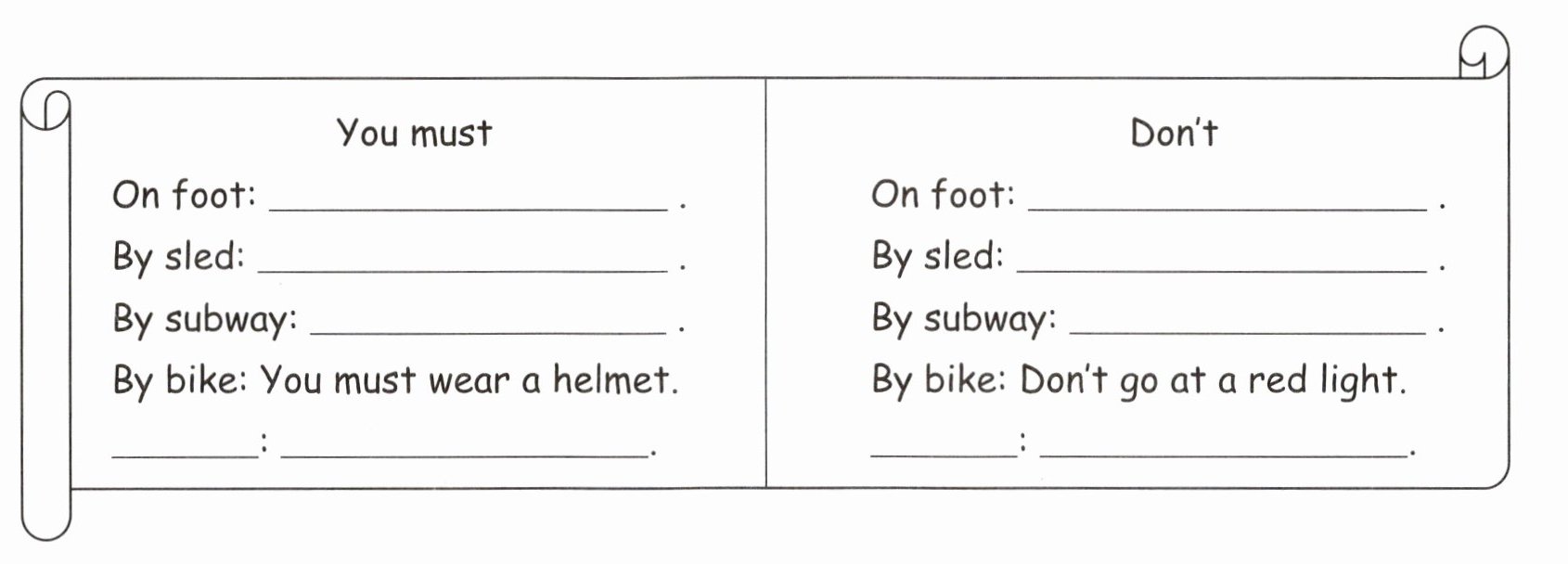
Pay attention!
答案:
“You must” :
On foot: Look at the traffic lights.
By sled: Sit properly.
By subway: Wait in line.
By car: Wear a seat belt.
“Don't” :
On foot: Don't run on the road.
By sled: Don't stand on the sled.
By subway: Don't push others when getting on or off.
By car: Don't put your head out of the window.
查看更多完整答案,请扫码查看

