

 搜索
搜索
第13页
- 第1页
- 第2页
- 第3页
- 第4页
- 第5页
- 第6页
- 第7页
- 第8页
- 第9页
- 第10页
- 第11页
- 第12页
- 第13页
- 第14页
- 第15页
- 第16页
- 第17页
- 第18页
- 第19页
- 第20页
- 第21页
- 第22页
- 第23页
- 第24页
- 第25页
- 第26页
- 第27页
- 第28页
- 第29页
- 第30页
- 第31页
- 第32页
- 第33页
- 第34页
- 第35页
- 第36页
- 第37页
- 第38页
- 第39页
- 第40页
- 第41页
- 第42页
- 第43页
- 第44页
- 第45页
- 第46页
- 第47页
- 第48页
- 第49页
- 第50页
- 第51页
- 第52页
- 第53页
- 第54页
- 第55页
- 第56页
- 第57页
- 第58页
- 第59页
- 第60页
- 第61页
- 第62页
- 第63页
- 第64页
- 第65页
- 第66页
- 第67页
- 第68页
- 第69页
- 第70页
- 第71页
- 第72页
- 第73页
- 第74页
- 第75页
- 第76页
- 第77页
- 第78页
- 第79页
- 第80页
- 第81页
- 第82页
- 第83页
- 第84页
- 第85页
- 第86页
- 第87页
- 第88页
- 第89页
- 第90页
- 第91页
- 第92页
- 第93页
- 第94页
- 第95页
- 第96页
- 第97页
- 第98页
- 第99页
- 第100页
- 第101页
- 第102页
- 第103页
- 第104页
- 第105页
- 第106页
- 第107页
- 第108页
- 第109页
- 第110页
- 第111页
- 第112页
- 第113页
- 第114页
- 第115页
- 第116页
- 第117页
- 第118页
- 第119页
- 第120页
- 第121页
- 第122页
- 第123页
- 第124页
- 第125页
( )3.(江阴毕业)—What's for dinner, Mum?
—Do you want to eat fish, dear?
对话中两个句子的末尾升降调应该是“
A.➘;↗
B.➘;➘
C.↗;➘
思路点拨
“What's for dinner, Mum?”是特殊疑问句,语调应为降调;“Do you want to eat fish, dear?”是一般疑问句,语调应为升调。
答案:A
—Do you want to eat fish, dear?
对话中两个句子的末尾升降调应该是“
降调,升调
”。A.➘;↗
B.➘;➘
C.↗;➘
思路点拨
“What's for dinner, Mum?”是特殊疑问句,语调应为降调;“Do you want to eat fish, dear?”是一般疑问句,语调应为升调。
答案:A
答案:
A 思路点拨 “What's for dinner, Mum?”是特殊疑问句,语调应为降调;“Do you want to eat fish, dear?”是一般疑问句,语调应为升调。
一、(广东广州祈福英语实验学校分班)找出每组单词重读音节与其他不同的一个词。
(
(
(
(
(
D
)1. A. nervous B. father C. everything D. important(
A
)2. A. pollution B. dumpling C. butterfly D. building(
B
)3. A. interview B. information C. friendly D. Germany(
C
)4. A. grandson B. model C. unusual D. really
答案:
1. D nervous 的发音为/'nɜːvəs/; everything 的发音为/'evriθɪŋ/; father 的发音为/'fɑːðə(r)/; important 的发音为/ɪm'pɔːtnt/。选项 D 的单词重读音节与其他不同。 2. A pollution 的发音为/pə'luːʃn/; dumpling 的发音为/'dʌmplɪŋ/; butterfly 的发音为/'bʌtəflaɪ/; building 的发音为/'bɪldɪŋ/。选项 A 的单词重读音节与其他不同。 3. B interview 的发音为/'ɪntəvjuː/; information 的发音为/ɪnfə'meɪʃn/; friendly 的发音为/'frendli/; Germany 的发音为/'dʒɜːməni/。选项 B 的单词重读音节与其他不同。 4. C
(
A.beautiful
B.palace
C.country
D.expensive
D
)1.(四川绵阳分班)Which word's stress(重音) is different from the others?A.beautiful
B.palace
C.country
D.expensive
答案:
D
(
A.辅音浊化、降调
B.连读、降调
C.连读、升调
B
)2.(南通如东实验中学分班)在读“Our teacher asked us about our dream.”这句话时,我们注意要______。A.辅音浊化、降调
B.连读、降调
C.连读、升调
答案:
B
一、新考法 补全龙图 Read and write. 按照字母表顺序写出字母的左邻右舍,帮助中国龙腾飞,注意大小写。
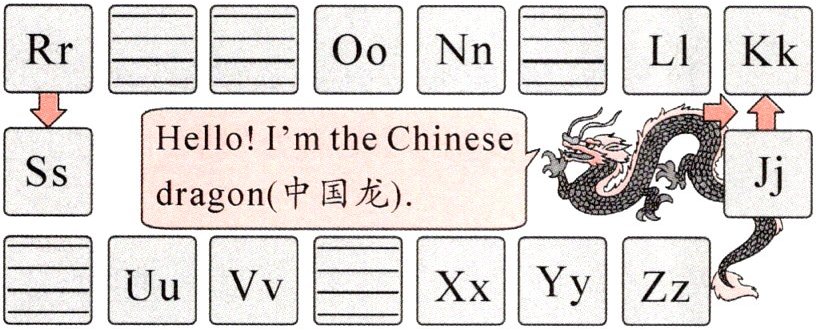
答案:
从上往下,从左往右:Qq,Pp,Mm,Tt,Ww
二、(无锡滨湖区毕业)按字母表顺序写出 Jj 到 Ss 之间的字母大小写。
Kk Ll Mm Nn Oo Pp Qq Rr
答案:
Kk Ll Mm Nn Oo Pp Qq Rr
三、(无锡通德桥教育集团毕业)把下面的句子正确规范地书写在四线三格内,注意大小写及标点符号。
in hong kong and macau, people drive on the left side of the road.______
in hong kong and macau, people drive on the left side of the road.______
In Hong Kong and Macau, people drive on the left side of the road.
答案:
In Hong Kong and Macau people drive on the left side of the road.
Hong Kong意为"香港",Macau意为"澳门",均为专有名词,首字母应大写,句尾加句号。大写字母I、H、K、M和小写字母d、l、i、h、f、t占中上格;小写字母n、o、a、c、u、e、r、v、s占中格;小写字母g、p占中下格。
Hong Kong意为"香港",Macau意为"澳门",均为专有名词,首字母应大写,句尾加句号。大写字母I、H、K、M和小写字母d、l、i、h、f、t占中上格;小写字母n、o、a、c、u、e、r、v、s占中格;小写字母g、p占中下格。
1. “It's often cloudy in my country,” said the young girl.
2. Oh, dear! I can't hear anything. There is something wrong with my ears.
3. The fat boy did some sports with Liu Hong for a short time.
4. My mother cooked some noodles this afternoon.
5. Open the window now and you'll see how heavy the rain is.
D
2. Oh, dear! I can't hear anything. There is something wrong with my ears.
S
3. The fat boy did some sports with Liu Hong for a short time.
S
4. My mother cooked some noodles this afternoon.
D
5. Open the window now and you'll see how heavy the rain is.
D
答案:
1. D 字母组合ou在单词cloudy中发音为/aʊ/;在单词country和young中发音均为/ʌ/,三者发音不相同。
2. S 字母组合ear在单词dear、hear和ears中发音均为/ɪə(r)/,三者发音相同。
3. S 字母组合or在单词sports、for和short中发音均为/ɔː(r)/,三者发音相同。
4. D 字母组合oo在单词cooked中发音为/ʊ/;在单词noodles和afternoon中发音均为/uː/,三者发音不相同。
5. D 字母组合ow在单词now和how中发音均为/aʊ/;在单词window中发音为/əʊ/,三者发音不相同。
2. S 字母组合ear在单词dear、hear和ears中发音均为/ɪə(r)/,三者发音相同。
3. S 字母组合or在单词sports、for和short中发音均为/ɔː(r)/,三者发音相同。
4. D 字母组合oo在单词cooked中发音为/ʊ/;在单词noodles和afternoon中发音均为/uː/,三者发音不相同。
5. D 字母组合ow在单词now和how中发音均为/aʊ/;在单词window中发音为/əʊ/,三者发音不相同。
查看更多完整答案,请扫码查看

