

 搜索
搜索
第47页
- 第1页
- 第2页
- 第3页
- 第4页
- 第5页
- 第6页
- 第7页
- 第8页
- 第9页
- 第10页
- 第11页
- 第12页
- 第13页
- 第14页
- 第15页
- 第16页
- 第17页
- 第18页
- 第19页
- 第20页
- 第21页
- 第22页
- 第23页
- 第24页
- 第25页
- 第26页
- 第27页
- 第28页
- 第29页
- 第30页
- 第31页
- 第32页
- 第33页
- 第34页
- 第35页
- 第36页
- 第37页
- 第38页
- 第39页
- 第40页
- 第41页
- 第42页
- 第43页
- 第44页
- 第45页
- 第46页
- 第47页
- 第48页
- 第49页
- 第50页
- 第51页
- 第52页
- 第53页
- 第54页
- 第55页
- 第56页
- 第57页
- 第58页
- 第59页
- 第60页
- 第61页
- 第62页
- 第63页
- 第64页
- 第65页
- 第66页
- 第67页
- 第68页
- 第69页
- 第70页
- 第71页
- 第72页
- 第73页
- 第74页
- 第75页
- 第76页
- 第77页
- 第78页
- 第79页
- 第80页
- 第81页
十一、完形填空。
David was a little boy. He 1 four years old. One day his mother 2 him to see his grandmother. His grandmother’s home was very far 3 them, so they went there 4. There 5 only a few(一些)people on the bus. They all sat on 6 seats. David was 7. He looked out of the window and talked with his mother.
A moment later(一会儿以后), David started running on the bus. He ran and ran(不停地跑来跑去). “ 8 are you always running? Please sit 9,” his mother said. “I want to see my grandmother 10. I want the bus to go faster,” David answered.
( )1. A. has B. are C. was D. were
( )2. A. takes B. took C. is taking D. taking
( )3. A. from B. on C. in D. at
( )4. A. on bus B. with a bus C. by a bus D. by bus
( )5. A. was B. were C. is D. had
( )6. A. they B. them C. their D. theirs
( )7. A. happy B. happier C. happiest D. happily
( )8. A. What B. How C. Which D. Why
( )9. A. in B. on C. down D. up
( )10. A. harder B. later C. earlier D. slower
David was a little boy. He 1 four years old. One day his mother 2 him to see his grandmother. His grandmother’s home was very far 3 them, so they went there 4. There 5 only a few(一些)people on the bus. They all sat on 6 seats. David was 7. He looked out of the window and talked with his mother.
A moment later(一会儿以后), David started running on the bus. He ran and ran(不停地跑来跑去). “ 8 are you always running? Please sit 9,” his mother said. “I want to see my grandmother 10. I want the bus to go faster,” David answered.
( )1. A. has B. are C. was D. were
( )2. A. takes B. took C. is taking D. taking
( )3. A. from B. on C. in D. at
( )4. A. on bus B. with a bus C. by a bus D. by bus
( )5. A. was B. were C. is D. had
( )6. A. they B. them C. their D. theirs
( )7. A. happy B. happier C. happiest D. happily
( )8. A. What B. How C. Which D. Why
( )9. A. in B. on C. down D. up
( )10. A. harder B. later C. earlier D. slower
答案:
1. C 2. B 3. A 4. D 5. B 6. C 7. A 8. D 9. C 10. C
十二、阅读理解。
(一)
American people like to say “Thank you” when other people help them or say something kind to them. People in many other countries do so, too. It is a very good habit. You should say “Thank you” when someone passes you something on the table, when someone opens the door for you and when someone says you do your work well, or you have a nice thing, or your city is very beautiful. “Thank you” is used not only between friends, but also between parents and children, brothers and sisters, husbands and wives.
“Excuse me” is another useful sentence①. When you hear someone say it behind you, you know that someone wants to walk past you. It’s not polite② to interrupt③ others while they are talking. If you want to speak to one of them, say “Excuse me” first, and then begin talking. You should also do so when you want to cough or make any noise before others.
Let’s learn to say “Thank you” and “Excuse me”.
(注:① sentence 句子;② polite 有礼貌的;③ interrupt 打断)
( )1. ______ like to say “Thank you” and “Excuse me”.
A. People in many countries
B. Only American people
C. Except American people
D. All the people in the world
( )2. You should say “Thank you” when(当……时)_______.
A. someone asks you for help
B. someone opens the door for you
C. you pass something to others on the table
D. you make mistakes
( )3. When others say your city is very beautiful, you should say “_______”.
A. Not at all B. Excuse me
C. Thank you D. I’m sorry
( )4. If you want to walk past someone, you’d better say “_______” first.
A. Hello B. Don’t move
C. Excuse me D. I’m sorry
( )5. It’s _______ to interrupt others when they are talking.
A. not polite B. polite
C. good D. happy
(二)
Exhibition(展览)of the Palace Museum
The Palace Museum is a wonderful place to visit. There are lots of things to see. Come to visit the Palace Museum.
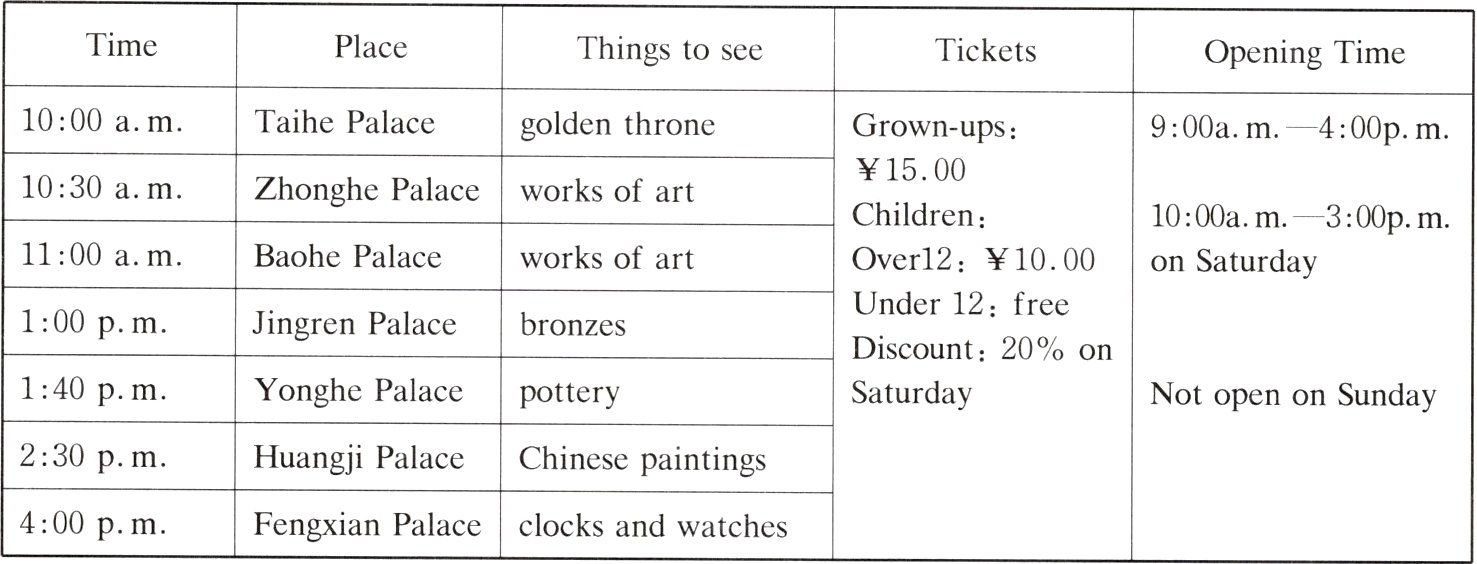
Notice:Keep quiet.
Keep the museum clean.
Don’t forget to buy some things for your friends and family.
Do not take any photos.
Do not touch anything.
( )1. How many kinds of things can you see at the exhibition?
A. 4 B. 5 C. 6 D. 8
( )2. When can you see clocks and watches?
A. At 4:00 p.m. from Monday to Saturday.
B. At 4:00 p.m. on Saturday.
C. At 4:00 p.m. every day.
D. At 4:00 p.m. from Monday to Friday.
( )3. Mr Wu wants to visit the exhibition with two students this Saturday. The two students are both 14. How much are the tickets together?
A. ¥35.00 B. ¥28.00 C. ¥15.00 D. ¥7.00
( )4. The Palace Museum opens _______ days a week.
A. 5 B. 2 C. 7 D. 6
( )5. Which of the following can you do at the exhibition?
A. To talk to each other. B. To take a few nice photos.
C. To speak in a low voice. D. To touch the golden throne.
(一)
American people like to say “Thank you” when other people help them or say something kind to them. People in many other countries do so, too. It is a very good habit. You should say “Thank you” when someone passes you something on the table, when someone opens the door for you and when someone says you do your work well, or you have a nice thing, or your city is very beautiful. “Thank you” is used not only between friends, but also between parents and children, brothers and sisters, husbands and wives.
“Excuse me” is another useful sentence①. When you hear someone say it behind you, you know that someone wants to walk past you. It’s not polite② to interrupt③ others while they are talking. If you want to speak to one of them, say “Excuse me” first, and then begin talking. You should also do so when you want to cough or make any noise before others.
Let’s learn to say “Thank you” and “Excuse me”.
(注:① sentence 句子;② polite 有礼貌的;③ interrupt 打断)
( )1. ______ like to say “Thank you” and “Excuse me”.
A. People in many countries
B. Only American people
C. Except American people
D. All the people in the world
( )2. You should say “Thank you” when(当……时)_______.
A. someone asks you for help
B. someone opens the door for you
C. you pass something to others on the table
D. you make mistakes
( )3. When others say your city is very beautiful, you should say “_______”.
A. Not at all B. Excuse me
C. Thank you D. I’m sorry
( )4. If you want to walk past someone, you’d better say “_______” first.
A. Hello B. Don’t move
C. Excuse me D. I’m sorry
( )5. It’s _______ to interrupt others when they are talking.
A. not polite B. polite
C. good D. happy
(二)
Exhibition(展览)of the Palace Museum
The Palace Museum is a wonderful place to visit. There are lots of things to see. Come to visit the Palace Museum.
Notice:Keep quiet.
Keep the museum clean.
Don’t forget to buy some things for your friends and family.
Do not take any photos.
Do not touch anything.
( )1. How many kinds of things can you see at the exhibition?
A. 4 B. 5 C. 6 D. 8
( )2. When can you see clocks and watches?
A. At 4:00 p.m. from Monday to Saturday.
B. At 4:00 p.m. on Saturday.
C. At 4:00 p.m. every day.
D. At 4:00 p.m. from Monday to Friday.
( )3. Mr Wu wants to visit the exhibition with two students this Saturday. The two students are both 14. How much are the tickets together?
A. ¥35.00 B. ¥28.00 C. ¥15.00 D. ¥7.00
( )4. The Palace Museum opens _______ days a week.
A. 5 B. 2 C. 7 D. 6
( )5. Which of the following can you do at the exhibition?
A. To talk to each other. B. To take a few nice photos.
C. To speak in a low voice. D. To touch the golden throne.
答案:
(一) 1. A 2. B 3. C 4. C 5. A (二) 1. C 2. D 3. B 4. D 5. C
查看更多完整答案,请扫码查看

