

 搜索
搜索
2025年金版新学案高三总复习数学北师大版
注:目前有些书本章节名称可能整理的还不是很完善,但都是按照顺序排列的,请同学们按照顺序仔细查找。练习册 2025年金版新学案高三总复习数学北师大版 答案主要是用来给同学们做完题方便对答案用的,请勿直接抄袭。
第88页
- 第1页
- 第2页
- 第3页
- 第4页
- 第5页
- 第6页
- 第7页
- 第8页
- 第9页
- 第10页
- 第11页
- 第12页
- 第13页
- 第14页
- 第19页
- 第20页
- 第21页
- 第22页
- 第23页
- 第24页
- 第25页
- 第26页
- 第27页
- 第28页
- 第29页
- 第30页
- 第31页
- 第32页
- 第33页
- 第34页
- 第35页
- 第36页
- 第37页
- 第38页
- 第39页
- 第40页
- 第41页
- 第42页
- 第43页
- 第44页
- 第45页
- 第46页
- 第47页
- 第48页
- 第49页
- 第50页
- 第51页
- 第52页
- 第53页
- 第54页
- 第55页
- 第56页
- 第57页
- 第58页
- 第59页
- 第60页
- 第61页
- 第62页
- 第63页
- 第64页
- 第65页
- 第66页
- 第67页
- 第68页
- 第69页
- 第70页
- 第71页
- 第72页
- 第73页
- 第74页
- 第75页
- 第76页
- 第77页
- 第78页
- 第79页
- 第80页
- 第81页
- 第82页
- 第83页
- 第84页
- 第85页
- 第86页
- 第87页
- 第88页
- 第89页
- 第90页
- 第91页
- 第92页
- 第93页
- 第94页
- 第95页
- 第96页
- 第97页
- 第98页
- 第99页
- 第100页
- 第101页
- 第102页
- 第103页
- 第104页
- 第105页
- 第106页
- 第107页
- 第108页
- 第109页
- 第110页
- 第111页
- 第112页
- 第113页
- 第114页
- 第115页
- 第116页
- 第117页
- 第118页
- 第119页
- 第120页
- 第121页
- 第122页
- 第123页
- 第124页
- 第125页
- 第126页
- 第127页
- 第128页
- 第129页
- 第130页
- 第131页
- 第132页
- 第133页
- 第134页
- 第135页
- 第136页
- 第137页
- 第138页
- 第139页
- 第140页
- 第141页
- 第142页
- 第143页
- 第144页
- 第145页
- 第146页
- 第147页
- 第148页
- 第149页
- 第150页
- 第151页
- 第152页
- 第153页
- 第154页
- 第155页
- 第156页
- 第157页
- 第158页
- 第159页
- 第160页
- 第161页
- 第162页
- 第163页
- 第164页
- 第165页
- 第166页
- 第167页
- 第168页
- 第169页
- 第170页
- 第171页
- 第172页
- 第173页
- 第174页
- 第175页
- 第176页
- 第177页
- 第178页
- 第179页
- 第180页
- 第181页
- 第182页
- 第183页
- 第184页
- 第185页
- 第186页
- 第187页
- 第188页
- 第189页
- 第190页
- 第191页
- 第192页
- 第193页
- 第194页
- 第195页
- 第196页
- 第197页
- 第198页
- 第199页
- 第200页
- 第201页
- 第202页
- 第203页
- 第204页
- 第205页
- 第206页
- 第207页
- 第208页
- 第209页
- 第210页
- 第211页
- 第212页
- 第213页
- 第214页
- 第215页
- 第216页
- 第217页
- 第218页
- 第219页
- 第220页
- 第221页
- 第222页
- 第223页
- 第224页
- 第225页
- 第226页
- 第227页
- 第228页
- 第229页
- 第230页
- 第231页
已知函数$f(x)=ax^2 - (\ln x)^2(a\in R)$. 若$f(x)$有两个极值点$x_1$,$x_2$.
答案:
$f^{\prime}(x)=2ax - \frac{2\ln x}{x}=\frac{2ax^{2}-2\ln x}{x}(x\gt0)$。
令$g(x)=2ax^{2}-2\ln x$,因为$f(x)$有两个极值点$x_1$,$x_2$,所以$g(x)$在$(0,+\infty)$上有两个零点。
$g^{\prime}(x)=4ax-\frac{2}{x}=\frac{4ax^{2}-2}{x}$。
当$a\leqslant0$时,$g^{\prime}(x)\lt0$,$g(x)$单调递减,$g(x)$不可能有两个零点,不符合题意。
当$a\gt0$时,令$g^{\prime}(x)=0$,得$x=\sqrt{\frac{1}{2a}}$。
当$0\lt x\lt\sqrt{\frac{1}{2a}}$时,$g^{\prime}(x)\lt0$,$g(x)$单调递减;当$x\gt\sqrt{\frac{1}{2a}}$时,$g^{\prime}(x)\gt0$,$g(x)$单调递增。
所以$g(x)_{\min}=g(\sqrt{\frac{1}{2a}})=1 - \ln\frac{1}{2a}$。
因为$g(x)$有两个零点,所以$g(x)_{\min}\lt0$,即$1-\ln\frac{1}{2a}\lt0$,解得$0\lt a\lt\frac{1}{2e}$。
又因为当$x\to0^{+}$时,$g(x)\to+\infty$;当$x\to+\infty$时,$g(x)\to+\infty$。
设$x_1\lt x_2$,$g(x_1)=g(x_2)=0$,即$2ax_{1}^{2}-2\ln x_1 = 0$,$2ax_{2}^{2}-2\ln x_2 = 0$。
两式相减得$2a(x_{1}^{2}-x_{2}^{2})-2(\ln x_1 - \ln x_2)=0$,则$a=\frac{\ln x_1 - \ln x_2}{x_{2}^{2}-x_{1}^{2}}$。
要证$x_1x_2\lt1$,即证$\ln x_1+\ln x_2\lt0$,由$2ax_{1}^{2}-2\ln x_1 = 0$,$2ax_{2}^{2}-2\ln x_2 = 0$相加得:
$2a(x_{1}^{2}+x_{2}^{2})-2(\ln x_1+\ln x_2)=0$,将$a=\frac{\ln x_1 - \ln x_2}{x_{2}^{2}-x_{1}^{2}}$代入得:
$\frac{2(\ln x_1 - \ln x_2)}{x_{2}^{2}-x_{1}^{2}}(x_{1}^{2}+x_{2}^{2})-2(\ln x_1+\ln x_2)=0$,
$\frac{\ln x_1 - \ln x_2}{x_{2}^{2}-x_{1}^{2}}(x_{1}^{2}+x_{2}^{2})= \ln x_1+\ln x_2$,
$\ln\frac{x_1}{x_2}·\frac{x_{1}^{2}+x_{2}^{2}}{x_{2}^{2}-x_{1}^{2}}=\ln(x_1x_2)$。
令$t=\frac{x_1}{x_2}(0\lt t\lt1)$,则$\ln t·\frac{t^{2}+1}{1 - t^{2}}=\ln(x_1x_2)$。
设$h(t)=\ln t·\frac{t^{2}+1}{1 - t^{2}}(0\lt t\lt1)$,$h^{\prime}(t)=\frac{(1 - t^{2})·\frac{t^{2}+1}{t}-(-2t)\ln t·(t^{2}+1)+(1 - t^{2})·2t\ln t}{(1 - t^{2})^{2}}\lt0$。
所以$h(t)\lt h(1)= - 1\lt0$,即$\ln(x_1x_2)\lt0$,所以$x_1x_2\lt1$。
综上,$a$的取值范围是$(0,\frac{1}{2e})$,且$x_1x_2\lt1$。
令$g(x)=2ax^{2}-2\ln x$,因为$f(x)$有两个极值点$x_1$,$x_2$,所以$g(x)$在$(0,+\infty)$上有两个零点。
$g^{\prime}(x)=4ax-\frac{2}{x}=\frac{4ax^{2}-2}{x}$。
当$a\leqslant0$时,$g^{\prime}(x)\lt0$,$g(x)$单调递减,$g(x)$不可能有两个零点,不符合题意。
当$a\gt0$时,令$g^{\prime}(x)=0$,得$x=\sqrt{\frac{1}{2a}}$。
当$0\lt x\lt\sqrt{\frac{1}{2a}}$时,$g^{\prime}(x)\lt0$,$g(x)$单调递减;当$x\gt\sqrt{\frac{1}{2a}}$时,$g^{\prime}(x)\gt0$,$g(x)$单调递增。
所以$g(x)_{\min}=g(\sqrt{\frac{1}{2a}})=1 - \ln\frac{1}{2a}$。
因为$g(x)$有两个零点,所以$g(x)_{\min}\lt0$,即$1-\ln\frac{1}{2a}\lt0$,解得$0\lt a\lt\frac{1}{2e}$。
又因为当$x\to0^{+}$时,$g(x)\to+\infty$;当$x\to+\infty$时,$g(x)\to+\infty$。
设$x_1\lt x_2$,$g(x_1)=g(x_2)=0$,即$2ax_{1}^{2}-2\ln x_1 = 0$,$2ax_{2}^{2}-2\ln x_2 = 0$。
两式相减得$2a(x_{1}^{2}-x_{2}^{2})-2(\ln x_1 - \ln x_2)=0$,则$a=\frac{\ln x_1 - \ln x_2}{x_{2}^{2}-x_{1}^{2}}$。
要证$x_1x_2\lt1$,即证$\ln x_1+\ln x_2\lt0$,由$2ax_{1}^{2}-2\ln x_1 = 0$,$2ax_{2}^{2}-2\ln x_2 = 0$相加得:
$2a(x_{1}^{2}+x_{2}^{2})-2(\ln x_1+\ln x_2)=0$,将$a=\frac{\ln x_1 - \ln x_2}{x_{2}^{2}-x_{1}^{2}}$代入得:
$\frac{2(\ln x_1 - \ln x_2)}{x_{2}^{2}-x_{1}^{2}}(x_{1}^{2}+x_{2}^{2})-2(\ln x_1+\ln x_2)=0$,
$\frac{\ln x_1 - \ln x_2}{x_{2}^{2}-x_{1}^{2}}(x_{1}^{2}+x_{2}^{2})= \ln x_1+\ln x_2$,
$\ln\frac{x_1}{x_2}·\frac{x_{1}^{2}+x_{2}^{2}}{x_{2}^{2}-x_{1}^{2}}=\ln(x_1x_2)$。
令$t=\frac{x_1}{x_2}(0\lt t\lt1)$,则$\ln t·\frac{t^{2}+1}{1 - t^{2}}=\ln(x_1x_2)$。
设$h(t)=\ln t·\frac{t^{2}+1}{1 - t^{2}}(0\lt t\lt1)$,$h^{\prime}(t)=\frac{(1 - t^{2})·\frac{t^{2}+1}{t}-(-2t)\ln t·(t^{2}+1)+(1 - t^{2})·2t\ln t}{(1 - t^{2})^{2}}\lt0$。
所以$h(t)\lt h(1)= - 1\lt0$,即$\ln(x_1x_2)\lt0$,所以$x_1x_2\lt1$。
综上,$a$的取值范围是$(0,\frac{1}{2e})$,且$x_1x_2\lt1$。
(1)求实数$a$的取值范围;
答案:
解:
(1)因为函数$f(x)=ax^2 - (\ln x)^2$,可得$f^{\prime}(x)=2ax-\frac{2\ln x}{x}$,令$f^{\prime}(x)=0$,解得$a=\frac{\ln x}{x^2}$,设$p(x)=\frac{\ln x}{x^2}$,可得$p^{\prime}(x)=\frac{1 - 2\ln x}{x^3},x>0$。因为$f(x)$有两个极值点$x_1,x_2$,则直线$y = a$与函数$p(x)=\frac{\ln x}{x^2}$的图象有两个不同的交点,当$x\in(0,\sqrt{e})$时,$p^{\prime}(x)>0$;当$x\in(\sqrt{e},+\infty)$时,$p^{\prime}(x)<0$,所以$p(x)$在$(0,\sqrt{e})$上单调递增,在$(\sqrt{e},+\infty)$上单调递减,所以$p(x)_{\max}=p(\sqrt{e})=\frac{1}{2e}$。又当$x\to0$时,$p(x)\to-\infty$,$x\to+\infty$时,$p(x)\to0$,故可作出$p(x)$的大致图象,如图所示,结合图象可得,$0<a<\frac{1}{2e}$,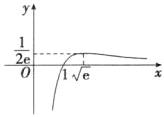 即实数$a$的取值范围为$\left(0,\frac{1}{2e}\right)$。
解:
(1)因为函数$f(x)=ax^2 - (\ln x)^2$,可得$f^{\prime}(x)=2ax-\frac{2\ln x}{x}$,令$f^{\prime}(x)=0$,解得$a=\frac{\ln x}{x^2}$,设$p(x)=\frac{\ln x}{x^2}$,可得$p^{\prime}(x)=\frac{1 - 2\ln x}{x^3},x>0$。因为$f(x)$有两个极值点$x_1,x_2$,则直线$y = a$与函数$p(x)=\frac{\ln x}{x^2}$的图象有两个不同的交点,当$x\in(0,\sqrt{e})$时,$p^{\prime}(x)>0$;当$x\in(\sqrt{e},+\infty)$时,$p^{\prime}(x)<0$,所以$p(x)$在$(0,\sqrt{e})$上单调递增,在$(\sqrt{e},+\infty)$上单调递减,所以$p(x)_{\max}=p(\sqrt{e})=\frac{1}{2e}$。又当$x\to0$时,$p(x)\to-\infty$,$x\to+\infty$时,$p(x)\to0$,故可作出$p(x)$的大致图象,如图所示,结合图象可得,$0<a<\frac{1}{2e}$,
即实数$a$的取值范围为$\left(0,\frac{1}{2e}\right)$。 (2)求证:$x_1x_2 > e$.
答案:
证明:由函数$f(x)$有两个零点$x_1,x_2$,所以$2ax_1^2=\ln x_1^2,2ax_2^2=\ln x_2^2$,令$t_1=x_1^2,t_2=x_2^2$,则等价于关于$t$的方程$2at=\ln t$有两个不相等的实数根$t_1,t_2$,只需证明$t_1t_2>e^2$,不妨令$t_1>t_2$,由$2at_1=\ln t_1,2at_2=\ln t_2$得$2a=\frac{\ln t_1 - \ln t_2}{t_1 - t_2}$,要证$t_1t_2>e^2$,只需证明$\ln t_1+\ln t_2>2$,即证$\ln t_1+\ln t_2=2a(t_1 + t_2)=(t_1 + t_2)·\frac{\ln t_1 - \ln t_2}{t_1 - t_2}>2$,即证$\ln t_1 - \ln t_2>\frac{2(t_1 - t_2)}{t_1 + t_2}$,即证$\ln\frac{t_1}{t_2}>\frac{2\left(\frac{t_1}{t_2}-1\right)}{\frac{t_1}{t_2}+1}$。令$m=\frac{t_1}{t_2}$,则$m>1$,只需证明$\ln m>\frac{2(m - 1)}{m + 1}(m>1)$,令$s(m)=\ln m-\frac{2(m - 1)}{m + 1}(m>1)$,则$s^{\prime}(m)=\frac{(m - 1)^2}{m(m + 1)^2}>0$,所以$s(m)$在$(1,+\infty)$上单调递增,所以$s(m)>s(1)=\ln 1-\frac{2×(1 - 1)}{1 + 1}=0$。综上所述,原不等式成立。
(2025·安徽亳州模拟结选)已知函数$f(x)=\ln x - ax - 1(a\in R)$. 若方程$f(x)+2 = 0$有两个实根$x_1$,$x_2$,且$x_2 > 2x_1$,求证:$x_1x_2^2 > \frac{32}{e^3}$.(参考数据:$\ln 2\approx 0.693$,$\ln 3\approx 1.099$)
答案:
证明:由题意知$f(x)+2=\ln x - ax + 1 = 0$有两个实根$x_1,x_2$,于是$\begin{cases}\ln x_1 + 1 = ax_1\\\ln x_2 + 1 = ax_2\end{cases}$令$\frac{x_2}{x_1}=t$,则由$x_2>2x_1$可得$t>2$。于是$t=\frac{x_2}{x_1}=\frac{\ln x_2 + 1}{\ln x_1 + 1}=\frac{\ln t+\ln x_1 + 1}{\ln x_1 + 1}$,即$\ln x_1=\frac{\ln t}{t - 1}-1$。从而$\ln x_2=\ln t+\ln x_1=\frac{t\ln t}{t - 1}-1$。另一方面,对$x_1x_2^2>\frac{32}{e^3}$两边分别取自然对数,则有$\ln x_1 + 2\ln x_2>5\ln2 - 3$,即证$\frac{\ln t}{t - 1}+\frac{2t\ln t}{t - 1}-3>5\ln2 - 3$,即$\frac{(1 + 2t)\ln t}{t - 1}>5\ln2$,其中$t>2$。设$g(t)=\frac{(1 + 2t)\ln t}{t - 1}$,则$g^{\prime}(t)=\frac{(2\ln t+\frac{1 + 2t}{t})(t - 1)-(1 + 2t)\ln t}{(t - 1)^2}=\frac{-3\ln t + 2t - \frac{1}{t}-1}{(t - 1)^2}$。设$\varphi(t)=-3\ln t + 2t-\frac{1}{t}-1,t>2$。则$\varphi^{\prime}(t)=-\frac{3}{t}+2+\frac{1}{t^2}=\frac{2t^2 - 3t + 1}{t^2}=\frac{(2t - 1)(t - 1)}{t^2}>0$在$(2,+\infty)$上恒成立。于是$\varphi(t)$在$(2,+\infty)$上单调递增,从而$\varphi(t)>\varphi(2)=-3\ln2 + 4-\frac{1}{2}-1=\frac{5}{2}-3\ln2>0$。所以$g^{\prime}(t)>0$,即函数$g(t)$在$(2,+\infty)$上单调递增,于是$g(t)>g(2)=5\ln2$。因此$x_1x_2^2>\frac{32}{e^3}$,即原不等式成立。
已知函数$f(x)=\frac{1}{2}x^2 - x + a\ln x$.
(1)当$a > 0$时,讨论函数$f(x)$的单调性;
(2)若函数$f(x)$有两个极值点$x_1$,$x_2$,证明:$f(x_1)+f(x_2) > -\frac{\ln 2}{2}-\frac{3}{4}$.
(1)当$a > 0$时,讨论函数$f(x)$的单调性;
(2)若函数$f(x)$有两个极值点$x_1$,$x_2$,证明:$f(x_1)+f(x_2) > -\frac{\ln 2}{2}-\frac{3}{4}$.
答案:
解:
(1)因为$f(x)=\frac{1}{2}x^2 - x + a\ln x$,所以$f^{\prime}(x)=x - 1+\frac{a}{x}=\frac{x^2 - x + a}{x}(x>0)$。①当$1 - 4a\leq0$,即$a\geq\frac{1}{4}$时,$f^{\prime}(x)\geq0$,所以$f(x)$在$(0,+\infty)$上单调递增;②当$1 - 4a>0$,即$0<a<\frac{1}{4}$时,令$f^{\prime}(x)=0$,得$x_1=\frac{1 - \sqrt{1 - 4a}}{2},x_2=\frac{1 + \sqrt{1 - 4a}}{2}$,且$0<x_1<x_2$。当$x\in\left(0,\frac{1 - \sqrt{1 - 4a}}{2}\right)\cup\left(\frac{1 + \sqrt{1 - 4a}}{2},+\infty\right)$时,$f^{\prime}(x)>0$,当$x\in\left(\frac{1 - \sqrt{1 - 4a}}{2},\frac{1 + \sqrt{1 - 4a}}{2}\right)$时,$f^{\prime}(x)<0$,所以$f(x)$的单调递增区间为$\left(0,\frac{1 - \sqrt{1 - 4a}}{2}\right),\left(\frac{1 + \sqrt{1 - 4a}}{2},+\infty\right)$;单调递减区间为$\left(\frac{1 - \sqrt{1 - 4a}}{2},\frac{1 + \sqrt{1 - 4a}}{2}\right)$。综上所述,当$a\geq\frac{1}{4}$时,$f(x)$在区间$(0,+\infty)$上单调递增;当$0<a<\frac{1}{4}$时,$f(x)$在区间$\left(0,\frac{1 - \sqrt{1 - 4a}}{2}\right),\left(\frac{1 + \sqrt{1 - 4a}}{2},+\infty\right)$上单调递增,在区间$\left(\frac{1 - \sqrt{1 - 4a}}{2},\frac{1 + \sqrt{1 - 4a}}{2}\right)$上单调递减。
证明:
(2)由
(1)得$f^{\prime}(x)=x - 1+\frac{a}{x}=\frac{x^2 - x + a}{x}(x>0)$。因为函数$f(x)$有两个极值点$x_1,x_2$,所以方程$x^2 - x + a = 0$在$(0,+\infty)$上有两个不同实根$x_1,x_2$,所以$\begin{cases}x_1 + x_2 = 1\\x_1x_2 = a\end{cases}$,且$\Delta = 1 - 4a>0$,所以$0<a<\frac{1}{4}$。由题意得$f(x_1)+f(x_2)=\frac{1}{2}x_1^2 - x_1 + a\ln x_1+\frac{1}{2}x_2^2 - x_2 + a\ln x_2=\frac{1}{2}(x_1^2 + x_2^2)-(x_1 + x_2)+a\ln(x_1x_2)=\frac{1}{2}(x_1 + x_2)^2 - x_1x_2-(x_1 + x_2)+a\ln(x_1x_2)=\frac{1}{2}-a - 1 + a\ln a=a\ln a - a - \frac{1}{2}$。令$h(a)=a\ln a - a - \frac{1}{2}\left(0<a<\frac{1}{4}\right)$,则$h^{\prime}(a)=\ln a<0$,所以$h(a)$在$\left(0,\frac{1}{4}\right)$上单调递减,所以$h(a)>h\left(\frac{1}{4}\right)=-\frac{\ln2}{2}-\frac{3}{4}$,所以$f(x_1)+f(x_2)>-\frac{\ln2}{2}-\frac{3}{4}$。
(1)因为$f(x)=\frac{1}{2}x^2 - x + a\ln x$,所以$f^{\prime}(x)=x - 1+\frac{a}{x}=\frac{x^2 - x + a}{x}(x>0)$。①当$1 - 4a\leq0$,即$a\geq\frac{1}{4}$时,$f^{\prime}(x)\geq0$,所以$f(x)$在$(0,+\infty)$上单调递增;②当$1 - 4a>0$,即$0<a<\frac{1}{4}$时,令$f^{\prime}(x)=0$,得$x_1=\frac{1 - \sqrt{1 - 4a}}{2},x_2=\frac{1 + \sqrt{1 - 4a}}{2}$,且$0<x_1<x_2$。当$x\in\left(0,\frac{1 - \sqrt{1 - 4a}}{2}\right)\cup\left(\frac{1 + \sqrt{1 - 4a}}{2},+\infty\right)$时,$f^{\prime}(x)>0$,当$x\in\left(\frac{1 - \sqrt{1 - 4a}}{2},\frac{1 + \sqrt{1 - 4a}}{2}\right)$时,$f^{\prime}(x)<0$,所以$f(x)$的单调递增区间为$\left(0,\frac{1 - \sqrt{1 - 4a}}{2}\right),\left(\frac{1 + \sqrt{1 - 4a}}{2},+\infty\right)$;单调递减区间为$\left(\frac{1 - \sqrt{1 - 4a}}{2},\frac{1 + \sqrt{1 - 4a}}{2}\right)$。综上所述,当$a\geq\frac{1}{4}$时,$f(x)$在区间$(0,+\infty)$上单调递增;当$0<a<\frac{1}{4}$时,$f(x)$在区间$\left(0,\frac{1 - \sqrt{1 - 4a}}{2}\right),\left(\frac{1 + \sqrt{1 - 4a}}{2},+\infty\right)$上单调递增,在区间$\left(\frac{1 - \sqrt{1 - 4a}}{2},\frac{1 + \sqrt{1 - 4a}}{2}\right)$上单调递减。
证明:
(2)由
(1)得$f^{\prime}(x)=x - 1+\frac{a}{x}=\frac{x^2 - x + a}{x}(x>0)$。因为函数$f(x)$有两个极值点$x_1,x_2$,所以方程$x^2 - x + a = 0$在$(0,+\infty)$上有两个不同实根$x_1,x_2$,所以$\begin{cases}x_1 + x_2 = 1\\x_1x_2 = a\end{cases}$,且$\Delta = 1 - 4a>0$,所以$0<a<\frac{1}{4}$。由题意得$f(x_1)+f(x_2)=\frac{1}{2}x_1^2 - x_1 + a\ln x_1+\frac{1}{2}x_2^2 - x_2 + a\ln x_2=\frac{1}{2}(x_1^2 + x_2^2)-(x_1 + x_2)+a\ln(x_1x_2)=\frac{1}{2}(x_1 + x_2)^2 - x_1x_2-(x_1 + x_2)+a\ln(x_1x_2)=\frac{1}{2}-a - 1 + a\ln a=a\ln a - a - \frac{1}{2}$。令$h(a)=a\ln a - a - \frac{1}{2}\left(0<a<\frac{1}{4}\right)$,则$h^{\prime}(a)=\ln a<0$,所以$h(a)$在$\left(0,\frac{1}{4}\right)$上单调递减,所以$h(a)>h\left(\frac{1}{4}\right)=-\frac{\ln2}{2}-\frac{3}{4}$,所以$f(x_1)+f(x_2)>-\frac{\ln2}{2}-\frac{3}{4}$。
已知函数$f(x)=\frac{1}{x}-x + a\ln x$.
(1)讨论$f(x)$的单调性;
(2)若$f(x)$存在两个极值点$x_1$,$x_2$,证明:$\frac{f(x_1)-f(x_2)}{x_1 - x_2} < a - 2$.
请完成课时测评 28
(1)讨论$f(x)$的单调性;
(2)若$f(x)$存在两个极值点$x_1$,$x_2$,证明:$\frac{f(x_1)-f(x_2)}{x_1 - x_2} < a - 2$.
请完成课时测评 28
答案:
解:(1)$f(x)$的定义域为$(0,+\infty)$,$f^{\prime}(x)=-\frac{1}{x^2}-1+\frac{a}{x}=\frac{-x^2 + ax + 1}{x^2}$。(ⅰ)若$a\leq2$,则$f^{\prime}(x)\leq0$,当且仅当$a = 2,x = 1$时$f^{\prime}(x)=0$,所以$f(x)$在$(0,+\infty)$上单调递减。(ⅱ)若$a>2$,令$f^{\prime}(x)=0$得,$x=\frac{a - \sqrt{a^2 - 4}}{2}$或$x=\frac{a + \sqrt{a^2 - 4}}{2}$。当$x\in\left(0,\frac{a - \sqrt{a^2 - 4}}{2}\right)\cup\left(\frac{a + \sqrt{a^2 - 4}}{2},+\infty\right)$时,$f^{\prime}(x)<0$;当$x\in\left(\frac{a - \sqrt{a^2 - 4}}{2},\frac{a + \sqrt{a^2 - 4}}{2}\right)$时,$f^{\prime}(x)>0$。所以$f(x)$在$\left(0,\frac{a - \sqrt{a^2 - 4}}{2}\right),\left(\frac{a + \sqrt{a^2 - 4}}{2},+\infty\right)$上单调递减,在$\left(\frac{a - \sqrt{a^2 - 4}}{2},\frac{a + \sqrt{a^2 - 4}}{2}\right)$上单调递增。综上,当$a\leq2$时,$f(x)$在$(0,+\infty)$上单调递减;当$a>2$时,$f(x)$在$\left(0,\frac{a - \sqrt{a^2 - 4}}{2}\right),\left(\frac{a + \sqrt{a^2 - 4}}{2},+\infty\right)$上单调递减,在$\left(\frac{a - \sqrt{a^2 - 4}}{2},\frac{a + \sqrt{a^2 - 4}}{2}\right)$上单调递增。
证明:(2)由
(1)知,$f(x)$存在两个极值点时,$a>2$。由于$f(x)$的两个极值点$x_1,x_2$满足$x^2 - ax + 1 = 0$,所以$x_1x_2 = 1$,不妨设$x_1<x_2$,则$x_2>1$。由于$\frac{f(x_1)-f(x_2)}{x_1 - x_2}=-\frac{1}{x_1x_2}-1 + a\frac{\ln x_1 - \ln x_2}{x_1 - x_2}=-2 + a\frac{-2\ln x_2}{x_2 - \frac{1}{x_2}}$。所以$\frac{f(x_1)-f(x_2)}{x_1 - x_2}<a - 2$等价于$\frac{1}{x_2}-x_2 + 2\ln x_2<0$。设函数$g(x)=\frac{1}{x}-x + 2\ln x$,由
(1)知,$g(x)$在$(0,+\infty)$上单调递减,又$g(1)=0$,从而当$x\in(1,+\infty)$时,$g(x)<0$。所以$\frac{1}{x_2}-x_2 + 2\ln x_2<0$,即$\frac{f(x_1)-f(x_2)}{x_1 - x_2}<a - 2$。
证明:(2)由
(1)知,$f(x)$存在两个极值点时,$a>2$。由于$f(x)$的两个极值点$x_1,x_2$满足$x^2 - ax + 1 = 0$,所以$x_1x_2 = 1$,不妨设$x_1<x_2$,则$x_2>1$。由于$\frac{f(x_1)-f(x_2)}{x_1 - x_2}=-\frac{1}{x_1x_2}-1 + a\frac{\ln x_1 - \ln x_2}{x_1 - x_2}=-2 + a\frac{-2\ln x_2}{x_2 - \frac{1}{x_2}}$。所以$\frac{f(x_1)-f(x_2)}{x_1 - x_2}<a - 2$等价于$\frac{1}{x_2}-x_2 + 2\ln x_2<0$。设函数$g(x)=\frac{1}{x}-x + 2\ln x$,由
(1)知,$g(x)$在$(0,+\infty)$上单调递减,又$g(1)=0$,从而当$x\in(1,+\infty)$时,$g(x)<0$。所以$\frac{1}{x_2}-x_2 + 2\ln x_2<0$,即$\frac{f(x_1)-f(x_2)}{x_1 - x_2}<a - 2$。
查看更多完整答案,请扫码查看

