

 搜索
搜索
2025年英语同步练习册八年级上册仁爱版河南专版
注:目前有些书本章节名称可能整理的还不是很完善,但都是按照顺序排列的,请同学们按照顺序仔细查找。练习册 2025年英语同步练习册八年级上册仁爱版河南专版 答案主要是用来给同学们做完题方便对答案用的,请勿直接抄袭。
第31页
- 第1页
- 第2页
- 第3页
- 第4页
- 第5页
- 第6页
- 第7页
- 第8页
- 第9页
- 第10页
- 第11页
- 第12页
- 第13页
- 第14页
- 第15页
- 第16页
- 第17页
- 第18页
- 第19页
- 第20页
- 第21页
- 第22页
- 第23页
- 第24页
- 第25页
- 第26页
- 第27页
- 第28页
- 第29页
- 第30页
- 第31页
- 第32页
- 第33页
- 第34页
- 第35页
- 第36页
- 第37页
- 第38页
- 第39页
- 第40页
- 第41页
- 第42页
- 第43页
- 第44页
- 第45页
- 第46页
- 第47页
- 第48页
- 第49页
- 第50页
- 第51页
- 第52页
- 第53页
- 第54页
- 第55页
- 第56页
- 第57页
- 第58页
- 第59页
- 第60页
- 第61页
- 第62页
- 第63页
- 第64页
- 第65页
- 第66页
- 第67页
- 第68页
- 第69页
- 第70页
- 第71页
- 第72页
- 第73页
- 第74页
- 第75页
- 第76页
- 第77页
- 第78页
- 第79页
- 第80页
- 第81页
- 第82页
- 第83页
- 第84页
- 第85页
- 第86页
- 第87页
- 第88页
- 第89页
- 第90页
- 第91页
- 第92页
- 第93页
- 第94页
- 第95页
- 第96页
- 第97页
- 第98页
- 第99页
- 第100页
- 第101页
- 第102页
- 第103页
- 第104页
- 第105页
- 第106页
- 第107页
- 第108页
- 第109页
- 第110页
- 第111页
- 第112页
- 第113页
- 第114页
- 第115页
- 第116页
- 第117页
- 第118页
- 第119页
- 第120页
- 第121页
- 第122页
- 第123页
- 第124页
- 第125页
- 第126页
- 第127页
- 第128页
- 第129页
- 第130页
- 第131页
- 第132页
- 第133页
- 第134页
- 第135页
- 第136页
- 第137页
- 第138页
- 第139页
- 第140页
- 第141页
- 第142页
- 第143页
- 第144页
二、根据短文完成思维导图。
Most Chinese characters (汉字) usually have good meanings, and some of them are especially loved by Chinese people. Here are three examples.
“Fu” (福) means happiness and good luck. The upside - down “Fu” means good luck is here.
“Shou” (寿) means long life. It also means age and birthday.
“Cai” (财) means wealth and money. Chinese people often say “gongxifacai” to their friends. It means “Wish you great fortune (财富).”
| “Fu” | “Shou” |
| · It means 1.
· The upside - down “Fu” means 2.
· 4.
| | Good meanings of Chinese characters |
| “Cai” | |
| · 5.
· 6.
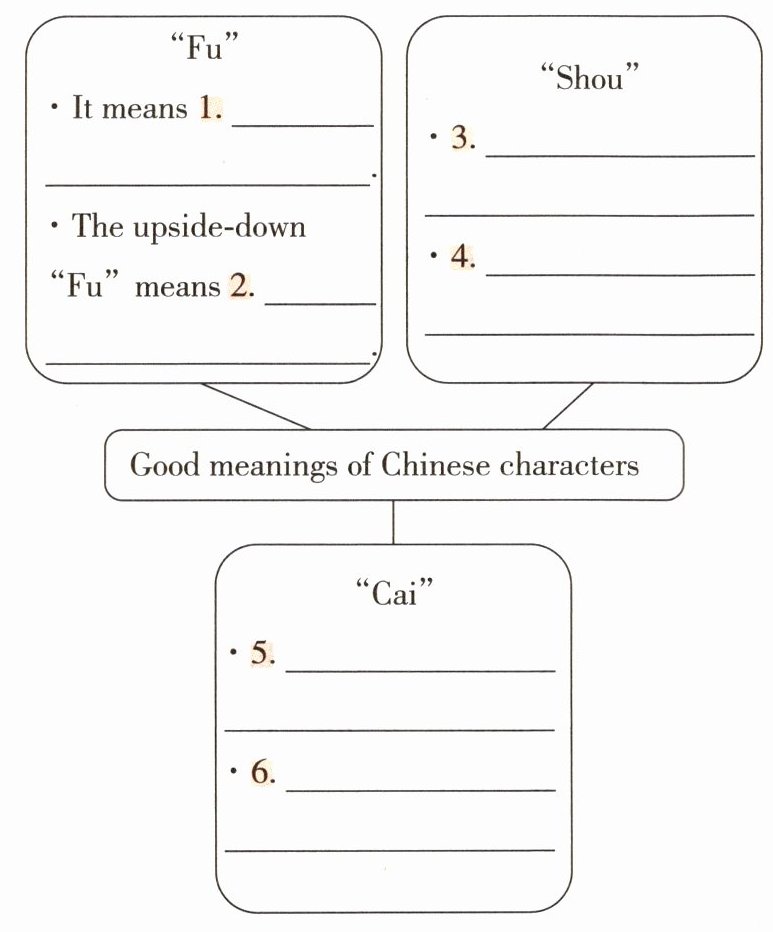
Most Chinese characters (汉字) usually have good meanings, and some of them are especially loved by Chinese people. Here are three examples.
“Fu” (福) means happiness and good luck. The upside - down “Fu” means good luck is here.
“Shou” (寿) means long life. It also means age and birthday.
“Cai” (财) means wealth and money. Chinese people often say “gongxifacai” to their friends. It means “Wish you great fortune (财富).”
| “Fu” | “Shou” |
| · It means 1.
happiness and good luck
. · The upside - down “Fu” means 2.
good luck is here
. | · 3. It means long life.
. · 4.
It also means age and birthday.
. || | Good meanings of Chinese characters |
| “Cai” | |
| · 5.
It means wealth and money.
. · 6.
"Gongxifacai" means "Wish you great fortune."
. | |
答案:
1. happiness and good luck 2. good luck is here
3. It means long life. 4. It also means age and birthday.
5. It means wealth and money. 6. "Gongxifacai" means "Wish you great fortune."
3. It means long life. 4. It also means age and birthday.
5. It means wealth and money. 6. "Gongxifacai" means "Wish you great fortune."
三、阅读理解。
阅读下面的语言材料,然后按文后要求做题。
*The Awakening Age* (《觉醒年代》) is one of the most meaningful and interesting TV dramas. It shows the history from the New Culture Movement (新文化运动) to the founding of the Communist Party of China (中国共产党成立).
In order to wake people up to the problems, many students gave speeches in the streets. They tried their best to fight for a better world. Also, they spread ideas of democracy (民主) and science no matter what troubles they would get into. You will feel excited while watching the drama.
Among all the characters (人物), I *admire* Chen Yannian the most. He gave great help to the growth of the CPC. His life was short and he only lived to the age of 29. But his spirit will always live in people’s hearts. The drama encourages me to face difficulties in a brave and positive (积极的) way.
根据材料内容选择最佳答案。
(
A. Drama.
B. Painting.
C. Dancing.
D. Film.
(
A. Literature.
B. Education.
C. Sports.
D. History.
(
A. By asking questions about *The Awakening Age*.
B. By listing numbers in *The Awakening Age*.
C. By showing what *The Awakening Age* is about.
D. By telling readers why he likes *The Awakening Age*.
(
A. 思念
B. 敬佩
C. 怀疑
D. 嫉妒
(
A. To show his love for the CPC.
B. To encourage readers to learn from heroes.
C. To ask readers to watch *The Awakening Age*.
D. To introduce *The Awakening Age* to readers.
阅读下面的语言材料,然后按文后要求做题。
*The Awakening Age* (《觉醒年代》) is one of the most meaningful and interesting TV dramas. It shows the history from the New Culture Movement (新文化运动) to the founding of the Communist Party of China (中国共产党成立).
In order to wake people up to the problems, many students gave speeches in the streets. They tried their best to fight for a better world. Also, they spread ideas of democracy (民主) and science no matter what troubles they would get into. You will feel excited while watching the drama.
Among all the characters (人物), I *admire* Chen Yannian the most. He gave great help to the growth of the CPC. His life was short and he only lived to the age of 29. But his spirit will always live in people’s hearts. The drama encourages me to face difficulties in a brave and positive (积极的) way.
根据材料内容选择最佳答案。
(
A
)1. What form of art does *The Awakening Age* belong to?A. Drama.
B. Painting.
C. Dancing.
D. Film.
(
D
)2. What is *The Awakening Age* about?A. Literature.
B. Education.
C. Sports.
D. History.
(
C
)3. How does the writer develop Paragraph 2?A. By asking questions about *The Awakening Age*.
B. By listing numbers in *The Awakening Age*.
C. By showing what *The Awakening Age* is about.
D. By telling readers why he likes *The Awakening Age*.
(
B
)4. What does the underlined word “admire” mean in Chinese?A. 思念
B. 敬佩
C. 怀疑
D. 嫉妒
(
D
)5. Why does the writer write this passage?A. To show his love for the CPC.
B. To encourage readers to learn from heroes.
C. To ask readers to watch *The Awakening Age*.
D. To introduce *The Awakening Age* to readers.
答案:
1. A 由第一段第一句可知,《觉醒年代》是一部电视剧。
2. D 由第一段第二句可知,这部剧是关于从新文化运动到中国共产党成立的这段历史的。
3. C 文章第二段主要介绍了《觉醒年代》这部电视剧的内容。
4. B 由下文可知,陈延年对中国共产党的成长给予了巨大的帮助。作者十分敬佩他。
5. D 通读全文可知,作者写这篇文章的主要目的是向读者介绍《觉醒年代》这部电视剧。
2. D 由第一段第二句可知,这部剧是关于从新文化运动到中国共产党成立的这段历史的。
3. C 文章第二段主要介绍了《觉醒年代》这部电视剧的内容。
4. B 由下文可知,陈延年对中国共产党的成长给予了巨大的帮助。作者十分敬佩他。
5. D 通读全文可知,作者写这篇文章的主要目的是向读者介绍《觉醒年代》这部电视剧。
查看更多完整答案,请扫码查看

