

 搜索
搜索
第113页
- 第1页
- 第2页
- 第3页
- 第4页
- 第5页
- 第6页
- 第7页
- 第8页
- 第9页
- 第10页
- 第11页
- 第12页
- 第13页
- 第14页
- 第15页
- 第16页
- 第17页
- 第18页
- 第19页
- 第20页
- 第21页
- 第22页
- 第23页
- 第24页
- 第25页
- 第26页
- 第27页
- 第28页
- 第29页
- 第30页
- 第31页
- 第32页
- 第33页
- 第34页
- 第35页
- 第36页
- 第37页
- 第38页
- 第39页
- 第40页
- 第41页
- 第42页
- 第43页
- 第44页
- 第45页
- 第46页
- 第47页
- 第48页
- 第49页
- 第50页
- 第51页
- 第52页
- 第53页
- 第54页
- 第55页
- 第56页
- 第57页
- 第58页
- 第59页
- 第60页
- 第61页
- 第62页
- 第63页
- 第64页
- 第65页
- 第66页
- 第67页
- 第68页
- 第69页
- 第70页
- 第71页
- 第72页
- 第73页
- 第74页
- 第75页
- 第76页
- 第77页
- 第78页
- 第79页
- 第80页
- 第81页
- 第82页
- 第83页
- 第84页
- 第85页
- 第86页
- 第87页
- 第88页
- 第89页
- 第90页
- 第91页
- 第92页
- 第93页
- 第94页
- 第95页
- 第96页
- 第97页
- 第98页
- 第99页
- 第100页
- 第101页
- 第102页
- 第103页
- 第104页
- 第105页
- 第106页
- 第107页
- 第108页
- 第109页
- 第110页
- 第111页
- 第112页
- 第113页
- 第114页
- 第115页
- 第116页
- 第117页
- 第118页
- 第119页
- 第120页
- 第121页
- 第122页
- 第123页
- 第124页
1. 下列方程组不是三元一次方程组的是( )
A.$\begin{cases}x = 5, \\ x + y = 7, \\ x + y + z = 6\end{cases} $
B.$\begin{cases}x + y = 3, \\ y + z = 4, \\ z + x = 2\end{cases} $
C.$\begin{cases}4x - 9z = 17, \\ 3x + y + 15z = 18, \\ x + 2y + 3z = 2\end{cases} $
D.$\begin{cases}x + y - z = 5, \\ xyz = 1, \\ x - 3y = 2\end{cases} $
A.$\begin{cases}x = 5, \\ x + y = 7, \\ x + y + z = 6\end{cases} $
B.$\begin{cases}x + y = 3, \\ y + z = 4, \\ z + x = 2\end{cases} $
C.$\begin{cases}4x - 9z = 17, \\ 3x + y + 15z = 18, \\ x + 2y + 3z = 2\end{cases} $
D.$\begin{cases}x + y - z = 5, \\ xyz = 1, \\ x - 3y = 2\end{cases} $
答案:
D
2. 解三元一次方程组$\begin{cases}3x - y + z = 4, ② \\ 2x - y - z = 12, ② \\ x + y + 2z = 6, ③\end{cases} 若先消去z$,组成关于$x$,$y$的方程组,则应对方程组进行的变形是( )
A.① - ②,② + ③
B.① × 2 + ③,② × 2 + ③
C.① + ②,② × 2 + ③
D.① + ③,② + ③
A.① - ②,② + ③
B.① × 2 + ③,② × 2 + ③
C.① + ②,② × 2 + ③
D.① + ③,② + ③
答案:
C
3. 若$(2x - 4)^2 + (x + y)^2 + |4z - y| = 0$,则$x + y + z = $______。
答案:
$-\frac{1}{2}$
4. 解下列方程组
(1) $\begin{cases}x - 4y + z = -3, ② \\ 2x + y - z = 18, ② \\ x - y - z = 7; ③\end{cases} $
(2) $\begin{cases}x + 3y + 2z = 2, ① \\ 3x + 2y - 4z = 3, ② \\ 2x - y = 7。③\end{cases} $
(1) $\begin{cases}x - 4y + z = -3, ② \\ 2x + y - z = 18, ② \\ x - y - z = 7; ③\end{cases} $
(2) $\begin{cases}x + 3y + 2z = 2, ① \\ 3x + 2y - 4z = 3, ② \\ 2x - y = 7。③\end{cases} $
答案:
(1)① + ②,得$3x - 3y = 15$,即$x - y = 5$④,
② - ③,得$x + 2y = 11$,⑤
⑤ - ④,得$3y = 6$,所以$y = 2$,把$y = 2$代入④,得$x = 7$。再把$x = 7$,$y = 2$代入③,得$z = -2$。
所以方程组的解为$\left\{\begin{array}{l} x = 7\\ y = 2\\ z = -2\end{array}\right.$。
(2)①×2 + ②,得$5x + 8y = 7$,④
解③,④组成的方程组$\left\{\begin{array}{l} 2x - y = 7\\ 5x + 8y = 7\end{array}\right.$,解这个方程组,得$\left\{\begin{array}{l} x = 3\\ y = -1\end{array}\right.$。
把$x = 3$,$y = -1$代入①,得$z = 1$,
所以原方程组的解为$\left\{\begin{array}{l} x = 3\\ y = -1\\ z = 1\end{array}\right.$。
(1)① + ②,得$3x - 3y = 15$,即$x - y = 5$④,
② - ③,得$x + 2y = 11$,⑤
⑤ - ④,得$3y = 6$,所以$y = 2$,把$y = 2$代入④,得$x = 7$。再把$x = 7$,$y = 2$代入③,得$z = -2$。
所以方程组的解为$\left\{\begin{array}{l} x = 7\\ y = 2\\ z = -2\end{array}\right.$。
(2)①×2 + ②,得$5x + 8y = 7$,④
解③,④组成的方程组$\left\{\begin{array}{l} 2x - y = 7\\ 5x + 8y = 7\end{array}\right.$,解这个方程组,得$\left\{\begin{array}{l} x = 3\\ y = -1\end{array}\right.$。
把$x = 3$,$y = -1$代入①,得$z = 1$,
所以原方程组的解为$\left\{\begin{array}{l} x = 3\\ y = -1\\ z = 1\end{array}\right.$。
5. 已知关于$x$,$y的方程组\begin{cases}2x + y = 6 - 2k, \\ x + 2y = 2k - 3\end{cases} 的解满足2x - y = 2k$,则$k$的值为______。
答案:
$\frac{7}{4}$
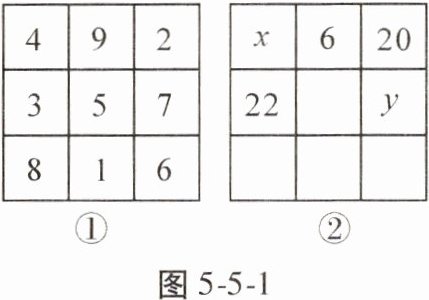
6. 将$9$个数填入幻方的空格中,要求每一横行,每一竖列以及两条对角线上的$3$个数之和相等,例如图$5 - 5 - 1$①就是一个幻方,图②是一个未完成的幻方,则$x与y$的和是多少?
答案:
解:设如图表所示:
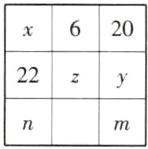
根据题意可得$x + 6 + 20 = 22 + z + y$,
整理得$y + z - x = 4$,
又根据题意可得$x + 22 + n = 20 + z + n$,$20 + y + m = x + z + m$,
整理得$z - x = 2$,$x + z - y = 20$,
联立方程组得$\left\{\begin{array}{l} y + z - x = 4\\ z - x = 2\\ x + z - y = 20\end{array}\right.$,解得$\left\{\begin{array}{l} x = 10\\ y = 2\\ z = 12\end{array}\right.$。
所以$x + y = 12$。
解:设如图表所示:
根据题意可得$x + 6 + 20 = 22 + z + y$,
整理得$y + z - x = 4$,
又根据题意可得$x + 22 + n = 20 + z + n$,$20 + y + m = x + z + m$,
整理得$z - x = 2$,$x + z - y = 20$,
联立方程组得$\left\{\begin{array}{l} y + z - x = 4\\ z - x = 2\\ x + z - y = 20\end{array}\right.$,解得$\left\{\begin{array}{l} x = 10\\ y = 2\\ z = 12\end{array}\right.$。
所以$x + y = 12$。
7. 【阅读理解】在求代数式的值时,可以用整体求值的方法,化难为易。
例:已知$\begin{cases}3x + 2y + z = 4, ① \\ 7x + 5y + 3z = 10, ②\end{cases} 求x + y + z$的值。
解:由① × 2,得$6x + 4y + 2z = 8$,③
由② - ③,得$x + y + z = 2$,
所以$x + y + z的值为2$。
【类比迁移】已知$\begin{cases}x + 2y + 3z = 10, \\ 5x + 60y + 7z = 26,\end{cases} 求3x + 4y + 5z$的值。
【实际应用】某班级组织活动购买小奖品,买$10$支铅笔、$4$块橡皮、$2本日记本共需28$元,买$19$支铅笔、$7$块橡皮、$3本日记本共需48$元,则购买$3$支铅笔、$3$块橡皮、$3$本日记本共需多少元?
例:已知$\begin{cases}3x + 2y + z = 4, ① \\ 7x + 5y + 3z = 10, ②\end{cases} 求x + y + z$的值。
解:由① × 2,得$6x + 4y + 2z = 8$,③
由② - ③,得$x + y + z = 2$,
所以$x + y + z的值为2$。
【类比迁移】已知$\begin{cases}x + 2y + 3z = 10, \\ 5x + 60y + 7z = 26,\end{cases} 求3x + 4y + 5z$的值。
【实际应用】某班级组织活动购买小奖品,买$10$支铅笔、$4$块橡皮、$2本日记本共需28$元,买$19$支铅笔、$7$块橡皮、$3本日记本共需48$元,则购买$3$支铅笔、$3$块橡皮、$3$本日记本共需多少元?
答案:
解:[类比迁移]$\left\{\begin{array}{l} x + 2y + 3z = 10,\enclose{circle}{1}\\ 5x + 6y + 7z = 26,\enclose{circle}{2}\end{array}\right.$
由① + ②,得$6x + 8y + 10z = 36$,所以$3x + 4y + 5z = 18$。
[实际应用]设铅笔、橡皮和日记本的单价分别为$m$元、$n$元、$p$元,
根据题意,得$\left\{\begin{array}{l} 10m + 4n + 2p = 28,\enclose{circle}{1}\\ 19m + 7n + 3p = 48,\enclose{circle}{2}\end{array}\right.$
由$2×$① - ②,得$m + n + p = 8$,
所以$3m + 3n + 3p = 24$,所以购买3支铅笔、3块橡皮、3本日记本共需24元。
由① + ②,得$6x + 8y + 10z = 36$,所以$3x + 4y + 5z = 18$。
[实际应用]设铅笔、橡皮和日记本的单价分别为$m$元、$n$元、$p$元,
根据题意,得$\left\{\begin{array}{l} 10m + 4n + 2p = 28,\enclose{circle}{1}\\ 19m + 7n + 3p = 48,\enclose{circle}{2}\end{array}\right.$
由$2×$① - ②,得$m + n + p = 8$,
所以$3m + 3n + 3p = 24$,所以购买3支铅笔、3块橡皮、3本日记本共需24元。
查看更多完整答案,请扫码查看

