

 搜索
搜索
第14页
- 第1页
- 第2页
- 第3页
- 第4页
- 第5页
- 第6页
- 第7页
- 第8页
- 第9页
- 第10页
- 第11页
- 第12页
- 第13页
- 第14页
- 第15页
- 第16页
- 第17页
- 第18页
- 第19页
- 第20页
- 第21页
- 第22页
- 第23页
- 第24页
- 第25页
- 第26页
- 第27页
- 第28页
- 第29页
- 第30页
- 第31页
- 第32页
- 第33页
- 第34页
- 第35页
- 第36页
- 第37页
- 第38页
- 第39页
- 第40页
- 第41页
- 第42页
- 第43页
- 第44页
- 第45页
- 第46页
- 第47页
- 第48页
- 第49页
- 第50页
- 第51页
- 第52页
- 第53页
- 第54页
- 第55页
- 第56页
- 第57页
- 第58页
- 第59页
- 第60页
- 第61页
- 第62页
- 第63页
- 第64页
- 第65页
- 第66页
- 第67页
- 第68页
- 第69页
- 第70页
- 第71页
- 第72页
- 第73页
- 第74页
- 第75页
- 第76页
- 第77页
- 第78页
- 第79页
- 第80页
- 第81页
- 第82页
- 第83页
- 第84页
- 第85页
- 第86页
- 第87页
- 第88页
- 第89页
- 第90页
- 第91页
- 第92页
- 第93页
- 第94页
- 第95页
- 第96页
- 第97页
- 第98页
- 第99页
- 第100页
- 第101页
- 第102页
- 第103页
- 第104页
- 第105页
- 第106页
- 第107页
- 第108页
- 第109页
- 第110页
- 第111页
- 第112页
- 第113页
- 第114页
- 第115页
- 第116页
- 第117页
- 第118页
- 第119页
- 第120页
- 第121页
- 第122页
- 第123页
- 第124页
- 第125页
- 第126页
- 第127页
- 第128页
- 第129页
- 第130页
- 第131页
- 第132页
- 第133页
- 第134页
- 第135页
- 第136页
- 第137页
- 第138页
- 第139页
- 第140页
- 第141页
- 第142页
- 第143页
- 第144页
- 第145页
- 第146页
- 第147页
- 第148页
- 第149页
- 第150页
- 第151页
- 第152页
- 第153页
- 第154页
- 第155页
- 第156页
- 第157页
- 第158页
- 第159页
- 第160页
- 第161页
- 第162页
- 第163页
- 第164页
Ⅳ. 阅读理解。
The world's population has increased to 7 billion since 2011. However, it is not even (均匀) all over the world, so different countries have carried out different population policies.
Russia has the largest territory (领土) in the world, but its population is only about 140 million. Its death rate is higher than its birth rate. What's worse, more and more families don't want to have babies. Russian president Putin once said, "If this situation goes on, our nation will be in danger." So Russia has taken measures to encourage its families to have more children. It has increased the money paid for babies.
Germany is also worried about its population. Dr. Herman, a hospital president, said, "We are short of nothing but babies." German mothers can get a large amount of money from the government each month if they give birth to a baby. However, money doesn't often work well.
South Korea started its family planning policy in 1962. After controlling (控制) its population for almost thirty years, South Korea had to change its policy in 1990 because of low birth rate and sex ratio imbalance (性别比失衡). Japan has experienced the same problem. It began to control its population in 1948, but now it is making its effort to increase its population because of the low birth rate.
(
A. high B. low
C. dangerous D. increasing
(
A. Russia. B. South Korea.
C. India. D. Japan.
(
A. low B. high
C. expensive D. reasonable (合理的)
(
A. China and Russia
B. Germany and Japan
C. Russia and Germany
D. Russia and Japan
(
A. Because it is very rich.
B. Because its death rate is low.
C. Because its birth rate is low.
D. Because its sex ratio is reasonable (合理的).
The world's population has increased to 7 billion since 2011. However, it is not even (均匀) all over the world, so different countries have carried out different population policies.
Russia has the largest territory (领土) in the world, but its population is only about 140 million. Its death rate is higher than its birth rate. What's worse, more and more families don't want to have babies. Russian president Putin once said, "If this situation goes on, our nation will be in danger." So Russia has taken measures to encourage its families to have more children. It has increased the money paid for babies.
Germany is also worried about its population. Dr. Herman, a hospital president, said, "We are short of nothing but babies." German mothers can get a large amount of money from the government each month if they give birth to a baby. However, money doesn't often work well.
South Korea started its family planning policy in 1962. After controlling (控制) its population for almost thirty years, South Korea had to change its policy in 1990 because of low birth rate and sex ratio imbalance (性别比失衡). Japan has experienced the same problem. It began to control its population in 1948, but now it is making its effort to increase its population because of the low birth rate.
(
B
)1. According to the passage, the density (密度) of population in Russia is ______.A. high B. low
C. dangerous D. increasing
(
C
)2. According to the passage, which of the following country has never controlled its population?A. Russia. B. South Korea.
C. India. D. Japan.
(
A
)3. We can infer from the passage that the birth rate in Germany is ______.A. low B. high
C. expensive D. reasonable (合理的)
(
C
)4. The government will give money to babies in ______.A. China and Russia
B. Germany and Japan
C. Russia and Germany
D. Russia and Japan
(
C
)5. Why Japan don't control its population now?A. Because it is very rich.
B. Because its death rate is low.
C. Because its birth rate is low.
D. Because its sex ratio is reasonable (合理的).
答案:
1. B 根据第二段第一句可知Russia的人口密度低。因为有一个only。2. C 3. A 第三段We are short of nothing but babies。4. C China没有相应的鼓励政策。日本也没有提及。5. C
Ⅴ. 书面表达。
写一篇80词左右的短文,谈谈你对人口增长问题的看法。文章应包含以下内容:
1. 人口问题一直是世界上最大的问题;
2. 人口过多带来诸多问题;
3. 发展中国家人口占世界人口的$\frac{4}{5}$;
4. 中国采取有效的生育政策。
要求:不能逐句翻译,语句通顺,行文流畅。
参考词汇:policy
写一篇80词左右的短文,谈谈你对人口增长问题的看法。文章应包含以下内容:
1. 人口问题一直是世界上最大的问题;
2. 人口过多带来诸多问题;
3. 发展中国家人口占世界人口的$\frac{4}{5}$;
4. 中国采取有效的生育政策。
要求:不能逐句翻译,语句通顺,行文流畅。
参考词汇:policy
答案:
The Problems of Large Population
It is reported that the world's population was 6 billion in the year 2000 and it is growing faster and faster. The world's population problem is the greatest one because it brings many problems, such as water resources problems, food problems and unemployment problems. These problems are mainly in the developing countries, because the population of the developing countries is about four fifths of the world's population. So China, the largest developing country, has carried out some policies.
It is reported that the world's population was 6 billion in the year 2000 and it is growing faster and faster. The world's population problem is the greatest one because it brings many problems, such as water resources problems, food problems and unemployment problems. These problems are mainly in the developing countries, because the population of the developing countries is about four fifths of the world's population. So China, the largest developing country, has carried out some policies.
Ⅰ. 听力。
(A)听句子,选择与其内容相符的图片。每个句子读一遍 (其中有一幅图片是多余的)。
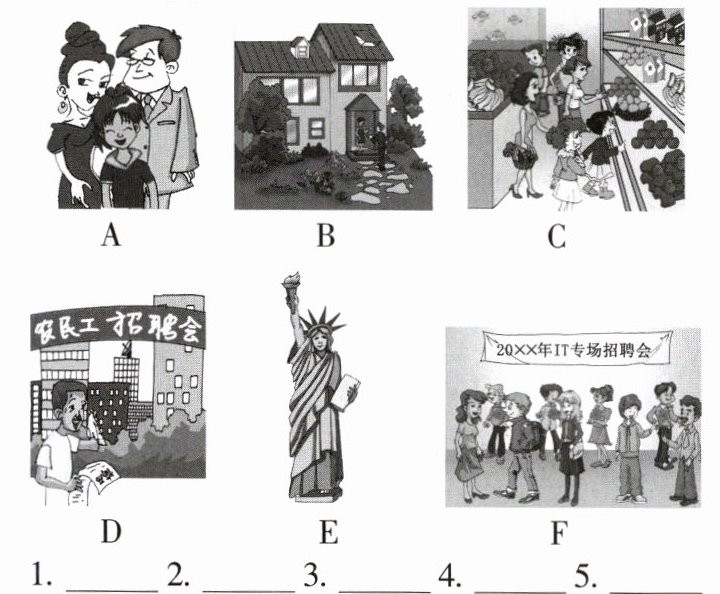
1. ______ 2. ______ 3. ______ 4. ______ 5. ______
(B)听对话及问题,选择正确的答案。每组对话及问题读两遍。
( )6. A. The USA.
B. Indonesia.
C. Brazil.
( )7. A. The man.
B. The woman.
C. They both.
( )8. A. Four.
B. Five.
C. Six.
( )9. A. The man.
B. The woman.
C. Neither of them.
( )10. A. The water problem.
B. The population problem.
C. Something about a village.
(A)听句子,选择与其内容相符的图片。每个句子读一遍 (其中有一幅图片是多余的)。
1. ______ 2. ______ 3. ______ 4. ______ 5. ______
(B)听对话及问题,选择正确的答案。每组对话及问题读两遍。
( )6. A. The USA.
B. Indonesia.
C. Brazil.
( )7. A. The man.
B. The woman.
C. They both.
( )8. A. Four.
B. Five.
C. Six.
( )9. A. The man.
B. The woman.
C. Neither of them.
( )10. A. The water problem.
B. The population problem.
C. Something about a village.
答案:
(A)1. E 2. C 3. A 4. D 5. B (B)6. A 7. B 8. B 9. B 10. C
查看更多完整答案,请扫码查看

