

 搜索
搜索
第112页
- 第1页
- 第2页
- 第3页
- 第4页
- 第5页
- 第6页
- 第7页
- 第8页
- 第9页
- 第10页
- 第11页
- 第12页
- 第13页
- 第14页
- 第15页
- 第16页
- 第17页
- 第18页
- 第19页
- 第20页
- 第21页
- 第22页
- 第23页
- 第24页
- 第25页
- 第26页
- 第27页
- 第28页
- 第29页
- 第30页
- 第31页
- 第32页
- 第33页
- 第34页
- 第35页
- 第36页
- 第37页
- 第38页
- 第39页
- 第40页
- 第41页
- 第42页
- 第43页
- 第44页
- 第45页
- 第46页
- 第47页
- 第48页
- 第49页
- 第50页
- 第51页
- 第52页
- 第53页
- 第54页
- 第55页
- 第56页
- 第57页
- 第58页
- 第59页
- 第60页
- 第61页
- 第62页
- 第63页
- 第64页
- 第65页
- 第66页
- 第67页
- 第68页
- 第69页
- 第70页
- 第71页
- 第72页
- 第73页
- 第74页
- 第75页
- 第76页
- 第77页
- 第78页
- 第79页
- 第80页
- 第81页
- 第82页
- 第83页
- 第84页
- 第85页
- 第86页
- 第87页
- 第88页
- 第89页
- 第90页
- 第91页
- 第92页
- 第93页
- 第94页
- 第95页
- 第96页
- 第97页
- 第98页
- 第99页
- 第100页
- 第101页
- 第102页
- 第103页
- 第104页
- 第105页
- 第106页
- 第107页
- 第108页
- 第109页
- 第110页
- 第111页
- 第112页
- 第113页
- 第114页
- 第115页
- 第116页
- 第117页
- 第118页
- 第119页
- 第120页
- 第121页
- 第122页
- 第123页
- 第124页
- 第125页
- 第126页
- 第127页
- 第128页
- 第129页
- 第130页
- 第131页
- 第132页
- 第133页
- 第134页
- 第135页
- 第136页
完成句子,明确本课重点句型
1. 你不久要来中国,一定很兴奋。
You must
2. 关于中国的风俗,让我给你一些建议和忠告。
Let me give you some
3. 祝你一路平安,我期待着尽快见到你!
____ ____ ____ ____
4. 如果你想要开车旅行,早点出发是很重要的。
It is important
1. 你不久要来中国,一定很兴奋。
You must
be excited about coming
to China soon.2. 关于中国的风俗,让我给你一些建议和忠告。
Let me give you some
suggestions and advice
about Chinese customs.3. 祝你一路平安,我期待着尽快见到你!
____ ____ ____ ____
Have a safe trip
, and I ____ ____ ____ ____look forward to meeting
you soon!4. 如果你想要开车旅行,早点出发是很重要的。
It is important
to leave earlier
if you are traveling by car.
答案:
1. be excited about coming
2. suggestions and advice
3. Have a safe trip; look forward to meeting
4. to leave earlier
2. suggestions and advice
3. Have a safe trip; look forward to meeting
4. to leave earlier
写作任务
假如你叫王鹏,你的笔友 Simon 要来中国了,来之前他请你发一封电子邮件介绍一下中国的风俗习惯,以便更好地了解中国。不少于 60 词。
要点:1. 姓氏在前,名字在后;
2. 初次见面时握手;谈论很多话题(topic),甚至包括年龄和薪水(salary);
3. 就餐时用筷子,不能把筷子插在食物上,也不能用筷子指向他人。
写前指导
1. 人称:第一人称
2. 时态:主要为一般现在时
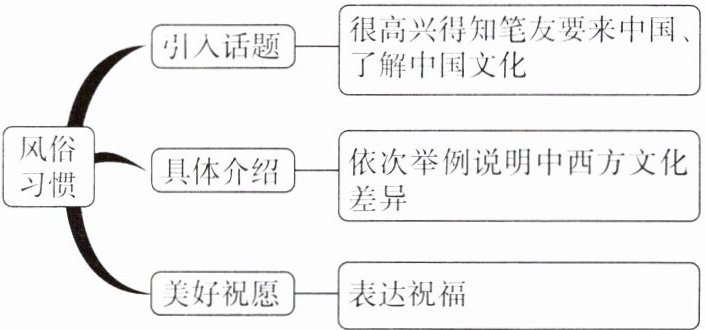
3. 思维导图:
4. 语句储备:
(1)You are supposed to do...
(2)... be allowed to...
(3)It's impolite to...
汇思成篇Dear Simon,
Thanks for your message. I'm glad to know you'll come to China soon. You asked about the customs in China. Here are some differences between China and Western countries.
First, we Chinese put family names first, and then we have given names. For example, in China you are supposed to call me Wang Peng, not Peng Wang.
Second, when we meet for the first time we usually shake hands. We often talk about many topics, even age and salaries.
Third, we use chopsticks to eat, not forks or knives. While eating you mustn't stick them into the food, and you are not allowed to point at others with chopsticks. It's impolite to do so.
Hope you'll have a great time in China.
Yours,
Wang Peng
假如你叫王鹏,你的笔友 Simon 要来中国了,来之前他请你发一封电子邮件介绍一下中国的风俗习惯,以便更好地了解中国。不少于 60 词。
要点:1. 姓氏在前,名字在后;
2. 初次见面时握手;谈论很多话题(topic),甚至包括年龄和薪水(salary);
3. 就餐时用筷子,不能把筷子插在食物上,也不能用筷子指向他人。
写前指导
1. 人称:第一人称
2. 时态:主要为一般现在时
3. 思维导图:
4. 语句储备:
(1)You are supposed to do...
(2)... be allowed to...
(3)It's impolite to...
汇思成篇Dear Simon,
Thanks for your message. I'm glad to know you'll come to China soon. You asked about the customs in China. Here are some differences between China and Western countries.
First, we Chinese put family names first, and then we have given names. For example, in China you are supposed to call me Wang Peng, not Peng Wang.
Second, when we meet for the first time we usually shake hands. We often talk about many topics, even age and salaries.
Third, we use chopsticks to eat, not forks or knives. While eating you mustn't stick them into the food, and you are not allowed to point at others with chopsticks. It's impolite to do so.
Hope you'll have a great time in China.
Yours,
Wang Peng
答案:
One possible version:
Dear Simon,
Thanks for your message. I'm glad to know you'll come to China soon. You asked about the customs in China. Here are some differences between China and Western countries.
First, we Chinese put family names first, and then we have given names. For example, in China you are supposed to call me Wang Peng, not Peng Wang.
Second, when we meet for the first time we usually shake hands. We often talk about many topics, even age and salaries.
Third, we use chopsticks to eat, not forks or knives. While eating you mustn't stick them into the food, and you are not allowed to point at others with chopsticks. It's impolite to do so.
Hope you'll have a great time in China.
Yours,
Wang Peng
Dear Simon,
Thanks for your message. I'm glad to know you'll come to China soon. You asked about the customs in China. Here are some differences between China and Western countries.
First, we Chinese put family names first, and then we have given names. For example, in China you are supposed to call me Wang Peng, not Peng Wang.
Second, when we meet for the first time we usually shake hands. We often talk about many topics, even age and salaries.
Third, we use chopsticks to eat, not forks or knives. While eating you mustn't stick them into the food, and you are not allowed to point at others with chopsticks. It's impolite to do so.
Hope you'll have a great time in China.
Yours,
Wang Peng
Ⅰ. 用所给词的适当形式填空
1. He ____
2. Can you give me some ____
3. We were all ____
4. Harbin is a big city in the ____
5. By reading this article, we can learn about table ____
1. He ____
gradually
(gradual) understood the text with the help of the teacher.2. Can you give me some ____
suggestions
(suggest) about how to recite the text?3. We were all ____
excited
(excite) about seeing the famous football star.4. Harbin is a big city in the ____
northern
(north) part of China.5. By reading this article, we can learn about table ____
manners
(manner).
答案:
1. gradually 2. suggestions
3. excited 4. northern 5. manners
3. excited 4. northern 5. manners
1. There is no water in the bottle. It's
A.full
B.useful
C.empty
D.wet
C
.A.full
B.useful
C.empty
D.wet
答案:
C
查看更多完整答案,请扫码查看

