

 搜索
搜索
第37页
- 第1页
- 第2页
- 第3页
- 第4页
- 第5页
- 第6页
- 第7页
- 第8页
- 第9页
- 第10页
- 第11页
- 第12页
- 第13页
- 第14页
- 第15页
- 第16页
- 第17页
- 第18页
- 第19页
- 第20页
- 第21页
- 第22页
- 第23页
- 第24页
- 第25页
- 第26页
- 第27页
- 第28页
- 第29页
- 第30页
- 第31页
- 第32页
- 第33页
- 第34页
- 第35页
- 第36页
- 第37页
- 第38页
- 第39页
- 第40页
- 第41页
- 第42页
- 第43页
- 第44页
- 第45页
- 第46页
- 第47页
- 第48页
- 第49页
- 第50页
- 第51页
- 第52页
- 第53页
- 第54页
- 第55页
- 第56页
- 第57页
- 第58页
- 第59页
- 第60页
- 第61页
- 第62页
- 第63页
- 第64页
- 第65页
- 第66页
- 第67页
- 第68页
- 第69页
- 第70页
- 第71页
- 第72页
- 第73页
- 第74页
- 第75页
- 第76页
- 第77页
- 第78页
- 第79页
- 第80页
- 第81页
- 第82页
- 第83页
- 第84页
- 第85页
- 第86页
- 第87页
- 第88页
- 第89页
- 第90页
- 第91页
- 第92页
- 第93页
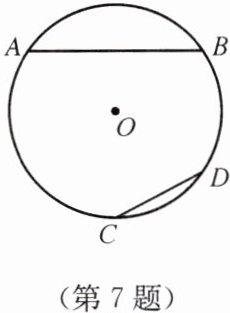
7. 如图,$\widehat{AB}的长度是\widehat{CD}$的长度的2倍.弦AB的长度是弦CD的长度的2倍吗?动手量一量,并说明其中的道理.
答案:
解:AB<2CD
理由: 取$\widehat{AB}$的中点E,连接AE、BE
∵$ \widehat{AB}=2\widehat{CD}$
∴$ \widehat{AE}=\widehat{BE}=\widehat{CD}$
∴AE=BE=CD
在△AEB中,AE+BE>AB
∴2CD>AB
理由: 取$\widehat{AB}$的中点E,连接AE、BE
∵$ \widehat{AB}=2\widehat{CD}$
∴$ \widehat{AE}=\widehat{BE}=\widehat{CD}$
∴AE=BE=CD
在△AEB中,AE+BE>AB
∴2CD>AB
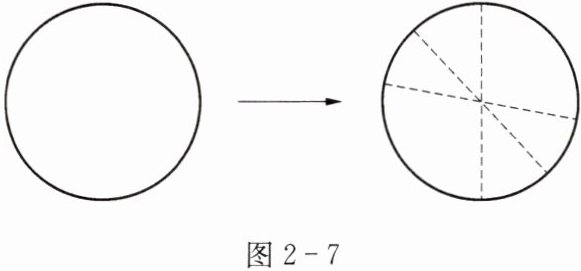
如图2-7,剪一个圆形纸片,对折后使两个半圆完全重合,重复做几次,你发现了什么?由此你能得到什么结论?
答案:
解:实验表明,直径两侧的半圆能互相重合,
这说明圆是轴对称图形
结论:经过圆心的每一条直线都是对称轴
这说明圆是轴对称图形
结论:经过圆心的每一条直线都是对称轴
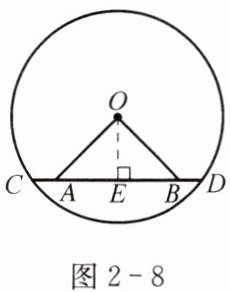
例1 如图2-8,在$\odot O$中,点A、B在弦CD上,且$OA= OB$.
求证:$AC= BD$.
证明 过圆心O作$OE\perp AB$,垂足为E,则$CE= ED$.
$\because OA= OB$,
$\therefore AE= BE$.
$\therefore AC= BD$.
说明 若将A、B视为弦CD上的两动点,则在变化过程中,只要满足一组对称的变化,那么根据其轴对称性均可得到其他对称的结果,"过点O作弦的垂线"为关键点.
求证:$AC= BD$.
证明 过圆心O作$OE\perp AB$,垂足为E,则$CE= ED$.
$\because OA= OB$,
$\therefore AE= BE$.
$\therefore AC= BD$.
说明 若将A、B视为弦CD上的两动点,则在变化过程中,只要满足一组对称的变化,那么根据其轴对称性均可得到其他对称的结果,"过点O作弦的垂线"为关键点.
答案:
证明:过圆心O作OE⊥CD,垂足为E,
∵OE过圆心且OE⊥CD,
∴CE=ED(垂直于弦的直径平分弦)。
∵OA=OB,OE⊥AB(CD与AB共线,OE⊥CD即OE⊥AB),
∴AE=BE(等腰三角形底边上的高平分底边)。
∵CE=ED,AE=BE,
∴CE - AE = ED - BE,即AC=BD。
∵OE过圆心且OE⊥CD,
∴CE=ED(垂直于弦的直径平分弦)。
∵OA=OB,OE⊥AB(CD与AB共线,OE⊥CD即OE⊥AB),
∴AE=BE(等腰三角形底边上的高平分底边)。
∵CE=ED,AE=BE,
∴CE - AE = ED - BE,即AC=BD。
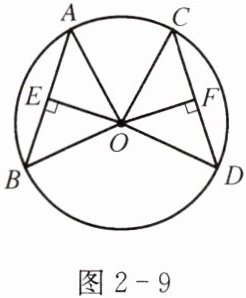
例2 如图2-9,在$\odot O$中,AB、CD是两条弦,$OE\perp AB$,$OF\perp CD$,垂足分别为E、F.
(1)已知$\angle AOB= \angle COD$,那么OE与OF的大小有什么关系?为什么?
(2)已知$OE= OF$,那么AB与CD的大小有什么关系?$\overset{\frown}{AB}与\overset{\frown}{CD}$的大小有什么关系?为什么?$\angle AOB与\angle COD$呢?
解 (1)$OE= OF$.理由:
$\because \angle AOB= \angle COD$,
$\therefore AB= CD$.
$\because OE\perp AB$,$OF\perp CD$,
$\therefore AE= \frac{1}{2}AB$,$CF= \frac{1}{2}CD$.
$\therefore AE= CF$.
又$\because OA= OC$,
$\therefore Rt\triangle OAE\cong Rt\triangle OCF$.
$\therefore OE= OF$.
(2)$AB= CD$,$\overset{\frown}{AB}= \overset{\frown}{CD}$,$\angle AOB= \angle COD$.理由:
$\because OE\perp AB$,$OF\perp CD$,
$\therefore AE= \frac{1}{2}AB$,$CF= \frac{1}{2}CD$.
$\because OA= OC$,$OE= OF$,
$\therefore Rt\triangle OAE\cong Rt\triangle OCF$.
$\therefore AE= CF$.
$\therefore AB= CD$.
$\therefore \overset{\frown}{AB}= \overset{\frown}{CD}$,$\angle AOB= \angle COD$.
说明 我们可以看出:在同圆或等圆中,如果两个圆心角、两条弧、两条弦或圆心到这两条弦的距离中有一组量相等,那么它们所对应的其余各组量都分别相等.
(1)已知$\angle AOB= \angle COD$,那么OE与OF的大小有什么关系?为什么?
(2)已知$OE= OF$,那么AB与CD的大小有什么关系?$\overset{\frown}{AB}与\overset{\frown}{CD}$的大小有什么关系?为什么?$\angle AOB与\angle COD$呢?
解 (1)$OE= OF$.理由:
$\because \angle AOB= \angle COD$,
$\therefore AB= CD$.
$\because OE\perp AB$,$OF\perp CD$,
$\therefore AE= \frac{1}{2}AB$,$CF= \frac{1}{2}CD$.
$\therefore AE= CF$.
又$\because OA= OC$,
$\therefore Rt\triangle OAE\cong Rt\triangle OCF$.
$\therefore OE= OF$.
(2)$AB= CD$,$\overset{\frown}{AB}= \overset{\frown}{CD}$,$\angle AOB= \angle COD$.理由:
$\because OE\perp AB$,$OF\perp CD$,
$\therefore AE= \frac{1}{2}AB$,$CF= \frac{1}{2}CD$.
$\because OA= OC$,$OE= OF$,
$\therefore Rt\triangle OAE\cong Rt\triangle OCF$.
$\therefore AE= CF$.
$\therefore AB= CD$.
$\therefore \overset{\frown}{AB}= \overset{\frown}{CD}$,$\angle AOB= \angle COD$.
说明 我们可以看出:在同圆或等圆中,如果两个圆心角、两条弧、两条弦或圆心到这两条弦的距离中有一组量相等,那么它们所对应的其余各组量都分别相等.
答案:
(1)$OE=OF$.理由:
$\because\angle AOB=\angle COD$,
$\therefore AB=CD$.
$\because OE\perp AB$,$OF\perp CD$,
$\therefore AE=\frac{1}{2}AB$,$CF=\frac{1}{2}CD$.
$\therefore AE=CF$.
又$\because OA=OC$,
$\therefore Rt\triangle OAE\cong Rt\triangle OCF$.
$\therefore OE=OF$.
(2)$AB=CD$,$\overset{\frown}{AB}=\overset{\frown}{CD}$,$\angle AOB=\angle COD$.理由:
$\because OE\perp AB$,$OF\perp CD$,
$\therefore AE=\frac{1}{2}AB$,$CF=\frac{1}{2}CD$.
$\because OA=OC$,$OE=OF$,
$\therefore Rt\triangle OAE\cong Rt\triangle OCF$.
$\therefore AE=CF$.
$\therefore AB=CD$.
$\therefore\overset{\frown}{AB}=\overset{\frown}{CD}$,$\angle AOB=\angle COD$.
(1)$OE=OF$.理由:
$\because\angle AOB=\angle COD$,
$\therefore AB=CD$.
$\because OE\perp AB$,$OF\perp CD$,
$\therefore AE=\frac{1}{2}AB$,$CF=\frac{1}{2}CD$.
$\therefore AE=CF$.
又$\because OA=OC$,
$\therefore Rt\triangle OAE\cong Rt\triangle OCF$.
$\therefore OE=OF$.
(2)$AB=CD$,$\overset{\frown}{AB}=\overset{\frown}{CD}$,$\angle AOB=\angle COD$.理由:
$\because OE\perp AB$,$OF\perp CD$,
$\therefore AE=\frac{1}{2}AB$,$CF=\frac{1}{2}CD$.
$\because OA=OC$,$OE=OF$,
$\therefore Rt\triangle OAE\cong Rt\triangle OCF$.
$\therefore AE=CF$.
$\therefore AB=CD$.
$\therefore\overset{\frown}{AB}=\overset{\frown}{CD}$,$\angle AOB=\angle COD$.
查看更多完整答案,请扫码查看

