

 搜索
搜索
第109页
- 第1页
- 第2页
- 第3页
- 第4页
- 第5页
- 第6页
- 第7页
- 第8页
- 第9页
- 第10页
- 第11页
- 第12页
- 第13页
- 第14页
- 第15页
- 第16页
- 第17页
- 第18页
- 第19页
- 第20页
- 第21页
- 第22页
- 第23页
- 第24页
- 第25页
- 第26页
- 第27页
- 第28页
- 第29页
- 第30页
- 第31页
- 第32页
- 第33页
- 第34页
- 第35页
- 第36页
- 第37页
- 第38页
- 第39页
- 第40页
- 第41页
- 第42页
- 第43页
- 第44页
- 第45页
- 第46页
- 第47页
- 第48页
- 第49页
- 第50页
- 第51页
- 第52页
- 第53页
- 第54页
- 第55页
- 第56页
- 第57页
- 第58页
- 第59页
- 第60页
- 第61页
- 第62页
- 第63页
- 第64页
- 第65页
- 第66页
- 第67页
- 第68页
- 第69页
- 第70页
- 第71页
- 第72页
- 第73页
- 第74页
- 第75页
- 第76页
- 第77页
- 第78页
- 第79页
- 第80页
- 第81页
- 第82页
- 第83页
- 第84页
- 第85页
- 第86页
- 第87页
- 第88页
- 第89页
- 第90页
- 第91页
- 第92页
- 第93页
- 第94页
- 第95页
- 第96页
- 第97页
- 第98页
- 第99页
- 第100页
- 第101页
- 第102页
- 第103页
- 第104页
- 第105页
- 第106页
- 第107页
- 第108页
- 第109页
一、词汇运用
1. Kate has a tight (不宽裕的)
2. Life is like a
3. Does your grandma know how to open a WeChat
4. Things made in China are popular around the world because they are of high quality (品质), but not
5. Money isn’t everything, but it
6. They met at the gate of Nanjing Museum on a
7. How about
8. The key (关键) to learning a language well is to use it in our
1. Kate has a tight (不宽裕的)
budget
(预算), but she still plans to buy her best friend a birthday gift.2. Life is like a
bank
(银行). If you put a lot of happiness in it, you can enjoy some when you feel sad.3. Does your grandma know how to open a WeChat
account
(账户)?4. Things made in China are popular around the world because they are of high quality (品质), but not
expensive
(昂贵的).5. Money isn’t everything, but it
matters
(要紧) a lot to the poor.6. They met at the gate of Nanjing Museum on a
rainy
(rain) morning.7. How about
saving
(save) some money for a sweeping robot?8. The key (关键) to learning a language well is to use it in our
daily
(day) lives.
答案:
1.budget 2.bank 3.account 4.expensive 5.matters 6.rainy 7.saving 8.daily
(
A.have
B.has
C.having
D.to have
A
) 1.40 per cent of the students in my class __________ a computer.A.have
B.has
C.having
D.to have
答案:
1.A
(
A.spend; on
B.take; on
C.pay; for
D.cost; in
C
) 2.I have to __________ 3 000 yuan __________ the house rent (房租) every month.A.spend; on
B.take; on
C.pay; for
D.cost; in
答案:
2.C
(
A.must
B.can
C.need
D.should
B
) 3.Don’t forget (忘记) to carry an umbrella when you go to visit Shanghai in July. It __________ be really rainy in that time.A.must
B.can
C.need
D.should
答案:
3.B
(
A.finishes
B.reads
C.means
D.covers
D
) 4.All inclusive package (一价全包) tours are popular now. The price (价格) usually __________ everything in the travelling and people needn’t pay more.A.finishes
B.reads
C.means
D.covers
答案:
4.D
(
— __________.
A.No, you are busy too
B.You are welcome
C.Thanks, but I can manage
D.Help yourself
C
) 5.— Annie, there’s a lot to do to get ready for the dinner. Let me help you.— __________.
A.No, you are busy too
B.You are welcome
C.Thanks, but I can manage
D.Help yourself
答案:
5.C
三、完成句子
1. 这条牛仔裤太贵了。我想要试穿另一条。
This pair of jeans _____________________ __________. I’d like _______ __________ __________.
2. 这个家庭花费百分之五十的预算在孩子的教育上。
The family spends 50 ______________ their child’s education.
3. 妈妈在她的银行账户中存了20 000元,以备不时之需。
Mum saves 20 000 yuan ______________ __________ __________.
4. 在日常生活中,你常常会做预算吗?
Do you often ______________ in your ______________?__________________________________________
1. 这条牛仔裤太贵了。我想要试穿另一条。
This pair of jeans _____________________ __________. I’d like _______ __________ __________.
2. 这个家庭花费百分之五十的预算在孩子的教育上。
The family spends 50 ______________ their child’s education.
3. 妈妈在她的银行账户中存了20 000元,以备不时之需。
Mum saves 20 000 yuan ______________ __________ __________.
4. 在日常生活中,你常常会做预算吗?
Do you often ______________ in your ______________?__________________________________________
答案:
1.is too expensive/costs too much,to try another pair on 2.per cent of the budget on 3.in her bank account,a rainy day 4.make a budget,daily life
四、阅读理解
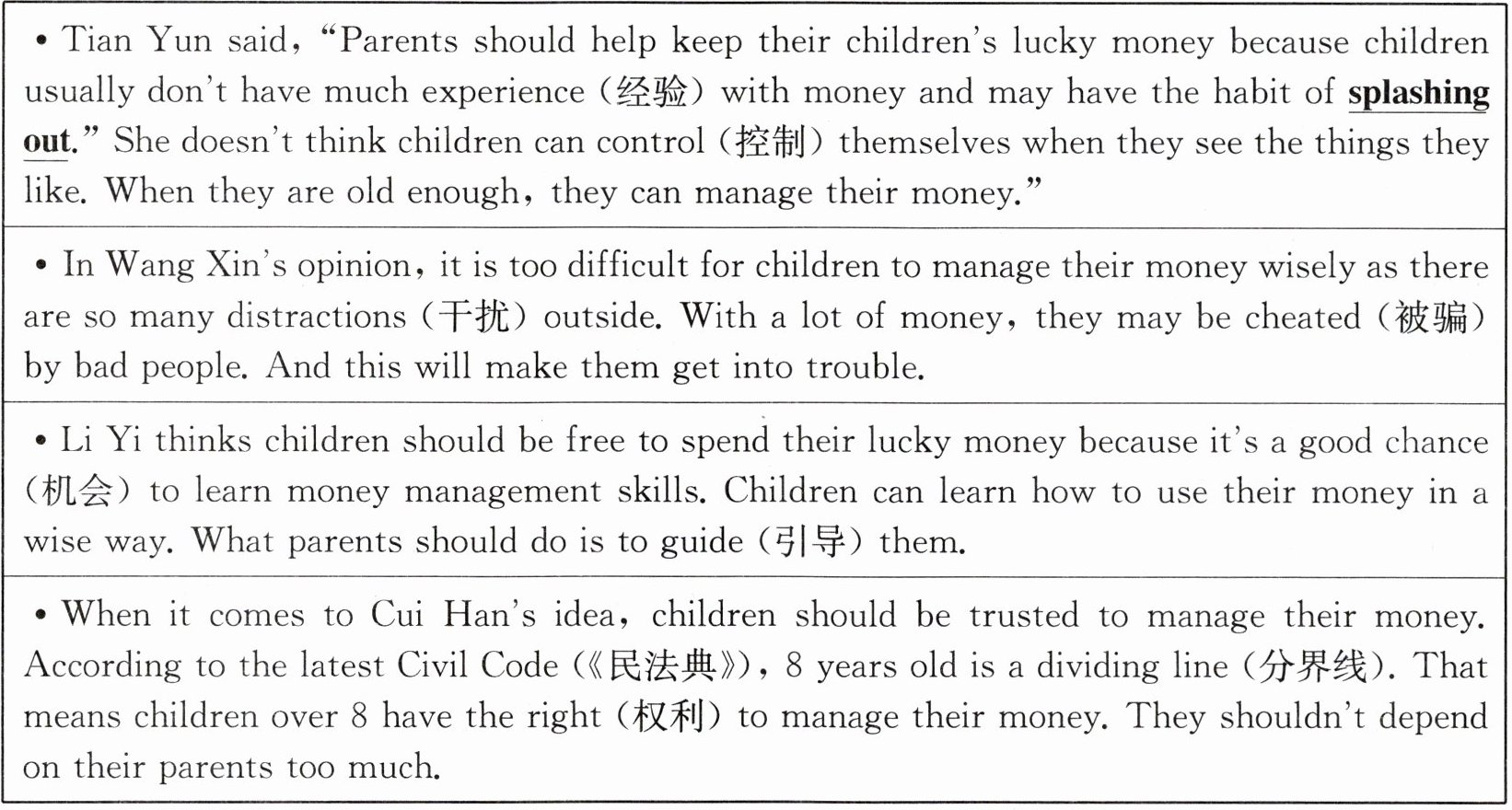
The Spring Festival is a time for children to get lucky money. Do you think parents should keep their children’s lucky money? Here, some middle school students are sharing their ideas.
(
A. Saving money. B. Borrowing money from others.
C. Giving money to others. D. Spending money like running water.
(
① Tian Yun ② Wang Xin ③ Li Yi ④ Cui Han
a. Children may be cheated if they have a lot of money.
b. Children older than eight can manage their money.
c. Parents can guide children to spend money in a right way.
d. Children can manage their money when they grow up.
A. ①-a; ②-d; ③-b; ④-c B. ①-d; ②-a; ③-c; ④-b
C. ①-d; ②-b; ③-a; ④-c D. ①-a; ②-c; ③-d; ④-b
(
A. Who can keep lucky money. B. Where to save lucky money.
C. How to use lucky money. D. When to get lucky money.
(
A. Health and exercise. B. Family and society (社会).
C. Nature and history. D. Festivals and traditions.
The Spring Festival is a time for children to get lucky money. Do you think parents should keep their children’s lucky money? Here, some middle school students are sharing their ideas.
(
D
) 1. What do the underlined words “splashing out” probably mean?A. Saving money. B. Borrowing money from others.
C. Giving money to others. D. Spending money like running water.
(
B
) 2. Match the students with their ideas and choose the right answer.① Tian Yun ② Wang Xin ③ Li Yi ④ Cui Han
a. Children may be cheated if they have a lot of money.
b. Children older than eight can manage their money.
c. Parents can guide children to spend money in a right way.
d. Children can manage their money when they grow up.
A. ①-a; ②-d; ③-b; ④-c B. ①-d; ②-a; ③-c; ④-b
C. ①-d; ②-b; ③-a; ④-c D. ①-a; ②-c; ③-d; ④-b
(
A
) 3. What are the students talking about?A. Who can keep lucky money. B. Where to save lucky money.
C. How to use lucky money. D. When to get lucky money.
(
B
) 4. In which part of a magazine can you read the text?A. Health and exercise. B. Family and society (社会).
C. Nature and history. D. Festivals and traditions.
答案:
1.D 2.B 3.A 4.B
查看更多完整答案,请扫码查看

