

 搜索
搜索
第26页
- 第1页
- 第2页
- 第3页
- 第4页
- 第5页
- 第6页
- 第7页
- 第8页
- 第9页
- 第10页
- 第11页
- 第12页
- 第13页
- 第14页
- 第15页
- 第16页
- 第17页
- 第18页
- 第19页
- 第20页
- 第21页
- 第22页
- 第23页
- 第24页
- 第25页
- 第26页
- 第27页
- 第28页
- 第29页
- 第30页
- 第31页
- 第32页
- 第33页
- 第34页
- 第35页
- 第36页
- 第37页
- 第38页
- 第39页
- 第40页
- 第41页
- 第42页
- 第43页
- 第44页
- 第45页
- 第46页
- 第47页
- 第48页
- 第49页
- 第50页
- 第51页
- 第52页
- 第53页
- 第54页
- 第55页
- 第56页
- 第57页
- 第58页
- 第59页
- 第60页
- 第61页
- 第62页
- 第63页
- 第64页
- 第65页
- 第66页
( ) (8) Does your father
A.help
B.helps
C.helping
A
with the housework?A.help
B.helps
C.helping
答案:
【解析】:此题考查的是一般现在时的疑问句结构,其中Does已经作为助动词出现在句首,表示疑问,并且Does作为助动词后,其后的动词应该用原形。选项A是动词原形,选项B是动词的第三人称单数形式,选项C是动词的现在分词形式。根据语法规则,应该选择动词原形。
【答案】:A
【答案】:A
( ) (9) Toby can’t
A.look for, finding
B.see, finding
C.find, looking for
find
his maths book. He’s ______looking for
it in the living room.A.look for, finding
B.see, finding
C.find, looking for
答案:
【解析】:
这道题目考查的是动词“look for”和“find”的区别以及现在进行时的用法。首先,“look for”表示寻找的过程,而“find”表示找到的结果。但在这道题目中,第一个空需要填入的词表示的是结果,即Toby不能找到他的数学书,所以应该用“find”。第二个空后面的“it”指的是数学书,根据句意“他正在客厅里找它”,这里表示的是寻找的过程,但题目中用了现在进行时(“he's”是“he is”的缩写,后面应该接动词的-ing形式),然而“looking for”虽然表示寻找的过程,但在这里与“finding”相比,“finding”更侧重于找到的结果,但在此上下文中,因为前文提到了他找不到书,所以这里用“looking for”的现在进行时态更合适,表示他正在客厅里寻找(但还没找到)。但实际上,根据英语习惯用法,“He's finding it in the living room.”虽然语法上无误,但通常不这样表达正在寻找的过程,而是更倾向于用“He's looking for it in the living room.”来表达。因此,正确答案是“find”用于第一个空表示结果,“looking for”的现在进行时态用于第二个空(但题目已给出“he's”,所以我们只需选“looking for”对应的选项部分)表示正在寻找的过程。但根据题目给出的选项,我们需要选择最符合题意的答案。
根据以上分析,正确选项应该是表示“找到结果”的“find”用于第一个空,和表示“正在寻找”的现在进行时态的“looking for”(题目已给出“he's”,所以我们选择“looking for”来匹配)用于第二个空的动作过程描述(尽管第二个空直接填的是动词原形形式用于匹配“he's”后的-ing需求)。对比选项,C选项“find, looking for”符合这一要求。
【答案】:
C
这道题目考查的是动词“look for”和“find”的区别以及现在进行时的用法。首先,“look for”表示寻找的过程,而“find”表示找到的结果。但在这道题目中,第一个空需要填入的词表示的是结果,即Toby不能找到他的数学书,所以应该用“find”。第二个空后面的“it”指的是数学书,根据句意“他正在客厅里找它”,这里表示的是寻找的过程,但题目中用了现在进行时(“he's”是“he is”的缩写,后面应该接动词的-ing形式),然而“looking for”虽然表示寻找的过程,但在这里与“finding”相比,“finding”更侧重于找到的结果,但在此上下文中,因为前文提到了他找不到书,所以这里用“looking for”的现在进行时态更合适,表示他正在客厅里寻找(但还没找到)。但实际上,根据英语习惯用法,“He's finding it in the living room.”虽然语法上无误,但通常不这样表达正在寻找的过程,而是更倾向于用“He's looking for it in the living room.”来表达。因此,正确答案是“find”用于第一个空表示结果,“looking for”的现在进行时态用于第二个空(但题目已给出“he's”,所以我们只需选“looking for”对应的选项部分)表示正在寻找的过程。但根据题目给出的选项,我们需要选择最符合题意的答案。
根据以上分析,正确选项应该是表示“找到结果”的“find”用于第一个空,和表示“正在寻找”的现在进行时态的“looking for”(题目已给出“he's”,所以我们选择“looking for”来匹配)用于第二个空的动作过程描述(尽管第二个空直接填的是动词原形形式用于匹配“he's”后的-ing需求)。对比选项,C选项“find, looking for”符合这一要求。
【答案】:
C
5. 根据表格内容仿照例子完成句子。
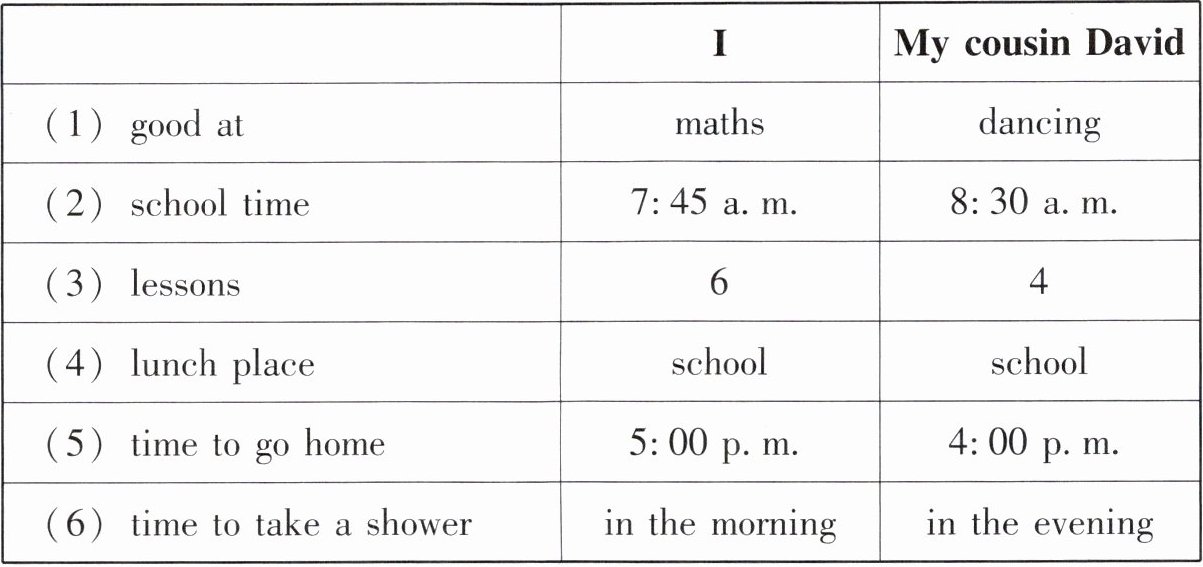
(1) I’m good at maths. My cousin David is good at
(2) I go to school at 7:45. David goes to school at
(3) I have 6 lessons a day. David
(4) I have lunch at school. David
(5) I go home at 5:00 in the afternoon. David
(6) I take a shower in the morning. David
(1) I’m good at maths. My cousin David is good at
dancing
.(2) I go to school at 7:45. David goes to school at
8:30 a.m.
.(3) I have 6 lessons a day. David
has 4 lessons a day
.(4) I have lunch at school. David
has lunch at school
, too.(5) I go home at 5:00 in the afternoon. David
goes home at 4:00 in the afternoon
.(6) I take a shower in the morning. David
takes a shower in the evening
.
答案:
【解析】:本题主要考查根据表格内容仿照例子完成句子的能力。需要仔细观察表格中“I”和“My cousin David”对应的各项信息,然后根据所给例子的句式结构,将相应的信息填入句子中。
(1) 从表格中“good at”这一行可知,“My cousin David”对应的是“dancing”,所以此处应填“dancing”。
(2) 由表格“school time”一行可得,“David goes to school at”后面应填“8:30 a.m.”。
(3) 依据表格“lessons”一行,“David”对应的课程数量是“4”,所以句子是“David has 4 lessons a day.”。
(4) 根据表格“lunch place”一行,“David”的午餐地点也是“school”,即“David has lunch at school, too.”。
(5) 从表格“time to go home”一行可知,“David”回家的时间是“4:00 p.m.”,故句子为“David goes home at 4:00 in the afternoon.”。
(6) 由表格“time to take a shower”一行可得,“David”洗澡的时间是“in the evening”,所以句子是“David takes a shower in the evening.”。
【答案】:
(1) dancing
(2) 8:30 a.m.
(3) has 4 lessons a day
(4) has lunch at school
(5) goes home at 4:00 in the afternoon
(6) takes a shower in the evening
(1) 从表格中“good at”这一行可知,“My cousin David”对应的是“dancing”,所以此处应填“dancing”。
(2) 由表格“school time”一行可得,“David goes to school at”后面应填“8:30 a.m.”。
(3) 依据表格“lessons”一行,“David”对应的课程数量是“4”,所以句子是“David has 4 lessons a day.”。
(4) 根据表格“lunch place”一行,“David”的午餐地点也是“school”,即“David has lunch at school, too.”。
(5) 从表格“time to go home”一行可知,“David”回家的时间是“4:00 p.m.”,故句子为“David goes home at 4:00 in the afternoon.”。
(6) 由表格“time to take a shower”一行可得,“David”洗澡的时间是“in the evening”,所以句子是“David takes a shower in the evening.”。
【答案】:
(1) dancing
(2) 8:30 a.m.
(3) has 4 lessons a day
(4) has lunch at school
(5) goes home at 4:00 in the afternoon
(6) takes a shower in the evening
6. 读短文,根据短文内容回答问题。
Mrs Potter is a housewife. In the morning, she gets up early and cooks breakfast for her family. Then she cleans the house and goes shopping for food. She usually has a sandwich for lunch. After lunch she has two hours for her hobby. She draws in the living room. At 4:00, she goes to the library and reads story books to the young kids there. She comes home at 5:30 and starts to cook dinner. Her husband (丈夫) and the children come home at 6:30. At 7:00, the family sit around the table, enjoying dinner and talking about their day. Mrs Potter takes exercise in the evening. After exercise she takes a bath and goes to bed.
(1) Does Mrs Potter buy food in the morning or in the afternoon?
(2) What does Mrs Potter have for lunch?
(3) What is Mrs Potter’s hobby?
(4) What does Mrs Potter do in the library?
(5) When does Mrs Potter take exercise?
Mrs Potter is a housewife. In the morning, she gets up early and cooks breakfast for her family. Then she cleans the house and goes shopping for food. She usually has a sandwich for lunch. After lunch she has two hours for her hobby. She draws in the living room. At 4:00, she goes to the library and reads story books to the young kids there. She comes home at 5:30 and starts to cook dinner. Her husband (丈夫) and the children come home at 6:30. At 7:00, the family sit around the table, enjoying dinner and talking about their day. Mrs Potter takes exercise in the evening. After exercise she takes a bath and goes to bed.
(1) Does Mrs Potter buy food in the morning or in the afternoon?
In the morning.
(2) What does Mrs Potter have for lunch?
A sandwich.
(3) What is Mrs Potter’s hobby?
Drawing.
(4) What does Mrs Potter do in the library?
She reads story books to the young kids.
(5) When does Mrs Potter take exercise?
In the evening.
答案:
【解析】:本题主要考查阅读理解,需要根据短文内容来回答相关问题。题目给出了Mrs Potter一天的活动安排,通过仔细阅读短文,可以找到与每个问题相关的信息。
(1) 第一个问题问Mrs Potter是在早上还是下午买食物,通过短文中的“Then she cleans the house and goes shopping for food.”可以确定她是在早上买食物的。
(2) 第二个问题问Mrs Potter午餐吃什么,短文中明确提到“She usually has a sandwich for lunch.”。
(3) 第三个问题问Mrs Potter的爱好是什么,短文中提到“After lunch she has two hours for her hobby. She draws in the living room.”,说明她的爱好是画画。
(4) 第四个问题问Mrs Potter在图书馆做什么,短文中提到“At 4:00, she goes to the library and reads story books to the young kids there.”,说明她在图书馆给孩子们读故事书。
(5) 第五个问题问Mrs Potter什么时候锻炼,短文中提到“Mrs Potter takes exercise in the evening.”,说明她晚上锻炼。
【答案】:
(1) In the morning.
(2) A sandwich.
(3) Drawing.
(4) She reads story books to the young kids.
(5) In the evening.
(1) 第一个问题问Mrs Potter是在早上还是下午买食物,通过短文中的“Then she cleans the house and goes shopping for food.”可以确定她是在早上买食物的。
(2) 第二个问题问Mrs Potter午餐吃什么,短文中明确提到“She usually has a sandwich for lunch.”。
(3) 第三个问题问Mrs Potter的爱好是什么,短文中提到“After lunch she has two hours for her hobby. She draws in the living room.”,说明她的爱好是画画。
(4) 第四个问题问Mrs Potter在图书馆做什么,短文中提到“At 4:00, she goes to the library and reads story books to the young kids there.”,说明她在图书馆给孩子们读故事书。
(5) 第五个问题问Mrs Potter什么时候锻炼,短文中提到“Mrs Potter takes exercise in the evening.”,说明她晚上锻炼。
【答案】:
(1) In the morning.
(2) A sandwich.
(3) Drawing.
(4) She reads story books to the young kids.
(5) In the evening.
查看更多完整答案,请扫码查看

