

 搜索
搜索
第26页
- 第4页
- 第5页
- 第6页
- 第7页
- 第8页
- 第9页
- 第10页
- 第11页
- 第12页
- 第13页
- 第14页
- 第15页
- 第16页
- 第17页
- 第18页
- 第19页
- 第20页
- 第21页
- 第22页
- 第23页
- 第24页
- 第25页
- 第26页
- 第27页
- 第28页
- 第29页
- 第30页
- 第31页
- 第32页
- 第33页
- 第34页
- 第35页
- 第36页
- 第37页
- 第38页
- 第39页
- 第40页
- 第41页
- 第42页
- 第43页
- 第44页
- 第45页
- 第46页
- 第47页
- 第48页
- 第49页
- 第50页
- 第51页
- 第52页
- 第53页
- 第54页
- 第55页
- 第56页
- 第57页
- 第58页
- 第59页
- 第60页
- 第61页
- 第62页
- 第63页
- 第64页
- 第65页
- 第66页
- 第67页
- 第68页
- 第69页
- 第70页
- 第71页
- 第72页
- 第73页
- 第74页
- 第75页
- 第76页
- 第77页
- 第78页
- 第79页
- 第80页
- 第81页
- 第82页
- 第83页
- 第84页
- 第85页
- 第86页
- 第87页
- 第88页
- 第89页
- 第90页
- 第91页
- 第92页
- 第93页
- 第94页
- 第95页
- 第96页
- 第97页
- 第98页
- 第99页
- 第100页
- 第101页
- 第102页
- 第103页
- 第104页
- 第105页
- 第106页
- 第107页
- 第108页
As red as chicken blood, the chicken-blood stone is one of the most costly ornamental(装饰用的) materials in China. With its 1.
Changhua in Zhejiang Province is one of the producing areas of such stones. The stones were created by volcanic activity 75 million years ago. 2.
In 2008, the chicken-blood stone carving was 4.
Craftsman Qian Gaochao, 67, and his son, 6.
Qian is a national inheritor(继承人) of the intangible cultural heritage of the chicken-blood stone carving technique. He said, "It's a great honour to be able to contribute to the Asian Games, 7.
According to Qian, the content and themes he chooses for carvings keep up with and show the style of the times. "I'm not only doing carving work, but also 8.
Qian has created fascinating works, many of which are related to important events in Chinese history, 9.
Qian hopes the technique can be learnt by more people so that it can be passed down. "We are looking for qualified people to continue to inherit and develop these traditional skills. At the same time, we also hold research activities and provide training courses, 10.
bright
red colour and jade-like texture(质地), it has been used for centuries to create carved works.Changhua in Zhejiang Province is one of the producing areas of such stones. The stones were created by volcanic activity 75 million years ago. 2.
Since
the Ming dynasty, local people have been using chicken-blood stones to carve all kinds of things in different 3.shapes
and sizes.In 2008, the chicken-blood stone carving was 4.
added
to the national intangible cultural heritage(非物质文化遗产) list. It not only records geological(地质的) changes, but is also a cultural relic that shows people's lives of different times. For Chinese people, the carving's red colour also means 5.joy
, success and good luck.Craftsman Qian Gaochao, 67, and his son, 6.
spent
more than six months making three "chicken-blood" stone carvings showing the taekwondo and wrestling competitions for the 19th Asian Games in Hangzhou.Qian is a national inheritor(继承人) of the intangible cultural heritage of the chicken-blood stone carving technique. He said, "It's a great honour to be able to contribute to the Asian Games, 7.
held
in my hometown, through my hand skills."According to Qian, the content and themes he chooses for carvings keep up with and show the style of the times. "I'm not only doing carving work, but also 8.
recording
the development and changes of our society, and remembering the important events through my carvings," he said.Qian has created fascinating works, many of which are related to important events in Chinese history, 9.
including
the Zunyi Conference in January 1935. He has also done work to celebrate the 100th anniversary of the founding of the Communist Party of China.Qian hopes the technique can be learnt by more people so that it can be passed down. "We are looking for qualified people to continue to inherit and develop these traditional skills. At the same time, we also hold research activities and provide training courses, 10.
allowing
more young students to understand and learn Chinese traditional culture," he said.
答案:
1. bright 2. Since 3. shapes 4. added 5. joy 6. spent 7. held 8. recording 9. including 10. allowing
六、(2023·重庆中考B卷)阅读理解
词数:315
体裁:说明文
核心素养:文化意识
话题:绿色对人们生活的影响
难度:中
建议用时:7分钟
① Green is the colour of nature and the symbol of life. For thousands of years, humans have followed the laws of nature to live in harmony(和谐) with nature.
② That has been seen in ancient Chinese houses. Ancient Chinese often built their homes at the foot of the mountain with a river running nearby. The mountains could stop the cold wind from the north and the river provided water for life. Most houses were also built facing south or west so that the rooms were able to get enough sunshine in winter and keep cool in summer.
③ In modern times, humans didn't follow the laws of nature during fast development. Luckily, it's never too late to make changes.
④ Green development is the goal of all countries. On April 22, 2016, China signed The Paris Agreement on climate change, giving a strong push to the international efforts against global(全球的) warming.
⑤ Also in China, the government added green development to the country's work plans. From 1999 to the end of 2018, by carrying out Mother River Protection Operation, China raised 600 million yuan to build over 5,700 green projects. Through international cooperation(合作), over 98.32 million trees were planted across China.
⑥ Denmark is a leading country in wind and solar technologies. This year Denmark has started the "Power-to-X" plan, providing about 1.25 billion kroner (about 1.27 billion yuan) for projects producing hydrogen(氢气).
⑦ Builders across the world are also playing a role in green development. In Chicago, pressed newspaper, recycled glass and plastic are used on buildings. In Bali, the green school is made from bamboo. The school gets its electricity(电) from solar panels(太阳能电池板), water power and a generator that burns farm waste.
⑧ Following the laws of nature is the only way out. A small move in one country may influence the global community as a whole. Let's join our hands to make the world a better place for now and future.
1. What do we know about the ancient Chinese houses?
A. They were built on the mountains.
B. They were built far from rivers.
C. They were built facing south or west.
D. They were built to get enough wind.
2. 中考新考法 推断写作方法 How does the writer develop his idea in Paragraph 7?
链接《教材核心考点新考法讲练》"推断写作方法题解题技巧"
A. By explaining the results.
B. By raising questions.
C. By comparing differences.
D. By giving examples.
3. Which of the following would the writer agree with?
A. Everyone is part of the green development.
B. Green buildings are the future of the world.
C. Green development is just protecting nature.
D. The future of humans depends on technology.
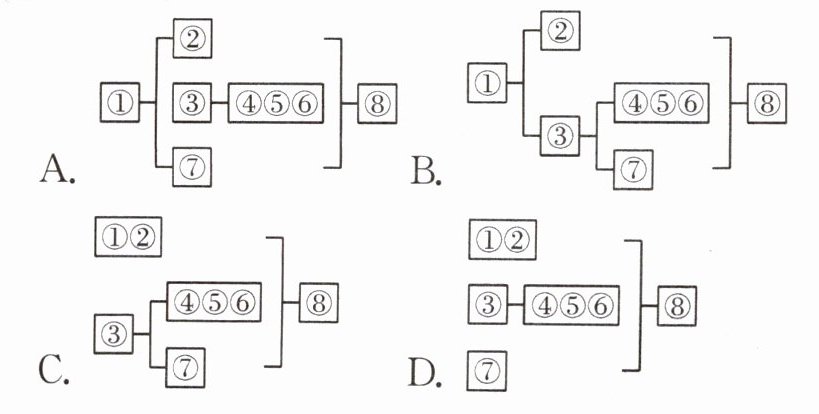
4. 中考新考法 推断篇章结构 Which is the best structure of this passage?
词数:315
体裁:说明文
核心素养:文化意识
话题:绿色对人们生活的影响
难度:中
建议用时:7分钟
① Green is the colour of nature and the symbol of life. For thousands of years, humans have followed the laws of nature to live in harmony(和谐) with nature.
② That has been seen in ancient Chinese houses. Ancient Chinese often built their homes at the foot of the mountain with a river running nearby. The mountains could stop the cold wind from the north and the river provided water for life. Most houses were also built facing south or west so that the rooms were able to get enough sunshine in winter and keep cool in summer.
③ In modern times, humans didn't follow the laws of nature during fast development. Luckily, it's never too late to make changes.
④ Green development is the goal of all countries. On April 22, 2016, China signed The Paris Agreement on climate change, giving a strong push to the international efforts against global(全球的) warming.
⑤ Also in China, the government added green development to the country's work plans. From 1999 to the end of 2018, by carrying out Mother River Protection Operation, China raised 600 million yuan to build over 5,700 green projects. Through international cooperation(合作), over 98.32 million trees were planted across China.
⑥ Denmark is a leading country in wind and solar technologies. This year Denmark has started the "Power-to-X" plan, providing about 1.25 billion kroner (about 1.27 billion yuan) for projects producing hydrogen(氢气).
⑦ Builders across the world are also playing a role in green development. In Chicago, pressed newspaper, recycled glass and plastic are used on buildings. In Bali, the green school is made from bamboo. The school gets its electricity(电) from solar panels(太阳能电池板), water power and a generator that burns farm waste.
⑧ Following the laws of nature is the only way out. A small move in one country may influence the global community as a whole. Let's join our hands to make the world a better place for now and future.
1. What do we know about the ancient Chinese houses?
A. They were built on the mountains.
B. They were built far from rivers.
C. They were built facing south or west.
D. They were built to get enough wind.
2. 中考新考法 推断写作方法 How does the writer develop his idea in Paragraph 7?
链接《教材核心考点新考法讲练》"推断写作方法题解题技巧"
A. By explaining the results.
B. By raising questions.
C. By comparing differences.
D. By giving examples.
3. Which of the following would the writer agree with?
A. Everyone is part of the green development.
B. Green buildings are the future of the world.
C. Green development is just protecting nature.
D. The future of humans depends on technology.
4. 中考新考法 推断篇章结构 Which is the best structure of this passage?
答案:
1. C [解析]细节理解题。根据第二段中“Most houses were also built facing south or west”可知,大多数房屋也朝南或朝西建造。故选 C。2. D [解析]推理判断题。分析第七段内容可知,作者通过举例说明世界各地的建筑商也在绿色发展中发挥着作用。故选 D。3. A [解析]推理判断题。根据第八段中“A small move in one country may influence the global community as a whole. Let's join our hands to make the world a better place for now and future.”可知,一个国家的一个小举动可能会影响整个国际社会。由此可知,作者认为我们每个人都是绿色发展的一份子。故选 A。4. C [解析]篇章结构题。分析文章内容可知,第①段总述,引出下文;第②、③段并列,分别介绍中国古代的房屋和现代人类的快速发展;第④⑤⑥段介绍现代人类的快速发展中各国的绿色发展,第⑦段介绍现代人类的快速发展中丹麦在风能和太阳能技术;第⑧段总结全文。故选 C。
查看更多完整答案,请扫码查看

