

 搜索
搜索
2025年新课程暑假作业本山西教育出版社七年级综合B版
注:目前有些书本章节名称可能整理的还不是很完善,但都是按照顺序排列的,请同学们按照顺序仔细查找。练习册 2025年新课程暑假作业本山西教育出版社七年级综合B版 答案主要是用来给同学们做完题方便对答案用的,请勿直接抄袭。
第112页
- 第1页
- 第2页
- 第3页
- 第4页
- 第5页
- 第6页
- 第7页
- 第8页
- 第9页
- 第10页
- 第11页
- 第12页
- 第13页
- 第14页
- 第15页
- 第16页
- 第17页
- 第18页
- 第19页
- 第20页
- 第21页
- 第22页
- 第23页
- 第24页
- 第25页
- 第26页
- 第27页
- 第28页
- 第29页
- 第30页
- 第31页
- 第32页
- 第33页
- 第34页
- 第35页
- 第36页
- 第37页
- 第38页
- 第39页
- 第40页
- 第41页
- 第42页
- 第43页
- 第44页
- 第45页
- 第46页
- 第47页
- 第48页
- 第49页
- 第50页
- 第51页
- 第52页
- 第53页
- 第54页
- 第55页
- 第56页
- 第57页
- 第58页
- 第59页
- 第60页
- 第61页
- 第62页
- 第63页
- 第64页
- 第65页
- 第66页
- 第67页
- 第68页
- 第69页
- 第70页
- 第71页
- 第72页
- 第73页
- 第74页
- 第75页
- 第76页
- 第77页
- 第78页
- 第79页
- 第80页
- 第81页
- 第82页
- 第83页
- 第84页
- 第85页
- 第86页
- 第87页
- 第88页
- 第89页
- 第90页
- 第91页
- 第92页
- 第93页
- 第94页
- 第95页
- 第96页
- 第97页
- 第98页
- 第99页
- 第100页
- 第101页
- 第102页
- 第103页
- 第104页
- 第105页
- 第106页
- 第107页
- 第108页
- 第109页
- 第110页
- 第111页
- 第112页
- 第113页
- 第114页
- 第115页
- 第116页
- 第117页
- 第118页
- 第119页
- 第120页
- 第121页
- 第122页
- 第123页
- 第124页
- 第125页
- 第126页
- 第127页
- 第128页
- 第129页
- 第130页
- 第131页
- 第132页
- 第133页
- 第134页
- 第135页
- 第136页
- 第137页
- 第138页
- 第139页
- 第140页
- 第141页
- 第142页
- 第143页
- 第144页
- 第145页
- 第146页
G 读一读,选一选,养成良好的生活习惯。
June 6 is National Eye Care Day. It is a good chance for us to improve our eye health.
Eyes are important in our everyday lives. We use them to read books, see colors and view the wonders of the world. But 1 we use them too much and it hurts them.
In the past nearsightedness(近视) was a common eye problem among 2. This is mostly(大部分情况下) because of their bad eye habits, such as watching TV too long and reading books in bed.
However, today's technology is 3 the way we live. Children 4 more time working and playing in front of computers, smartphones and tablets(平板电脑). 5 children spend an average(平均) of more than 42 hours a week in front of electronic screens(电子屏幕). The US ABC News reported the situation in its country.
This has caused a new 6 to our eyes: digital(数字的) eyestrain(眼疲劳). People with digital eyestrain 7 get headaches, dry and red eyes, eye pain, watering and 8 eye problems.
从每小题所给的 A、B、C 三个选项中,选出一个能填入空白处的最佳选项。
(
(
(
(
(
(
(
(
June 6 is National Eye Care Day. It is a good chance for us to improve our eye health.
Eyes are important in our everyday lives. We use them to read books, see colors and view the wonders of the world. But 1 we use them too much and it hurts them.
In the past nearsightedness(近视) was a common eye problem among 2. This is mostly(大部分情况下) because of their bad eye habits, such as watching TV too long and reading books in bed.
However, today's technology is 3 the way we live. Children 4 more time working and playing in front of computers, smartphones and tablets(平板电脑). 5 children spend an average(平均) of more than 42 hours a week in front of electronic screens(电子屏幕). The US ABC News reported the situation in its country.
This has caused a new 6 to our eyes: digital(数字的) eyestrain(眼疲劳). People with digital eyestrain 7 get headaches, dry and red eyes, eye pain, watering and 8 eye problems.
从每小题所给的 A、B、C 三个选项中,选出一个能填入空白处的最佳选项。
(
B
)1. A. sometime B. sometimes C. mostly(
A
)2. A. children B. students C. adults(
A
)3. A. changing B. keeping C. making(
C
)4. A. take B. cost C. spend(
A
)5. A. American B. British C. Chinese(
B
)6. A. question B. problem C. solution(
C
)7. A. should B. must C. may(
A
)8. A. other B. another C. the other
答案:
1—5 BAACA 6—8 BCA
H 读万卷书,行万里路。
As the saying goes, "Read ten thousand books and travel ten thousand miles." In modern society(社会), travelling is a very common(普通的) thing. Almost everyone can go on a trip at any time as long as they want to. In fact, centuries ago, some famous people already travelled around China and they got a lot from exploration(探险).
Xu Xiake, a geographer(地理学家) and writer in the Ming Dynasty, spent more than thirty years on the road four hundred years ago. With his mother's encouragement(鼓励), Xu Xiake travelled around China. He met with many difficulties on the road. But he never stopped travelling and writing.
Xu Xiake was on the road all his life, and his travel notes covered as much as his knowledge. His 600,000-word travel notes finally came out in 1776, about 135 years after his death. China Tourism Day(旅游日) is set on May 19th, the date when he started The Travels of Xu Xiake(《徐霞客游记》).
Marco Polo(马可·波罗), a businessman born in 1254 in Italy, is known as a travel king in the West. In 1271, Marco Polo with his father and uncle set foot on the Silk Road to China. It took him four years. Along the way, he met bad weather, a shortage(缺乏) of food and water and so on.
They reached Shangdu in Inner Mongolia(内蒙古) in 1275. Kublai Khan gave them a warm welcome there and took them to Dadu, which is now Beijing.
Marco Polo's hard journey created(创造) one of the world's first best-sellers(畅销书) The Travels of Marco Polo(《马可·波罗游记》). Medieval(中世纪的) readers fell in love with Polo's wonderful descriptions(描述) of faraway(遥远的) lands and got to know China and Middle Asia.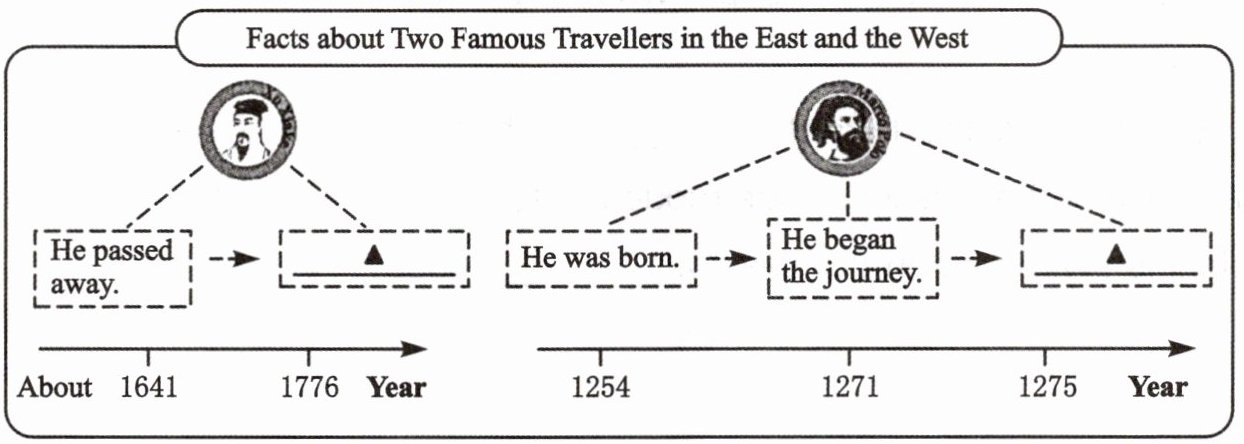
根据所阅读内容,按要求完成所给任务。
1. Please translate the underlined sentence into Chinese.______
2. According to the passage, Marco Polo journeyed east along ______
3. Why did medieval readers like The Travels of Marco Polo?______
4. Please complete the facts about Xu Xiake and Marco Polo in Chart Ⅰ.______
5. What have you learned from Xu Xiake and Marco Polo? How will you put what you have learned to good use in life?
______
As the saying goes, "Read ten thousand books and travel ten thousand miles." In modern society(社会), travelling is a very common(普通的) thing. Almost everyone can go on a trip at any time as long as they want to. In fact, centuries ago, some famous people already travelled around China and they got a lot from exploration(探险).
Xu Xiake, a geographer(地理学家) and writer in the Ming Dynasty, spent more than thirty years on the road four hundred years ago. With his mother's encouragement(鼓励), Xu Xiake travelled around China. He met with many difficulties on the road. But he never stopped travelling and writing.
Xu Xiake was on the road all his life, and his travel notes covered as much as his knowledge. His 600,000-word travel notes finally came out in 1776, about 135 years after his death. China Tourism Day(旅游日) is set on May 19th, the date when he started The Travels of Xu Xiake(《徐霞客游记》).
Marco Polo(马可·波罗), a businessman born in 1254 in Italy, is known as a travel king in the West. In 1271, Marco Polo with his father and uncle set foot on the Silk Road to China. It took him four years. Along the way, he met bad weather, a shortage(缺乏) of food and water and so on.
They reached Shangdu in Inner Mongolia(内蒙古) in 1275. Kublai Khan gave them a warm welcome there and took them to Dadu, which is now Beijing.
Marco Polo's hard journey created(创造) one of the world's first best-sellers(畅销书) The Travels of Marco Polo(《马可·波罗游记》). Medieval(中世纪的) readers fell in love with Polo's wonderful descriptions(描述) of faraway(遥远的) lands and got to know China and Middle Asia.
根据所阅读内容,按要求完成所给任务。
1. Please translate the underlined sentence into Chinese.______
只要人们想去旅行,几乎每个人都可以随时去。/几乎人人都可以来一场说走就走的旅行。
2. According to the passage, Marco Polo journeyed east along ______
the Silk Road
. And Dadu refers to(指) present-day ______Beijing
.3. Why did medieval readers like The Travels of Marco Polo?______
Because they fell in love with Polo's descriptions of faraway lands. / Because they got to know China and Middle Asia. / Because they fell in love with the wonderful descriptions of faraway lands and got to know China and Middle Asia.
4. Please complete the facts about Xu Xiake and Marco Polo in Chart Ⅰ.______
The Travels of Xu Xiake finally came out. / Xu Xiake's / His 600,000-word travel notes finally came out. Marco Polo / He got to China. / Marco Polo / He reached Shangdu in Inner Mongolia. / Marco Polo / He arrived in Shangdu.
5. What have you learned from Xu Xiake and Marco Polo? How will you put what you have learned to good use in life?
______
They never gave up when facing difficulties. / They had a spirit of exploration. / I will travel around China and enjoy the beautiful scenery. / I will keep a diary when I travel. / I will learn to face difficulties bravely and never give up.
答案:
1. 只要人们想去旅行,几乎每个人都可以随时去。/几乎人人都可以来一场说走就走的旅行。
2. the Silk Road; Beijing
3. Because they fell in love with Polo's descriptions of faraway lands. / Because they got to know China and Middle Asia. / Because they fell in love with the wonderful descriptions of faraway lands and got to know China and Middle Asia.
4. The Travels of Xu Xiake finally came out. / Xu Xiake's / His 600,000-word travel notes finally came out.
Marco Polo / He got to China. / Marco Polo / He reached Shangdu in Inner Mongolia. / Marco Polo / He arrived in Shangdu.
5. They never gave up when facing difficulties. / They had a spirit of exploration. / I will travel around China and enjoy the beautiful scenery. / I will keep a diary when I travel. / I will learn to face difficulties bravely and never give up.
2. the Silk Road; Beijing
3. Because they fell in love with Polo's descriptions of faraway lands. / Because they got to know China and Middle Asia. / Because they fell in love with the wonderful descriptions of faraway lands and got to know China and Middle Asia.
4. The Travels of Xu Xiake finally came out. / Xu Xiake's / His 600,000-word travel notes finally came out.
Marco Polo / He got to China. / Marco Polo / He reached Shangdu in Inner Mongolia. / Marco Polo / He arrived in Shangdu.
5. They never gave up when facing difficulties. / They had a spirit of exploration. / I will travel around China and enjoy the beautiful scenery. / I will keep a diary when I travel. / I will learn to face difficulties bravely and never give up.
查看更多完整答案,请扫码查看

