

 搜索
搜索
第72页
- 第1页
- 第2页
- 第3页
- 第4页
- 第5页
- 第6页
- 第7页
- 第8页
- 第9页
- 第10页
- 第11页
- 第12页
- 第13页
- 第14页
- 第15页
- 第16页
- 第17页
- 第18页
- 第19页
- 第20页
- 第21页
- 第22页
- 第23页
- 第24页
- 第25页
- 第26页
- 第27页
- 第28页
- 第29页
- 第30页
- 第31页
- 第32页
- 第33页
- 第34页
- 第35页
- 第36页
- 第37页
- 第38页
- 第39页
- 第40页
- 第41页
- 第42页
- 第43页
- 第44页
- 第45页
- 第46页
- 第47页
- 第48页
- 第49页
- 第50页
- 第51页
- 第52页
- 第53页
- 第54页
- 第55页
- 第56页
- 第57页
- 第58页
- 第59页
- 第60页
- 第61页
- 第62页
- 第63页
- 第64页
- 第65页
- 第66页
- 第67页
- 第68页
- 第69页
- 第70页
- 第71页
- 第72页
- 第73页
- 第74页
- 第75页
- 第76页
- 第77页
- 第78页
- 第79页
- 第80页
- 第81页
- 第82页
- 第83页
- 第84页
- 第85页
- 第86页
- 第87页
- 第88页
- 第89页
- 第90页
- 第91页
- 第92页
- 第93页
- 第94页
- 第95页
- 第96页
- 第97页
- 第98页
- 第99页
- 第100页
- 第101页
- 第102页
- 第103页
- 第104页
- 第105页
- 第106页
- 第107页
- 第108页
- 第109页
- 第110页
- 第111页
- 第112页
17. (8 分) 计算:
(1) $\frac{\sqrt{8}}{3 \sqrt{40}} \times \sqrt{5}$;
(2) $\sqrt{27} \times \sqrt{50} \div \sqrt{6}$;
(3) $\left(\frac{1}{2}\right)^{-1}-(\sqrt{3}-\sqrt{2})^{0}+|-3|$;
(4) $(\sqrt{3}+1)(\sqrt{3}-1)-\sqrt{(-3)^{2}}+\frac{1}{2-\sqrt{5}}$.
(1) $\frac{\sqrt{8}}{3 \sqrt{40}} \times \sqrt{5}$;
(2) $\sqrt{27} \times \sqrt{50} \div \sqrt{6}$;
(3) $\left(\frac{1}{2}\right)^{-1}-(\sqrt{3}-\sqrt{2})^{0}+|-3|$;
(4) $(\sqrt{3}+1)(\sqrt{3}-1)-\sqrt{(-3)^{2}}+\frac{1}{2-\sqrt{5}}$.
答案:
【解析】:
(1)
先将各项根式化简:$\sqrt{8} = 2\sqrt{2}$,$\sqrt{40}=2\sqrt{10}$。
则$\frac{\sqrt{8}}{3\sqrt{40}}\times\sqrt{5}=\frac{2\sqrt{2}}{3\times2\sqrt{10}}\times\sqrt{5}$。
对$\frac{2\sqrt{2}}{3\times2\sqrt{10}}$进行约分,$\frac{2\sqrt{2}}{3\times2\sqrt{10}}=\frac{\sqrt{2}}{3\sqrt{10}}$,再根据二次根式乘法法则$\frac{\sqrt{2}}{3\sqrt{10}}\times\sqrt{5}=\frac{\sqrt{2}\times\sqrt{5}}{3\sqrt{10}}$。
因为$\sqrt{2}\times\sqrt{5}=\sqrt{10}$,所以$\frac{\sqrt{2}\times\sqrt{5}}{3\sqrt{10}}=\frac{\sqrt{10}}{3\sqrt{10}}=\frac{1}{3}$。
(2)
先化简各项根式:$\sqrt{27}=3\sqrt{3}$,$\sqrt{50} = 5\sqrt{2}$。
则$\sqrt{27}\times\sqrt{50}\div\sqrt{6}=3\sqrt{3}\times5\sqrt{2}\div\sqrt{6}$。
根据二次根式乘法法则$3\sqrt{3}\times5\sqrt{2}=15\sqrt{6}$。
再根据二次根式除法法则$15\sqrt{6}\div\sqrt{6}=15$。
(3)
根据负整数指数幂的性质$a^{-p}=\frac{1}{a^{p}}(a\neq0)$,可得$(\frac{1}{2})^{-1}=\frac{1}{\frac{1}{2}} = 2$。
根据零指数幂的性质$a^{0}=1(a\neq0)$,可得$(\sqrt{3}-\sqrt{2})^{0}=1$。
根据绝对值的性质$\vert - 3\vert=3$。
所以$(\frac{1}{2})^{-1}-(\sqrt{3}-\sqrt{2})^{0}+\vert - 3\vert=2 - 1+3=4$。
(4)
根据平方差公式$(a + b)(a - b)=a^{2}-b^{2}$,则$(\sqrt{3}+1)(\sqrt{3}-1)=(\sqrt{3})^{2}-1^{2}=3 - 1=2$。
$\sqrt{(-3)^{2}}=\sqrt{9}=3$。
对$\frac{1}{2-\sqrt{5}}$进行分母有理化,分子分母同乘$2 + \sqrt{5}$,$\frac{1}{2-\sqrt{5}}=\frac{2+\sqrt{5}}{(2 - \sqrt{5})(2+\sqrt{5})}$,根据平方差公式$(2 - \sqrt{5})(2+\sqrt{5})=2^{2}-(\sqrt{5})^{2}=4 - 5=-1$,所以$\frac{2+\sqrt{5}}{(2 - \sqrt{5})(2+\sqrt{5})}=-(2+\sqrt{5})=-2-\sqrt{5}$。
则$(\sqrt{3}+1)(\sqrt{3}-1)-\sqrt{(-3)^{2}}+\frac{1}{2-\sqrt{5}}=2-3-2-\sqrt{5}=-3-\sqrt{5}$。
【答案】:
(1)$\frac{1}{3}$;
(2)$15$;
(3)$4$;
(4)$-3-\sqrt{5}$
(1)
先将各项根式化简:$\sqrt{8} = 2\sqrt{2}$,$\sqrt{40}=2\sqrt{10}$。
则$\frac{\sqrt{8}}{3\sqrt{40}}\times\sqrt{5}=\frac{2\sqrt{2}}{3\times2\sqrt{10}}\times\sqrt{5}$。
对$\frac{2\sqrt{2}}{3\times2\sqrt{10}}$进行约分,$\frac{2\sqrt{2}}{3\times2\sqrt{10}}=\frac{\sqrt{2}}{3\sqrt{10}}$,再根据二次根式乘法法则$\frac{\sqrt{2}}{3\sqrt{10}}\times\sqrt{5}=\frac{\sqrt{2}\times\sqrt{5}}{3\sqrt{10}}$。
因为$\sqrt{2}\times\sqrt{5}=\sqrt{10}$,所以$\frac{\sqrt{2}\times\sqrt{5}}{3\sqrt{10}}=\frac{\sqrt{10}}{3\sqrt{10}}=\frac{1}{3}$。
(2)
先化简各项根式:$\sqrt{27}=3\sqrt{3}$,$\sqrt{50} = 5\sqrt{2}$。
则$\sqrt{27}\times\sqrt{50}\div\sqrt{6}=3\sqrt{3}\times5\sqrt{2}\div\sqrt{6}$。
根据二次根式乘法法则$3\sqrt{3}\times5\sqrt{2}=15\sqrt{6}$。
再根据二次根式除法法则$15\sqrt{6}\div\sqrt{6}=15$。
(3)
根据负整数指数幂的性质$a^{-p}=\frac{1}{a^{p}}(a\neq0)$,可得$(\frac{1}{2})^{-1}=\frac{1}{\frac{1}{2}} = 2$。
根据零指数幂的性质$a^{0}=1(a\neq0)$,可得$(\sqrt{3}-\sqrt{2})^{0}=1$。
根据绝对值的性质$\vert - 3\vert=3$。
所以$(\frac{1}{2})^{-1}-(\sqrt{3}-\sqrt{2})^{0}+\vert - 3\vert=2 - 1+3=4$。
(4)
根据平方差公式$(a + b)(a - b)=a^{2}-b^{2}$,则$(\sqrt{3}+1)(\sqrt{3}-1)=(\sqrt{3})^{2}-1^{2}=3 - 1=2$。
$\sqrt{(-3)^{2}}=\sqrt{9}=3$。
对$\frac{1}{2-\sqrt{5}}$进行分母有理化,分子分母同乘$2 + \sqrt{5}$,$\frac{1}{2-\sqrt{5}}=\frac{2+\sqrt{5}}{(2 - \sqrt{5})(2+\sqrt{5})}$,根据平方差公式$(2 - \sqrt{5})(2+\sqrt{5})=2^{2}-(\sqrt{5})^{2}=4 - 5=-1$,所以$\frac{2+\sqrt{5}}{(2 - \sqrt{5})(2+\sqrt{5})}=-(2+\sqrt{5})=-2-\sqrt{5}$。
则$(\sqrt{3}+1)(\sqrt{3}-1)-\sqrt{(-3)^{2}}+\frac{1}{2-\sqrt{5}}=2-3-2-\sqrt{5}=-3-\sqrt{5}$。
【答案】:
(1)$\frac{1}{3}$;
(2)$15$;
(3)$4$;
(4)$-3-\sqrt{5}$
18. (6 分) 如图, 在 $\triangle A B C$ 中, $A D \perp B C, \angle B=45^{\circ}, \angle C=30^{\circ}, A D=1$, 求 $\triangle A B C$ 的周长.
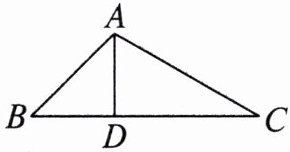
$\sqrt{2}+\sqrt{3}+3$
答案:
【解析】:
- 因为$AD\perp BC$,所以$\angle ADB = \angle ADC = 90^{\circ}$。
- 在$Rt\triangle ABD$中,$\angle B = 45^{\circ}$,$\angle ADB = 90^{\circ}$,所以$\angle BAD = 180^{\circ}-\angle B - \angle ADB = 45^{\circ}$,则$\angle B=\angle BAD$,所以$BD = AD = 1$。
根据勾股定理$AB=\sqrt{AD^{2}+BD^{2}}=\sqrt{1^{2}+1^{2}}=\sqrt{2}$。
- 在$Rt\triangle ADC$中,$\angle C = 30^{\circ}$,$\angle ADC = 90^{\circ}$,所以$AC = 2AD = 2$。
根据勾股定理$DC=\sqrt{AC^{2}-AD^{2}}=\sqrt{2^{2}-1^{2}}=\sqrt{3}$。
- 所以$BC = BD + DC = 1+\sqrt{3}$。
- 则$\triangle ABC$的周长为$AB + BC + AC=\sqrt{2}+1+\sqrt{3}+2=\sqrt{2}+\sqrt{3}+3$。
【答案】:$\sqrt{2}+\sqrt{3}+3$
- 因为$AD\perp BC$,所以$\angle ADB = \angle ADC = 90^{\circ}$。
- 在$Rt\triangle ABD$中,$\angle B = 45^{\circ}$,$\angle ADB = 90^{\circ}$,所以$\angle BAD = 180^{\circ}-\angle B - \angle ADB = 45^{\circ}$,则$\angle B=\angle BAD$,所以$BD = AD = 1$。
根据勾股定理$AB=\sqrt{AD^{2}+BD^{2}}=\sqrt{1^{2}+1^{2}}=\sqrt{2}$。
- 在$Rt\triangle ADC$中,$\angle C = 30^{\circ}$,$\angle ADC = 90^{\circ}$,所以$AC = 2AD = 2$。
根据勾股定理$DC=\sqrt{AC^{2}-AD^{2}}=\sqrt{2^{2}-1^{2}}=\sqrt{3}$。
- 所以$BC = BD + DC = 1+\sqrt{3}$。
- 则$\triangle ABC$的周长为$AB + BC + AC=\sqrt{2}+1+\sqrt{3}+2=\sqrt{2}+\sqrt{3}+3$。
【答案】:$\sqrt{2}+\sqrt{3}+3$
查看更多完整答案,请扫码查看

